AI agents often fail in the enterprise not because they cannot reason, but because they lack business knowledge. Neo4j's Context Engine organizes processes, terminology, data location, permissions, and past decisions into a six-layer ontology and graph, combining GraphRAG retrieval with memory and learning. This article explains the approach and the questions that remain in private preview.
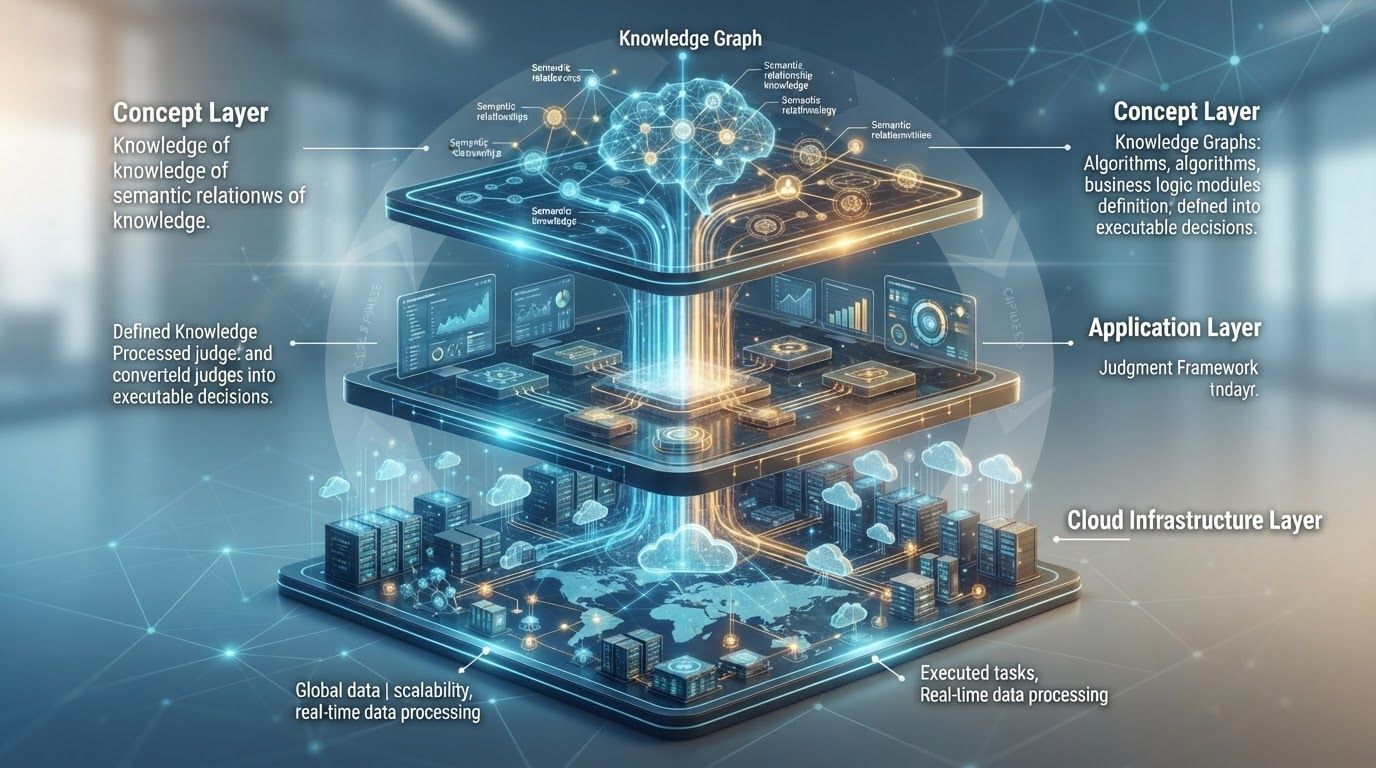
Most enterprise AI proposals stop at “you need a knowledge graph.” This article breaks the problem into three layers: the concept layer that defines what knowledge looks like, the application layer that extracts business logic and makes it judgeable, and the cloud infrastructure layer that lets judgment actually execute. It also covers a judgment framework built on five cycles and six capabilities, a modernization approach that wraps legacy systems in MCP-accessible services, and why intelligence without execution is worthless.
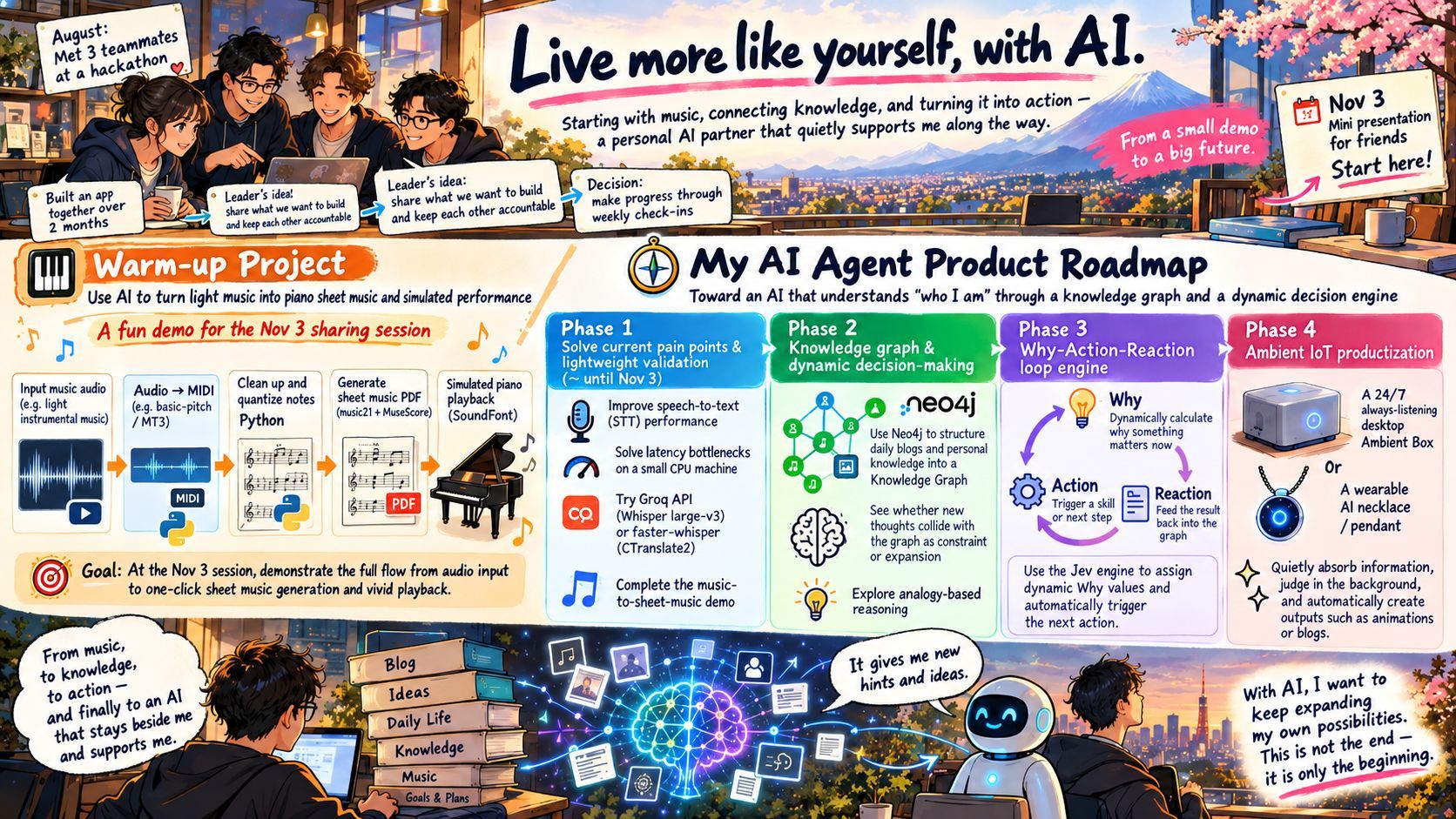
Ahead of a small November 3 session with friends, I'm building a warm-up demo that turns light music into piano sheet music and simulated playback, validating the audio-to-MIDI pipeline. Then I return to the core product: a Neo4j knowledge graph that gives an agent a dynamic “why,” developed across four phases — faster STT, knowledge collision, a Why-Action-Reaction loop, and Ambient IoT hardware. The post also records the open questions and the weekly cadence I'm using to keep moving.
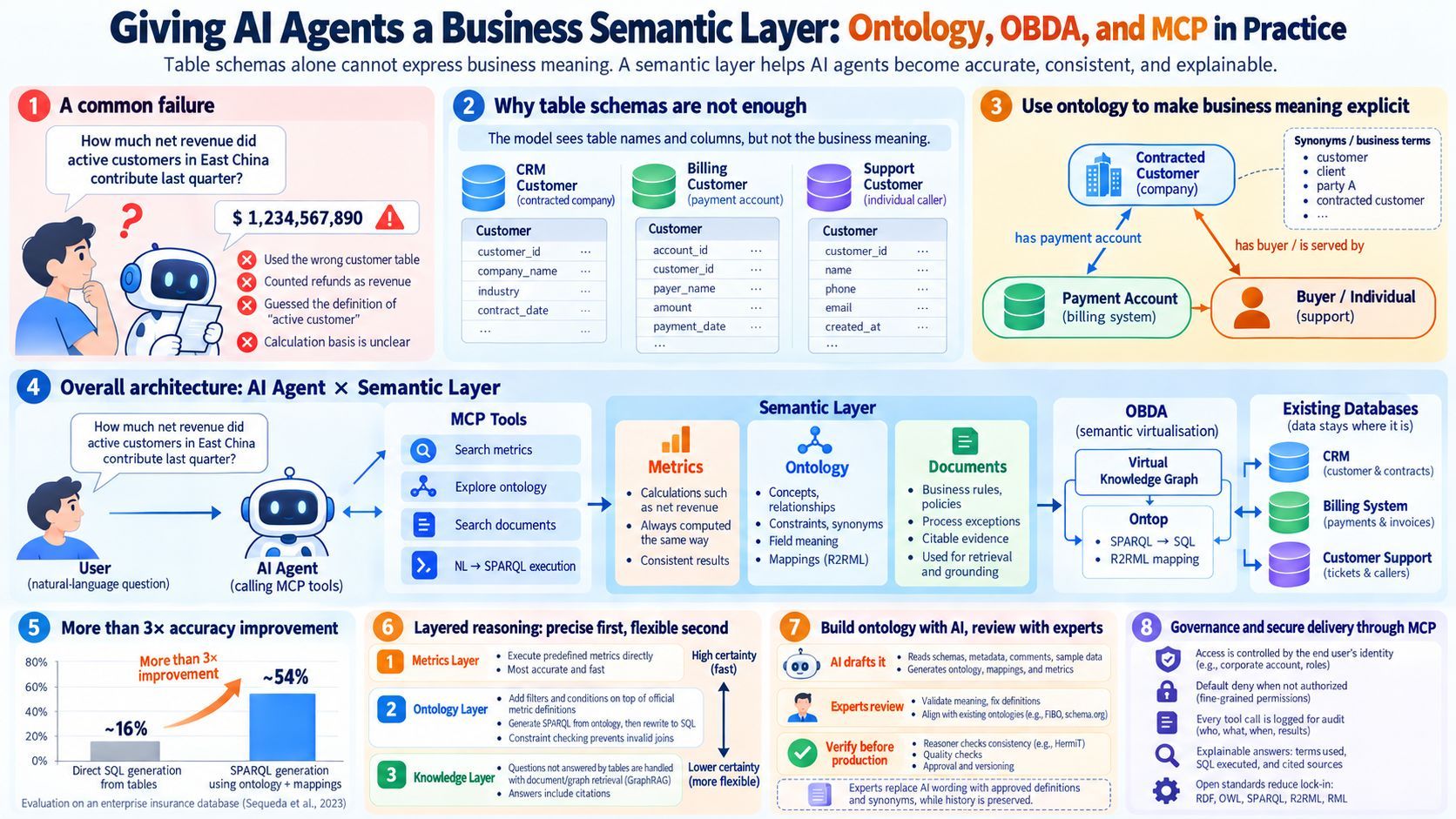
Putting a table schema in the prompt does not teach an AI agent what the business means, so it can still return a number that looks professional but is wrong. Drawing on an insurance-industry benchmark where GPT-4's execution accuracy rose from about 16% to about 54%, this article explains the semantic layer built from metrics, an ontology, and documents; how OBDA maps the ontology onto existing data; and how layered resolution balances determinism with flexibility. It also covers AI-drafted, expert-approved ontologies, MCP delivery, identity-aware governance, and five practical recommendations.
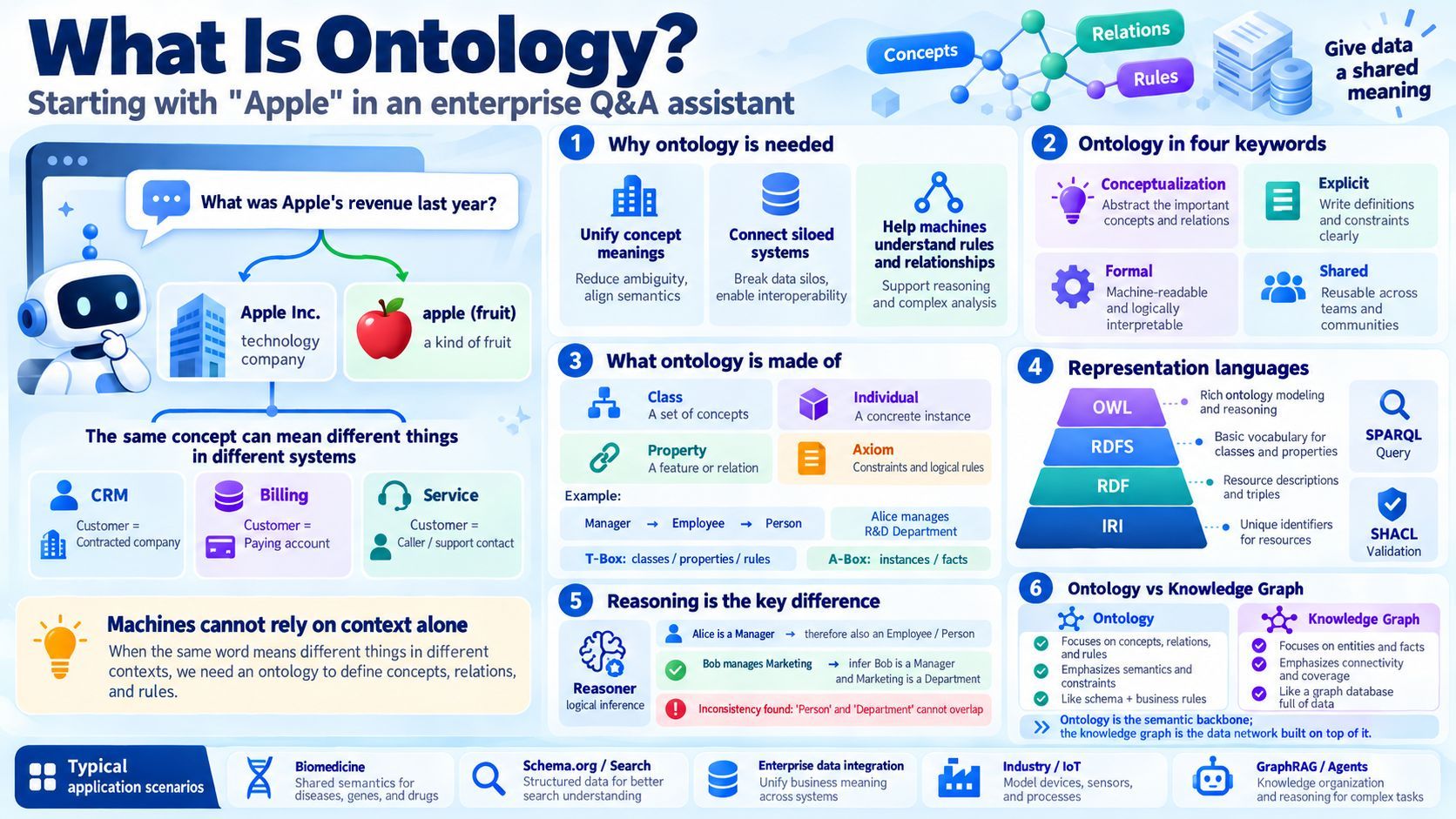
A machine cannot tell that "Apple" means a company rather than a fruit, or that three tables all named Customer mean different things, without an explicit semantic model: an ontology. This article traces the idea from philosophy to Gruber's and Studer's definitions, breaks down classes, individuals, properties, and axioms, and covers RDF, RDFS, OWL, and reasoners. It surveys real uses in biomedicine, Schema.org, enterprise data integration, industry and IoT, and the LLM era, then explains how ontology differs from a knowledge graph and how to start building one.
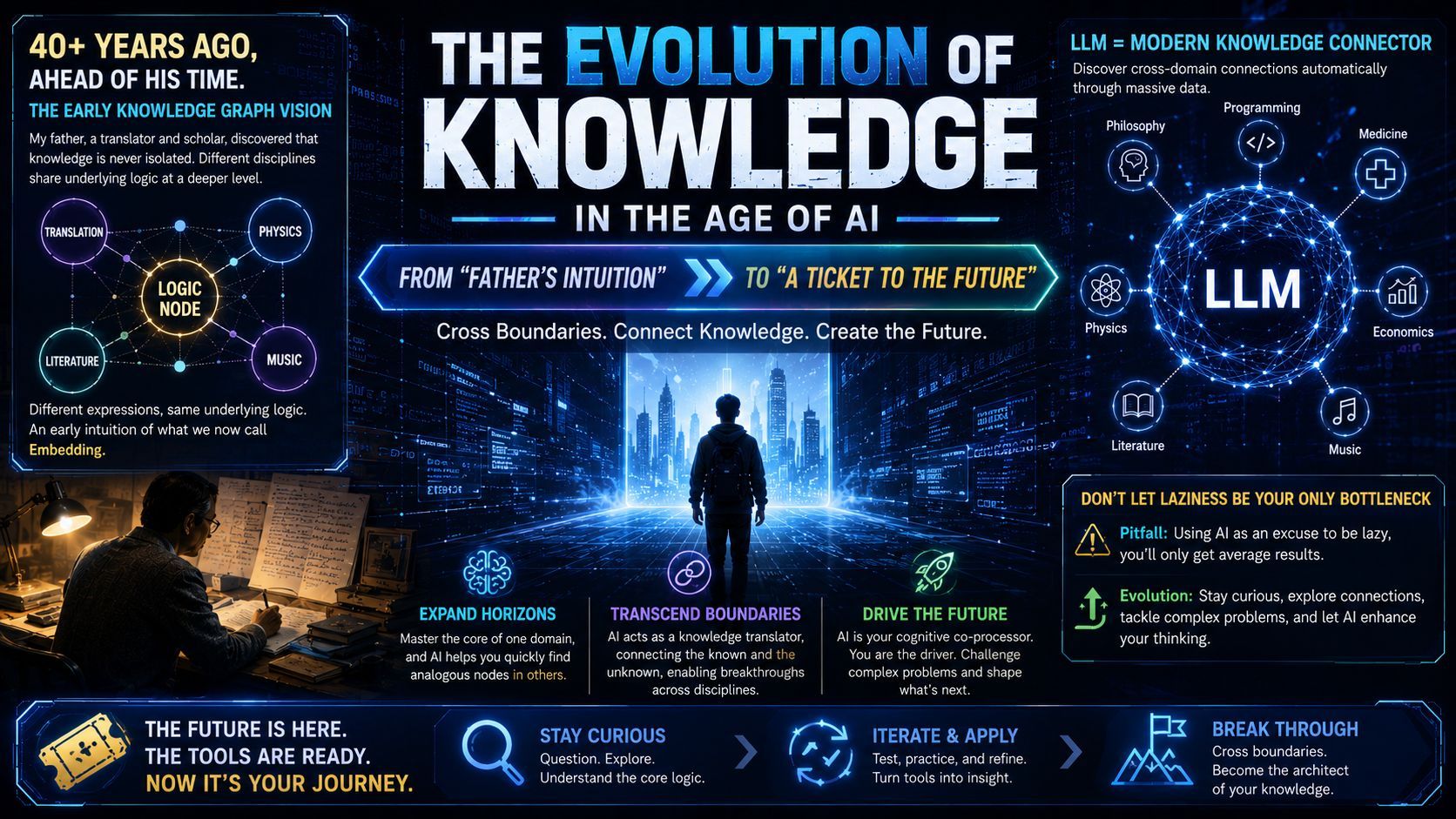
This article explores the parallels between a knowledge “node theory” proposed over forty years ago and the mechanisms behind modern Large Language Models (LLMs). Rather than viewing AI merely as a productivity tool, it argues that AI can serve as a cognitive coprocessor that connects knowledge across disciplines. By enabling lateral expansion of understanding, AI helps people traverse cognitive boundaries, while curiosity, critical thinking, and continuous exploration remain the true drivers of future growth.