
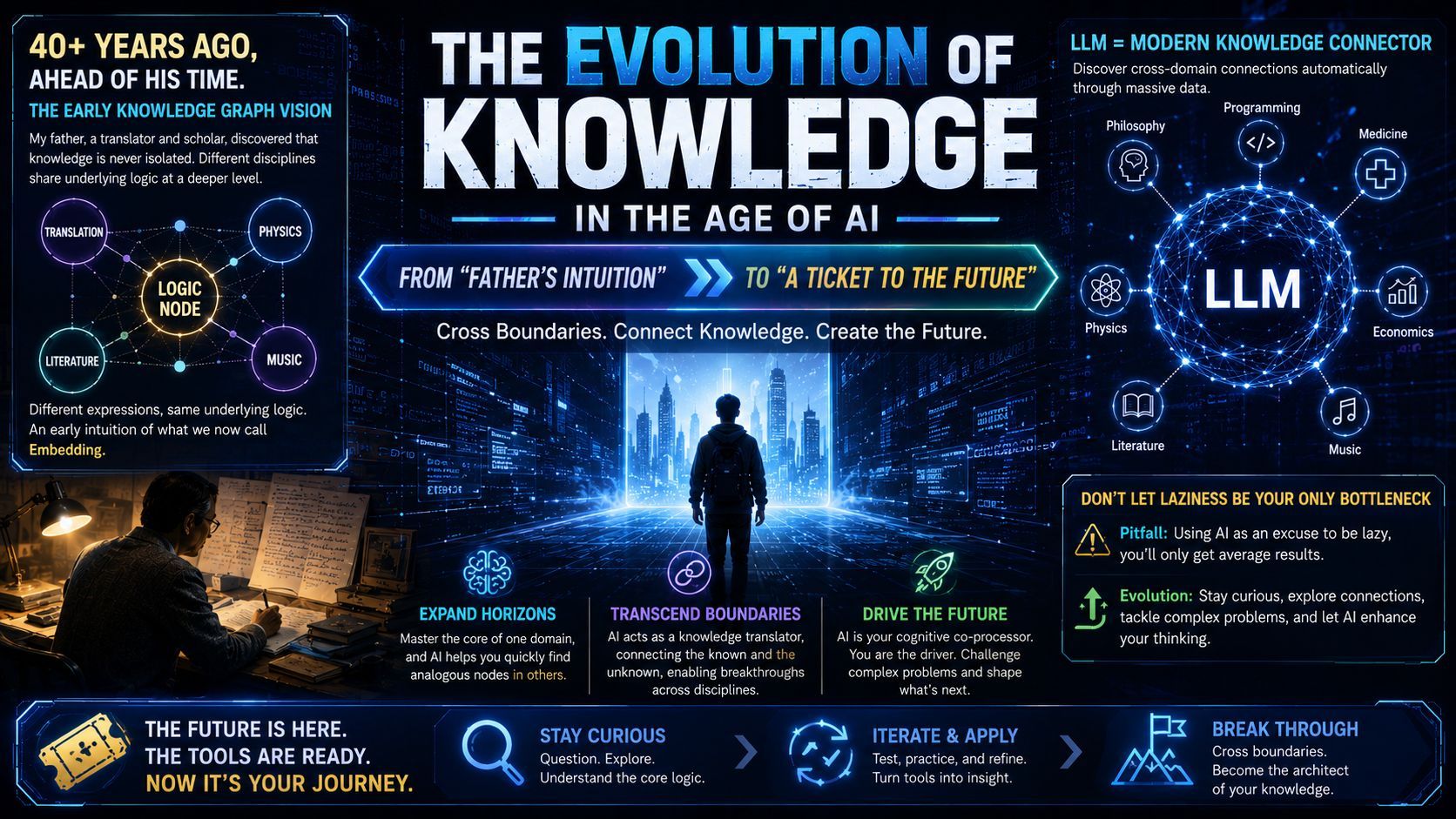
Knowledge Leap in the AI Era: From a Father's Intuition to a Ticket to the Future
This article explores the parallels between a knowledge “node theory” proposed over forty years ago and the mechanisms behind modern Large Language Models (LLMs). Rather than viewing AI merely as a productivity tool, it argues that AI can serve as a cognitive coprocessor that connects knowledge across disciplines. By enabling lateral expansion of understanding, AI helps people traverse cognitive boundaries, while curiosity, critical thinking, and continuous exploration remain the true drivers of future growth.

In the current internet context, when we talk about AI, we often fall into a trap of viewing it merely as an "efficiency tool"—treating it as an advanced search engine that can write weekly reports or look up information. But if we raise our perspective, we find that the true future is not just "smarter products," but "stronger human cognitive boundaries."
Recently, while organizing my thoughts on cognitive architecture, I had an interesting association: the LLMs (Large Language Models) we are using today are essentially reconstructing, in some way, the intuitive understanding of "knowledge systems" held by a translator decades ago.
This is not just a discussion about technology; it is a profound reflection on how to achieve "cognitive travel" through AI.
Father's "Dimensional Reduction Attack": Knowledge Graphs Forty Years Ago
Looking back over 40 years ago, when personal computers were an unreachable luxury, my father, then a deputy secretary-general of a translators association, observed a remarkably keen phenomenon while handling cross-language translation work.
In an era where human "computing power" was limited, he proposed a theory on the "architecture of knowledge systems." Simply put, he discovered that different knowledge systems (such as translation, physics, literature, etc.) are not isolated islands. If you treat every piece of knowledge as a "node," you will find that at certain core logical levels, these nodes possess "equivalence" across different knowledge systems.
Although the forms of expression (order, terminology) might differ vastly, their core logic is horizontally interconnected. For example, if you grasp the logic of "recursion" in the field of algorithms, you can quickly find the corresponding mental model in logic or music arrangement.
Engineering Perspective: This is actually the embryonic form of early "Embedding" ideas. In an era without vector databases, my father used pure logical reasoning to try and find mapping relationships across different dimensions of knowledge space. This was very advanced for its time.
When LLMs Meet "Node Theory"
Placing this forty-year-old insight into the current LLM context, you will find an exciting point of convergence: the mechanism of LLMs is to automatically find these horizontally connected "nodes" through massive data.
- Pain Point: We often say "knowledge is lacking when the time comes to use it." Traditional learning is vertical digging because a person's time is limited; one cannot master every discipline.
- Solution: The addition of AI breaks this limitation. It is not just an auxiliary tool, but a "knowledge translator." It can quickly help you establish connections from your current known knowledge system to unknown domains.
Through AI, we can achieve "horizontal expansion" of knowledge. When you grasp the core of one field, AI can help you quickly locate the "isomorphic nodes" in another field, thereby achieving a cross-disciplinary cognitive dimensionality reduction attack. This is no longer just "looking up information," but a shift in thought paradigms.
Traveling to the Future: Don't Let "Laziness" Become the Only Bottleneck
Since we have such a powerful external aid, why are we still talking about "traveling" to the future? Because often, the tools are ready, but the "driver" is asleep.
In My Mind, there is a sobering point: AI can provide you with the optimal solution, but it cannot "enlighten" you for you.
Future efficiency lies not only in how fast you can generate a piece of code or an article, but in whether you possess the ability to invoke these "horizontal knowledge nodes."
- Avoid Pitfalls: If you only use AI as an excuse to be lazy, you are just doing mediocre work with the most advanced tools.
- The Path of Evolution: The true future experience occurs when you use AI as a "cognitive co-processor" for your brain. You need to stay sharp, actively dig for potential connections, challenge complex cross-disciplinary topics, and then let AI fill in the details of your cognitive chain.
Conclusion: Be an Active Driver of the Future
We are at an excellent point in time. Although we cannot travel through space and time, through the deep reconstruction of knowledge graphs by AI, we do indeed possess the ability to "instantly cross" the cognitive boundaries of different disciplines.
This ability is not naturally endowed; it requires maintaining curiosity about the underlying logic of knowledge, just like my father did, and constantly testing, iterating, and utilizing these modern tools through practice, just like an engineer.
The future is already here, but it might need you to "drive" it with more effort. Since the toolbox has been opened, the only thing left is to stop watching and start your journey of knowledge leaps immediately.