
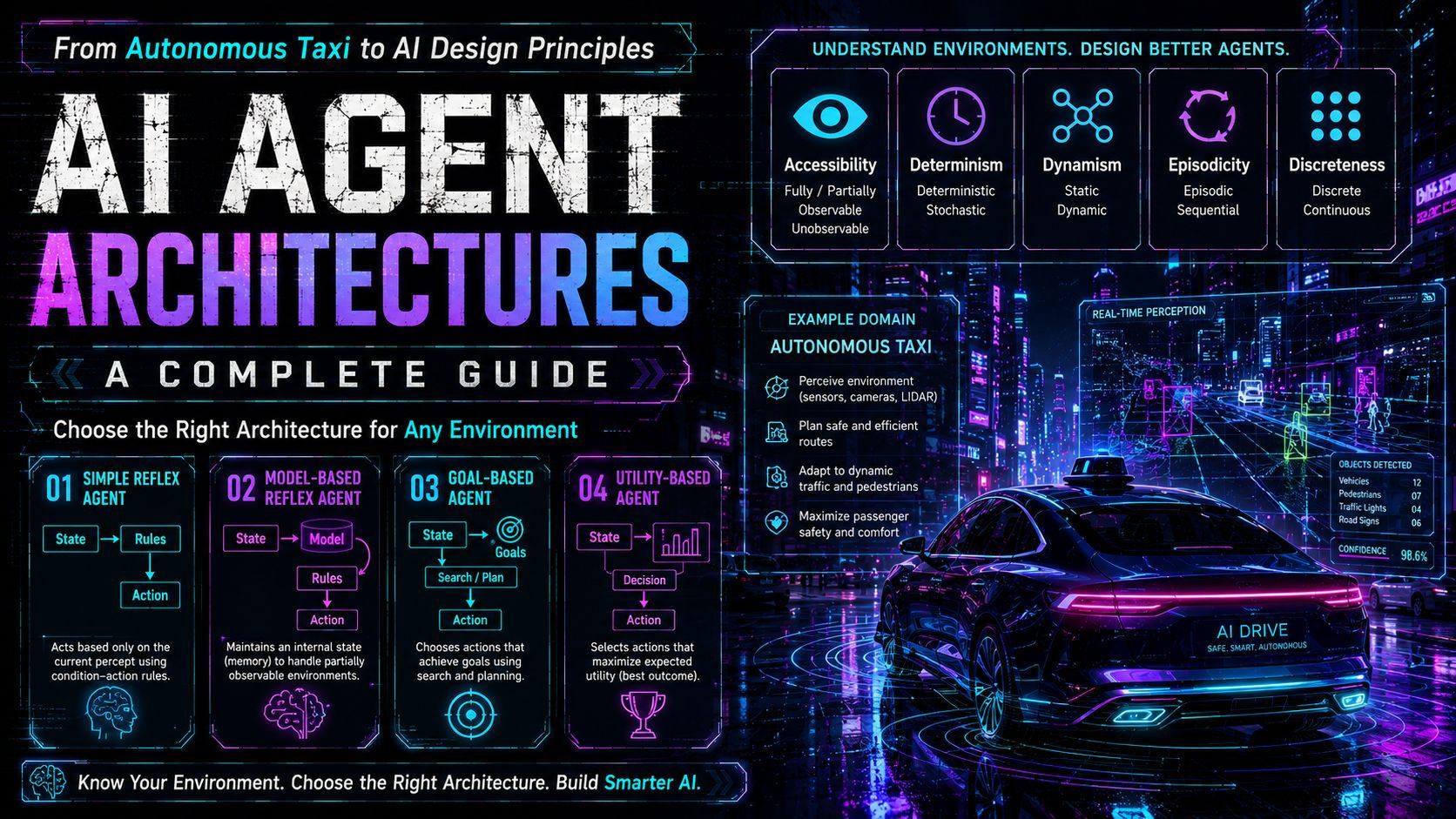
Understanding the Structure and Design Points of the "Four Intelligent Agents" Through Autonomous Taxis
When designing AI agents, selecting the right architecture based on the complexity of the environment is essential. Using an autonomous taxi as an example, this article explains the structures of four types of intelligent agents: simple reflex, reflex with state, goal-based, and utility-based. By organizing environmental characteristics (such as observability and dynamism), you will learn the foundational knowledge required to create optimal AI designs.

When designing AI agents, it is essential to choose the optimal architecture depending on the complexity of the environment in which the system is placed. Through the example of an autonomous taxi, this article explains the structure of the "Four Intelligent Agents" that form the foundation of AI. By reading this article, you will learn how to properly design AI based on environmental characteristics.
1. Simple Reflex Agents
This is the most basic structure, which selects actions based only on the current "perception."
- How it works: It follows condition-action rules (if-then rules) such as "If A, then do B."
- Taxi Example: In response to the perception "the brake lights of the car ahead turned on," it immediately executes the action "apply the brakes."
- Challenges: It is effective only if the environment is fully observable. It cannot handle complex, real-world situations or missing information. For instance, if you tried to map out every single action for an hour into a table, it would require an astronomical amount of data—$2^{60 \times 60 \times 50M}$—making implementation impossible.
2. Reflex Agents with State
By maintaining past information as an "internal state," this agent compensates for what cannot be seen by current sensors alone.
- How it works: It uses an
UPDATE-STATEfunction to update its internal state using knowledge of "how the world evolves" and "how its own actions affect the world." - Taxi Example: Even in a split second when it is not looking at the rearview mirror, it understands the state that "there is a car in the adjacent lane" from its immediate memory, allowing it to make a safe lane change decision.
- Key Operational Point: This model is indispensable in "partially observable environments" where sensors cannot capture the entire world all at once.
3. Goal-based Agents
In addition to the current state, this agent possesses information about the "goals" it needs to achieve.
- How it works: It predicts the future by asking, "Will this action bring me closer to the goal?" This is where core AI technologies like search and planning come into play.
- Taxi Example: Whether it chooses to "turn right, turn left, or go straight" at an intersection depends entirely on the passenger's destination (the goal).
- Flexibility: If the destination changes, you only need to update the goal information to trigger new actions. You do not need to rewrite a massive set of rules as you would for a reflex agent.
4. Utility-based Agents
This is the most advanced type of agent. It does not just achieve a goal, but evaluates the "quality (happiness)" of achieving it as a utility.
- How it works: It possesses a utility function that maps states to real numbers, and it selects the action that yields the highest utility.
- Taxi Example: When traveling to a destination, it compares multiple goals that are in a trade-off relationship—such as "faster," "safer," and "cheaper"—to select the optimal route.
- Advantages: It enables rational decision-making even when goals conflict or when the probability of success is uncertain.
Summary: Environmental Characteristics Dictate Design
The environment faced by an autonomous taxi is extremely challenging. As shown in the table below, by defining the nature of the environment, the required agent structure becomes clear.
| Environmental Characteristic | Description | Autonomous Taxi Example |
|---|---|---|
| Observability | Can all states be known via sensors? | × Partially Observable |
| Determinism | Is the next state fully certain? | × Stochastic / Non-deterministic |
| Episodic | Do past experiences have no effect on the next? | × Sequential / Non-episodic |
| Static / Dynamic | Does the world move while thinking? | × Dynamic |
| Discrete / Continuous | Are the choices and states finite? | × Continuous |
To operate in such a "dynamic and continuous environment," an AI must go beyond simple reflex actions; it requires a sophisticated design that leverages internal states and utilities. Mapping out what kind of environment your AI will be placed in is the very first step of architecture design.