
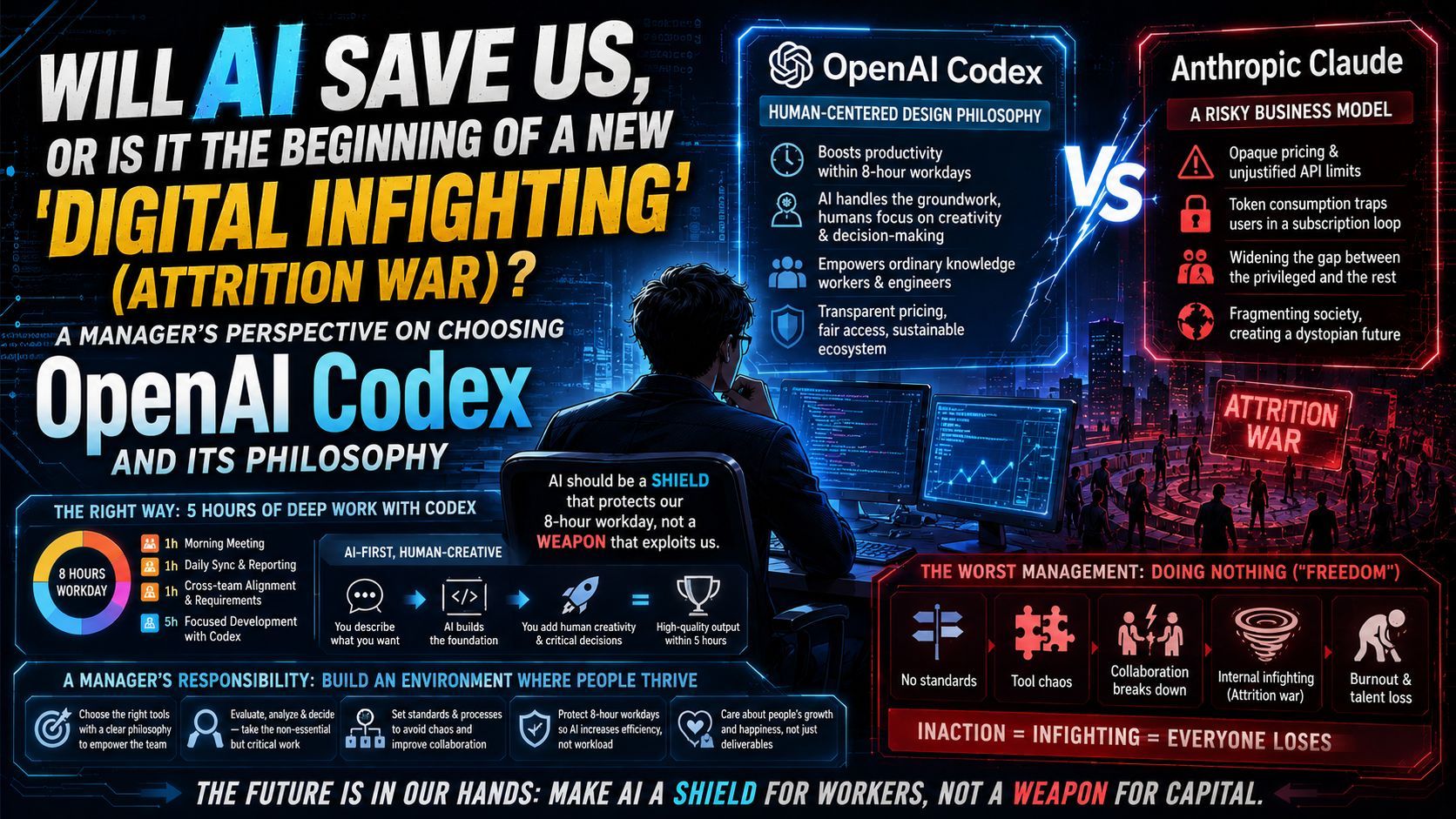
A Manager's Philosophy for Surviving the AI Era: Is Technology a "Tool for Exploitation" or a "Shield for Workers"?
In today's rapidly evolving AI landscape, this article explores a real-world question faced by managers: "Why are we still just as busy as before, even though our productivity has boosted?" It provides a critical perspective on looking past the hype to discern the "philosophy" behind technology, ensuring that AI benefits do not become a mere excuse to extend working hours. By comparing the business models of OpenAI and Anthropic, the text discusses the "human-centric way of working" truly needed in the AI era and the proper leadership approach that managers must adopt.

Hello. As of May 2026, the pace of AI evolution is accelerating faster than ever, and it has seamlessly integrated into our development workflows. However, this brings us to a major question:
"If AI has boosted our productivity so much, why are we still just as busy as before?"
Today, from the perspective of a senior engineer managing teams at an IT company, I want to share my honest thoughts on the evolution of AI tools, the accompanying "philosophy of the work environment," and the real-world impact that the business models of the two giants—OpenAI and Anthropic—are having on the ground.
1. AI's Evolution Should Be a Shield to Protect the "8-Hour Workday"
"AI has gotten so efficient that our value per employee-hour has skyrocketed! Fantastic!" Management and capitalists might cheer and applaud. However, if they use that as an excuse to demand even more code from employees, ultimately drowning them in overtime, then that is nothing more than exploitation disguised as technology.
In essence, if AI is advanced, accelerating, and efficient, shouldn't its benefits be used to "maintain a healthy 8-hour workday for employees (or even reduce actual working hours)?"
Let’s sketch out a timeline of a real day in the life of an engineer:
- Morning Standups & Meetings: 1 hour
- Evening Progress Summaries & Daily Reports: 1 hour
- Cross-department Coordination & Specification Alignment: 1 hour
- Pure Development Time: The remaining 5 hours
Out of a single day, 3 hours vanish into meetings and administrative tasks no matter what. In other words, actual time spent hitting the keyboard is only about 5 hours. Therefore, during those 5 hours, we should "fully leverage Codex to deliver outputs of far higher quality than manual copy-pasting." That is more than enough, and forcing more labor beyond that is complete nonsense.
2. Human-Centric Wisdom Observed in the OpenAI Codex Desktop App
Looking at the current subscription model and design philosophy of OpenAI's Codex Desktop App (which features advanced integration with ChatGPT), I sense a philosophy of intelligence geared toward human advancement, going far beyond a purely technical motive of "making a profit off API consumption."
What makes their approach fantastic is that they aren't just targeting "a handful of elite programmers or geniuses," but rather "perfectly ordinary, everyday workers (engineers and business professionals as a commodity)."
First, you tell the AI what you want to achieve, and the AI handles as much of the baseline legwork as possible. On top of that, the human adds value through "creativity and decision-making that only humans can provide." The system is designed to lock this workflow perfectly into that 5-hour window of working time. This stance of trying to use technology for "human happiness" is visible everywhere in the tool.
3. Why I Feel a Sense of Crisis Regarding Anthropic’s Business Model
Allow me to offer some sharp criticism here. It’s regarding their competitor, a company called Anthropic. This isn't a critique of whether the performance of their models (such as the Claude series) is good or bad. The issue lies in their management approach and business model.
To my eyes, the way they operate seems to point toward "disrupting social harmony."
- Opaque pricing structures and groundless supply restrictions (API limits)
- A vendor lock-in strategy that forces users to consume infinite tokens, trapping them in a continuous billing loop
This is not how you evolve AI to protect ordinary humanity. Such predatory business models only serve to further divide society. Only the privileged class who can master AI, or those who can depend on their ecosystem, will prosper, while everyone else is left out in the cold. In this scenario, the future AI brings is nothing but a dystopia.
4. A Manager's Greatest Sin is "Inaction Complacency"
As a manager leading a team at an IT company, I negotiate with the company side every single day. Of course, not everyone in the world is reasonable and intelligent, so building the ideal environment is never straightforward. However, I have made up my mind: "At least within the scope of my own authority (my own team), I will ensure every single member enjoys the benefits of AI and works happily."
A manager's role is not to wield a whip, threaten subordinates, and force them to write code. It is to "set up the environment" so that subordinates can deliver results more easily and smartly.
To achieve this, the decision-maker—the manager—must personally take on the "non-essential but mandatory heavy lifting" of tool selection, research, and analysis. And the criteria for that selection must be "how to make employees happier (human-centricity)." That is precisely why I introduced Codex to my team.
Neglect under the guise of "Total Freedom" destroys the workplace
The worst possible style of management you can engage in is "inaction (doing nothing)."
"You can use whatever tool you want; it’s completely up to you guys." On the surface, this makes you look like an understanding, kind boss, right? But in reality, it is a complete abandonment of duty.
A state where there are no clear evaluation standards or unified tools (= everything is OK) is exactly the same as a state where "even if you work hard, you won't be fairly evaluated (= nothing is OK)." This is a surefire way to cause ambitious and capable, high-performing engineers to rot.
Furthermore, if members use completely different, fragmented tools, code management within the same project becomes chaotic, and team collaboration collapses. As a result, what happens on the ground? It triggers what is known in Chinese as *"Neijuan"* (involution: pointless internal hyper-competition / a death game). People start dragging each other down, marking the entry into a dark age where everyone gets burnt out. This is nothing less than the exploitation of employees, practically brought about by a manager's "inaction."
5. Conclusion: Weapon for Capitalists, or Shield for Workers?
As of May 2026, powerful tools like OpenAI's Codex Desktop App are right in front of us.
We must not let these become merely "weapons for capitalists to exploit workers even further." We, the engineers on the ground and the managers, must have a strong will to redefine AI as a "shield to protect the 8-hour workday (quality of life) of employees, allowing them to work humanely and creatively."
When choosing a tool, look at the "philosophy" behind it. Is the AI in your team truly making its members happy?