
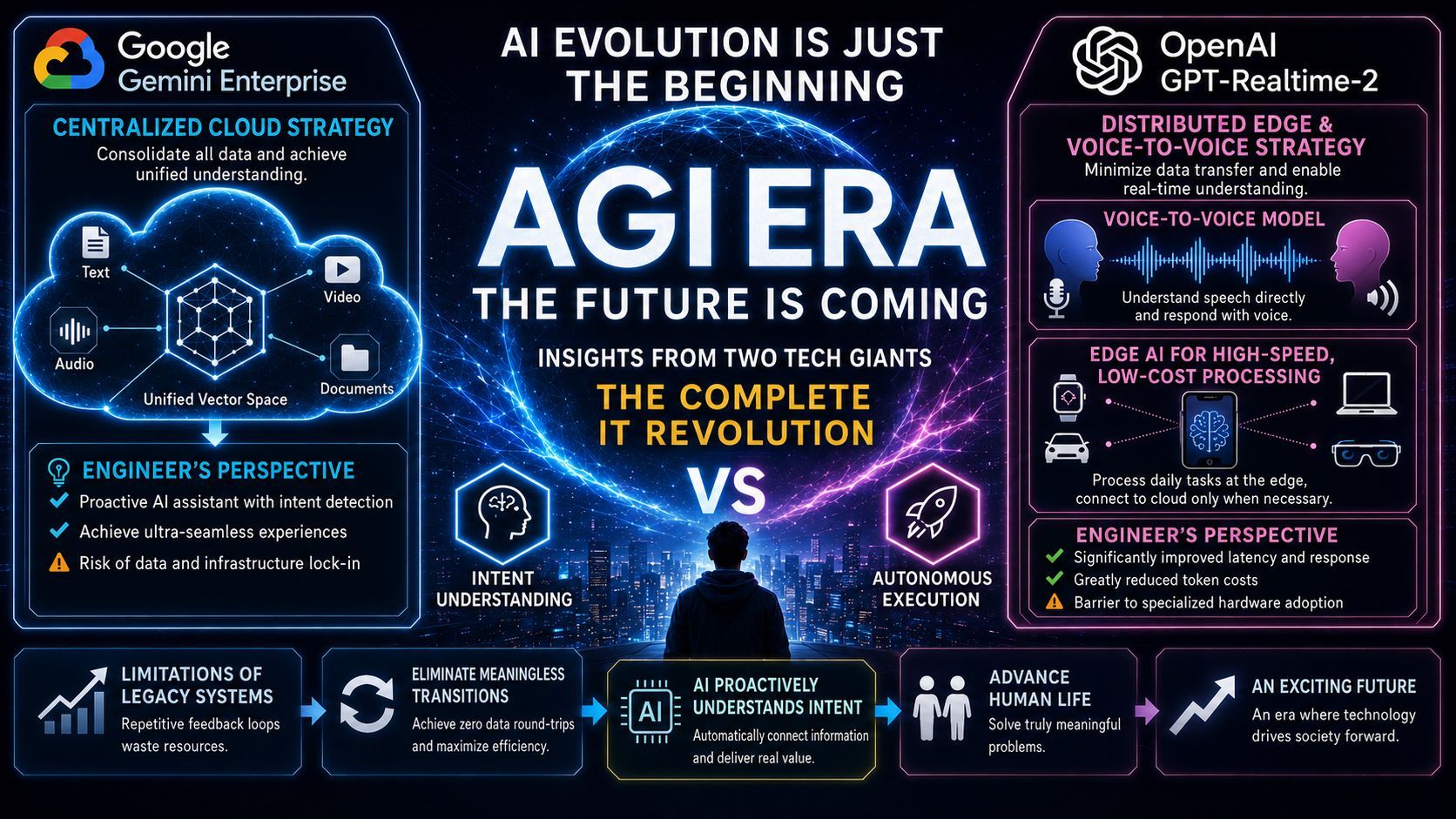
The Dawn of the AGI Era: A Strategic Comparison Between Google and OpenAI, and the Future for Engineers
The arrival of the AGI era marks the prologue to a "complete IT revolution." This article delivers a thorough comparison between Google’s "centralized cloud" strategy and OpenAI’s "decentralized edge & Voice-to-Voice" strategy. It explores everything from the limitations of current RAG (Retrieval-Augmented Generation) to the future outlook of the next-generation automated society that engineers must prepare for.

Are we engineers also about to run out of breath just trying to catch up with the terrifying speed of AI evolution every single day? However, the AI boom we are witnessing right now is nothing more than a prologue to the "complete IT revolution" that is about to unfold.
In the near future, humanity will plunge into the "AGI (Artificial General Intelligence) era," where everything is driven by AI—not as a mere extension of our tools. Today, let’s explore the exciting future awaiting us tech professionals by unpacking Google’s "centralized cloud" (Agentic Enterprise) strategy and OpenAI’s "decentralized edge & Voice-to-Voice" (GPT-Realtime-2) strategy, which are currently clashing beneath the surface.
IT has advanced so much, so why aren't our businesses moving "exactly as we envisioned"?
Entering the 21st century, IT has evolved at a staggering speed. Our operational efficiency has drastically improved, and compared to previous generations, the speed at which we can shape new ideas is incomparably faster.
But let's pause and think about it calmly. Has our work truly reached a dimension where "things materialize like magic the moment we speak them into existence"?
No matter how much technology evolves, at the end of the day, it still takes a matching amount of time and cost from the moment people hold a business negotiation until it actually starts moving on the ground.
What on earth is blocking our ideas from becoming reality and dragging down our efficiency?
The "mental consciousness translation rally" happening on the business front lines
Let’s consider an example of two business owners.
A passionate discussion in the office, followed by drinks. The two leaders hit it off, and the visions inside their respective minds violently spark off each other. This is a direct clash of 【Human Consciousness ⇄ Human Consciousness】. "Let's go with this!" A firm handshake is exchanged on the spot, and the business direction is set.
...Now, the real problem starts here.
- The CEO returns to the company and verbally conveys that passion to the executive assistant.
- The assistant receives the instructions and creates a proposal or document. 【Human Consciousness → IT Data】
- That document is sent to the person in charge at the partner company, who then reads through it. 【IT Data → Human Consciousness】
- The person in charge translates it into an execution plan and further instructs their front-line subordinates. 【Human Consciousness → IT Data】
If you are sharp, you have probably already noticed the "sense of discomfort" hidden within this process.
The wall of efficiency: The "epic game of telephone" we are bound by
That’s right. Even though we are supposedly making full use of modern IT tools, at the end of the day, we are just being forced to play an "epic game of telephone."
All stakeholders keep their nerves on edge, desperately repeating the cycle of "Report, Liaise, Consult (Hou-Ren-So)." What on earth is that for? It is merely a defensive measure to prevent the pure "mental consciousness (intent)" unleashed by the original proposer from getting distorted, diluted, or lost in the endless game of telephone: 【Consciousness → Data → Consciousness → Data...】.
With this setup, no matter how convenient IT tools become, it is only natural that fundamental efficiency hits a glass ceiling.
Not the future, but "now"—The revolution unleashed by Google and OpenAI
Is there no way to break through this limit? No, this is not a story about the distant future. A "real revolution" is about to happen right before our eyes, right now.
The flagbearers of this revolution are Google and OpenAI.
What they are trying to achieve using the latest AI technology is to directly save and process human "consciousness and intent." By doing so, they aim to completely cut out that troublesome "game of telephone" process from its roots and achieve overwhelming efficiency.
Today, we will dive into the essence of how the AI revolution they are bringing will transform the way we work.
Google’s Strategy: The ultimate "centralized vector space" that swallows all data—The Agentic Enterprise strategy
What Google is aiming for is a "complete revolution of the data foundation," backed by their overwhelming infrastructure power.
Their approach is to aggregate every conceivable type of data—such as text, documents, videos, and audio—onto their own cloud, converting everything into "embeddings (vectorized data)" for unified management.
"If all information can directly understand each other's meaning within the same vector space, any wasteful data translation becomes entirely unnecessary."
💡 An Engineer's Perspective: This is where it gets exciting!
If this approach becomes reality, just like the AI assistant in the movie *Iron Man*, users won't even have to painstakingly craft prompts anymore. The AI will automatically perform "Intent Detection" on its own. It will instantly connect past internal data and related information behind the scenes, stepping ahead to provide the answer: "Mr./Ms. XX, you mean this, right? I've already prepared this information for you."
- Pros: The user experience becomes phenomenally seamless, truly realizing an "automated smart life."
- Cons: Because all data and infrastructure will be locked into Google, there is a concern that companies will fall into a situation where they "have no choice but to ride on Google's cloud."
OpenAI’s Counterattack: "Voice-to-Voice" and Edge AI that shatter Token billing
In the face of Google's brute-force approach, OpenAI is presenting a revolutionary architecture head-on. They are aiming for a "decentralized" approach that minimizes data exchange on the cloud.
1. The impact of the Voice-to-Voice model: GPT-Realtime-2
OpenAI is pouring its focus into a native voice model (a mechanism like GPT Realtime) that "directly understands as voice and responds in voice," without bothering to convert audio into text or vectors. By creating a system that can directly process audio data containing all kinds of regional accents and nuances, they completely eliminate the overhead of wasteful data conversion on the cloud.
2. "Edge Processing" via AI-native devices
What is even more intriguing are the rumors that OpenAI is developing its own hardware (such as smartphones). Anticipating hardware evolution (Moore's Law-style performance gains), they envision the following future:
"Daily conversations and simple tasks will all be processed by small-scale models on the local device (the edge). Only when complex reasoning is required will it pinpoint and hit the necessary APIs on the cloud."
💡 An Engineer's Perspective: This is where it gets exciting!
As an engineer, anyone has likely lost sleep over the massive "Token fees" paid monthly to cloud vendors. OpenAI's strategy is an antithesis to this centralized cost structure.
- Pros: Since processing is completed locally, latency is drastically improved, and the perceived speed skyrockets. Additionally, dependency on giant data centers drops, offering a solution to the power shortage crisis.
- Cons: Because dependency on edge devices increases, there is a high hurdle of successfully popularizing dedicated hardware among users.
Future Outlook: How should we position ourselves?
Google's "ultimate cloud integration" or OpenAI's "ultra-fast edge decentralization." Though their approaches differ, the future destination both are aiming for is the same.
It will be an era where the tasks of manually searching for information or linking systems together vanish. Instead, AI will grasp our "intent," automatically cause information to collide, and deliver meaningful results to us.
For a time, business models that simply wrapped APIs to take a cut of Tokens and generate unfair profits (so-called mere "cloud brokers") ran rampant. However, what the coming era demands is not that kind of superficial monetization.
"How can we move human life forward?" and "How can we provide essential and meaningful problem-solving?" Only services that deliver value along this pure vector—the one technology is originally meant to have—will receive just compensation and survive.
The time has come for us engineers to also discern the major bloodstream (trends) of how the next technology will move, and shift our focus away from superficial hacks toward intrinsic development that truly propels society forward.
The incredibly thrilling "AGI era" is just around the corner. How will you ride this wave?