
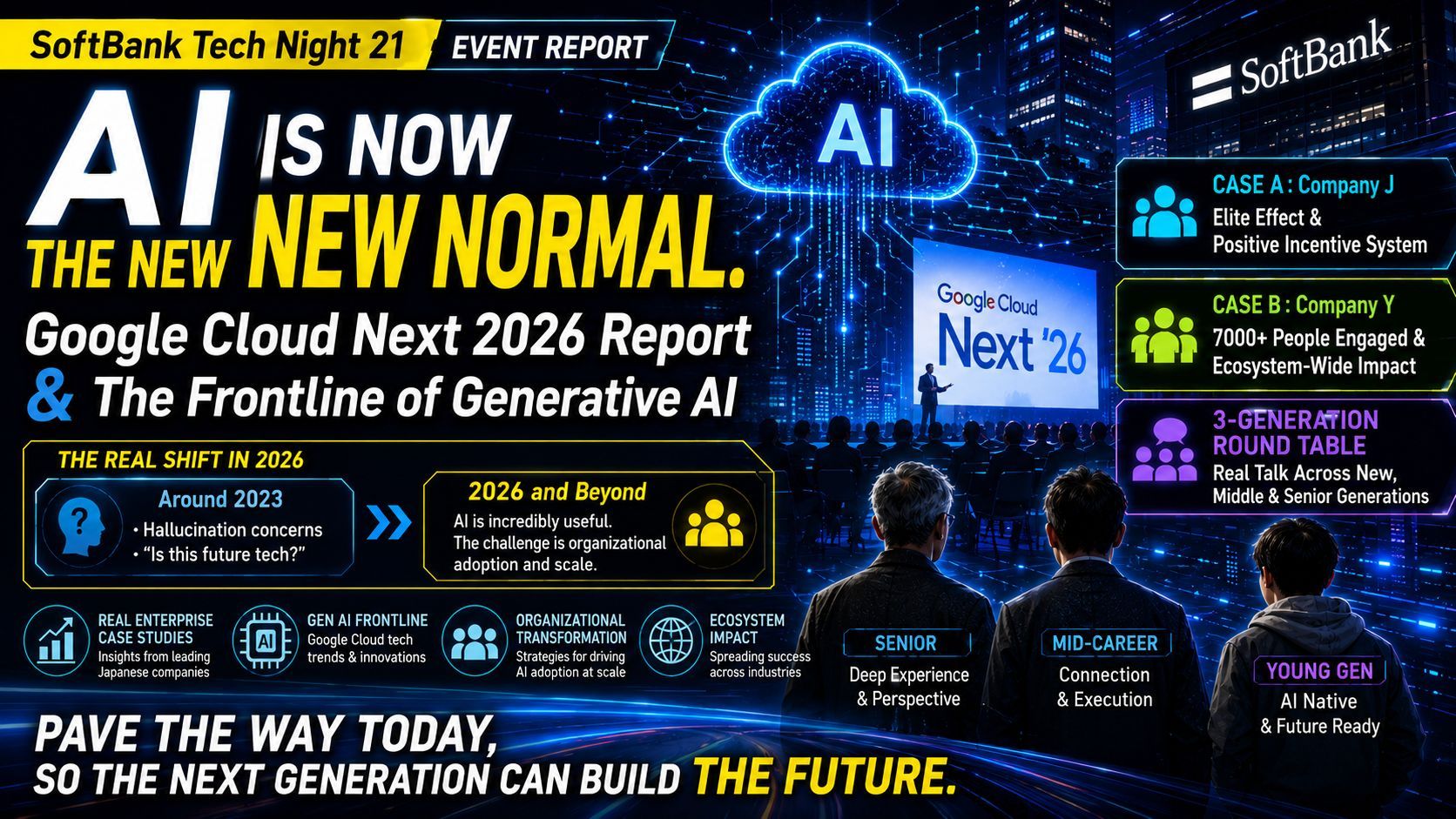
The Future of AI is in "People"! Insights from “AI is Now the Norm. Google Cloud Next 2026 Report & The Frontline of Generative AI Implementation - SoftBank Tech Night 21”
An event report on the Google Cloud '26 debriefing session hosted by SoftBank. It highlights the shift in 2026 AI implementation from a "performance barrier" to an "organizational barrier." The article provides an in-depth analysis of two corporate success stories, the generational gap, key factors for company-wide adoption, and the mission of today's engineers.

Hello there! I’m an engineer whose passion for technology is second to none.
Recently, I had the pleasure of attending an incredibly exciting learning event hosted by SoftBank! The theme was none other than the debriefing session for "Google Cloud '26" held in Las Vegas: "AI is Now the Norm. Google Cloud Next 2026 Report & The Frontline of Generative AI Implementation - SoftBank Tech Night 21".
To jump straight to the conclusion: the quality of the event was mind-blowing, and it was a thoroughly electrifying experience. While being completely awed by SoftBank's magnificent office environment (that unmistakable, intoxicating "mega-corporation" atmosphere), the core message shared there was a deep dive into the "realities, struggles, and silver linings of AI implementation in 2026."
Rather than just a tech-boasting session, it gave us a gritty yet hopeful look at the current state of social AI implementation. Here is my take and analysis in this fresh tech blog post!
1. Barriers Exist to be Lowered: The Pure Caliber of Great Pioneers
"Google's latest AI sounds intimidating..." For any attendee bracing themselves for a dense, overly academic lecture, the opening session shattered those preconceptions in the best way possible.
Overwhelming Approachability Backed by Technical Prowess
The speakers didn't hide behind convoluted jargon or try to smoke and mirror the audience. Instead, they broke down the core essence of Google Cloud from a very flat, relatable perspective that anyone could grasp.
"Because this is such a massive paradigm shift, it is our job as experts to thoroughly lower the technical barriers that might be hard to understand, and seamlessly support your implementation."
That line gave me chills. It takes immense technical prowess to make something highly complex look so simple. I could feel the sheer caliber of true professionals.
Young Talents and Women Shining at the Frontline
What struck me even more was seeing fresh grads who joined the company in 2024 confidently standing at the forefront, delivering phenomenal presentations. The organization also clearly places a strong emphasis on empowering women in tech. As a fellow engineer, I wanted to give a massive standing ovation to a corporate culture that believes diverse perspectives nurture better technology.
2. 【The Reality of 2026】 AI Shifts from a "Performance Barrier" to an "Organizational Barrier"
Now, into the meat of the matter. The deepest insight I gained from this event came from two corporate case studies on "how to implement Generative AI within the Japanese market and corporate organizations."
In fact, this highlights the defining difference between 2023 and 2026:
- The Challenge around 2023: "We can't use AI because it hallucinates," or "Isn't this just a tech for the distant future?"—skepticism focused on the accuracy and performance of the AI itself.
- The Challenge in 2026 (Present): Everyone and their mother knows AI is incredibly useful. The real bottleneck now is organizational: "How do we get the entire company—every single employee—to actually adopt and use it?"
The two approaches used to break through this "implementation barrier" were fascinating.
Case Study A: Company J—The "Elite Effect" and the "Carrot-Based Evaluation System"
The key to company-wide adoption implemented by Company J was a hybrid of top-down and bottom-up strategies.
- Getting Executives and Elites on Board: It wasn't just tech-savvy "AI elites" grinding away. The CEO and the entire executive board took the lead, actively using AI themselves every day. When the C-suite looks like they are genuinely having fun using a tool, the frontline employees can hardly say, "Well, I don't want to use it."
- A Non-Compulsory "Plus-Factor" Evaluation: Instead of a system where "you get penalized if you don't use AI," they introduced an evaluation scoring system based on positive reinforcement and goodwill. If an employee used AI to learn a new skill and successfully completed a task, they received bonus points. This positive loop worked wonders.
Case Study B: Company Y—The Power of Engaging 7,000 People and Rippling Across the Ecosystem
The case study of Company Y, another industry giant, was equally breathtaking. Remarkably, over 7,000 employees across the entire company are already leveraging AI, with monthly active users and usage frequency experiencing exponential growth.
During the Q&A session, I asked: "Do you have plans to take this successful experience and drive it forward to empower your partner companies as well?" I received a crystal-clear, definitive answer: "Yes, that is exactly our plan."
💡 My Perspective & Analysis: If they follow through with this answer—thoroughly empowering their headquarters with AI first, and then horizontally deploying those successful blueprints to their vast network of partner companies—this ceases to be just a success story for a single corporation. This textbook example of leadership by a major enterprise will powerfully pull up and revitalize the entire manufacturing and construction industries in Japan. This vision is exactly why I felt a fierce sense of "determination and resolve" from them.
3. 【The Reality of the Generative Gap】 A Heated Debate Among "The Veteran, The Middle, and The Youth" at the Mixer
At the end of the event, there was a networking mixer where we were randomly assigned to tables.
My table was an incredible mix of three generations:
- The Veteran: A head of a technical department who has been analyzing IT since the era before networks or the internet even existed.
- The Middle Tier (Me): A generation that entered IT during the "golden age of the internet," when web browsers and services were skyrocketing.
- The Youth (A student): An AI Native who has had AI around since birth and takes direct university courses on "AI Strategy."
This 30-minute discussion spanning three generations was wildly entertaining and profoundly thought-provoking.
Why Does Implementing AI Lead to Internal Corporate "Fights"?
It all started when I threw out a topic: "At the end of the day, scaling AI company-wide must trigger massive internal resistance and friction, right?"
The veteran manager deeply resonated with this, slapping the table and saying, "Exactly! It’s insanely difficult, and we are literally fighting over it every single day!" It's human nature. When you have past success stories and deeply ingrained workflows, and someone suddenly drops a tool from above saying "AI is great, so use this," your instinct is to push back: "I’m perfectly happy with how I do things now. Why should I be forced to learn something new?"
As a result, an internal corporate battle erupts between the "AI Promoters (like eager young employees)" vs. the "Status Quo Status-Maintainers."
The "Pure Amazement" of Youth, and the Responsibility We Must Bear
Listening to this gritty, real-world adult squabble (haha), the student sitting with us looked completely bewildered. To them, using AI is a default choice, as natural and obvious as using a smartphone.
He asked with pure, innocent curiosity: "Wait, why is there so much fighting? Can’t the head of DX just issue a top-down mandate saying 'You must use it!' and solve it in one shot?"
I looked at him and said: "You see, when it comes to management and organizations, if someone tries to force something down people's throats using raw power, the frontline will just shut their hearts, close the gates, and grind to a halt. In the end, it’s a battle of human psychology and emotion."
However, looking at this student, a furious sense of responsibility sparked in my chest.
4. Conclusion: What We, the "Middle Generation," Must Do Right Now for the Youth of Tomorrow
The younger generation entering society right now will graduate armed with the cutting-edge weapon of fully mastering AI. However, when they step into the real world a few years from now, what happens if the company they are assigned to is an adversarial environment that claims "AI is dangerous" or "We won't use it because there is no precedent"?
The brilliant skills they have cultivated will be viewed as a thorn in the side of the organization, and their spirits might break. It should be absolutely unacceptable for a young person—who is shining their eyes so brightly that they even attend a real-world tech conference for adults—to sink into despair the moment they enter society.
To be honest, in my own daily operations, I often find myself exhausted from communicating with slow-moving colleagues or stubborn partner companies. There are plenty of moments where I feel like compromising and thinking, "Sigh, whatever, let's just stick to the old way..."
But if our generation gives up here and slacks off on building the foundation for the future, the next generation will have no stage left to shine on.
It is our duty as the older generation to take the mud, fight the internal corporate politics, plow the organizational soil bit by bit, and establish a "foundation" where AI can be used as a given. If we do that, when they finally join us in the workforce, they won't have to waste their energy on pointless bureaucratic friction. Instead, they will be able to commit 100% to building an even more advanced, brand-new future. I am absolutely convinced that this is our "mission and responsibility" as engineers and leaders living in the present.
A massive thank you to the organizers of SBTechNight for putting together such a spectacular event! As soon as the official presentation videos and slides are made public, I will share the links with you all immediately. I guarantee the depth of the content, so please check it out!
Alright everyone, let's go out there tomorrow and keep fighting the corporate "AI allergy" with a smile!