
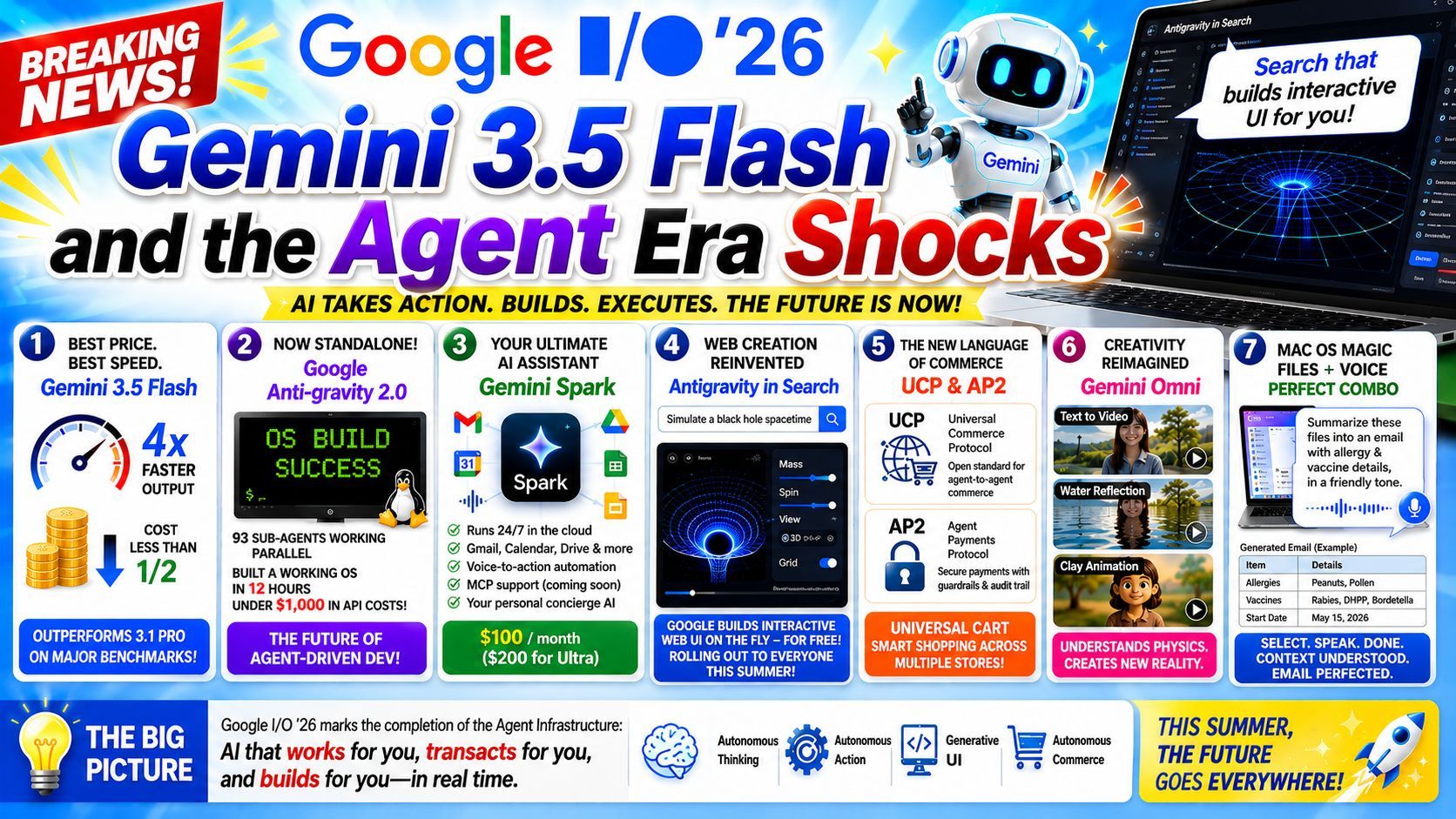
Google I/O '26 In-Depth Analysis: The Paradigm Shift from Text Generation to "Autonomous Action Agents"
This year's Google I/O '26 marked a definitive shift in the role of AI—evolving from a mere "text-returning tool" into an "Agent infrastructure that acts autonomously and builds its own UIs." From a developer's perspective, this article dives deep into the most noteworthy trends, including the mind-blowing speed and performance of the next-gen Gemini 3.5 Flash, the multi-agent development environment Anti-gravity 2.0, and "Generative UI," which codes dynamic Web UIs on the fly based on search queries. Stay ahead with this cutting-edge insight that is set to reshape the future of development and web creation.

Google I/O '26 Breaking News! The Shockwave of Gemini 3.5 Flash and the Evolved Agent Era
Hey everyone! Did you catch the Google I/O '26 Keynote this year? To put it in a nutshell, it was a definitive shift from the "AI returning text era" to the "AI Agent taking autonomous action and generating code for UIs on the fly era."
Today, I’m bringing you a breakdown of the updates that especially blew my mind from a developer's perspective, packed with my own analysis!
1. Ultimate Cost-Performance & Speed: The Debut of Gemini 3.5 Flash
The biggest shocker this time around has to be Gemini 3.5 Flash. It outperforms the previous generation's "3.1 Pro" across a wide range of benchmarks, with massive upgrades in coding proficiency and real-world task handling (SWE-bench / GDP-val).
Why it's mind-blowing: It boasts an output speed 4x faster than other frontier models. On top of that, infrastructure optimization has cut the cost to less than half of what it used to be. It looks poised to be the absolute savior of corporate token budgets.
2. Going Fully Standalone! "Google Anti-gravity 2.0"
Anti-gravity—the Agent-first development environment for developers—received a major upgrade to 2.0.
In a live keynote demo, they utilized a multi-agent system powered by Gemini 3.5 Flash and Anti-gravity (with 93 sub-agents running concurrently) to build a "working OS from scratch" in just 12 hours, for less than $1,000 in API costs.
Seeing typo utilities (like the sl command) and even *Doom* actually running on that OS was like looking straight into the future of Agent development.
3. The Ultimate Personal AI Agent: "Gemini Spark" is Born
Google announced Gemini Spark, a personal concierge built on their cutting-edge Agent harness.
- 24/7/365 Autonomy: It runs on a dedicated virtual machine in the cloud, so it keeps executing your tasks even after you close your laptop.
- Overwhelming Task Execution: Seamlessly crossing between Email, Calendar, and Drive, it can handle everything from "managing RSVPs for a neighborhood block party, auto-syncing them to Sheets, to creating presentation slides" based on voice commands alone.
- MCP (Model Context Protocol) Support: Third-party tool integration is scheduled to roll out over the coming weeks.
As for the price tag everyone's curious about, it sits at $100/month (with the Ultra plan dropping from $250 to $200). While it offers top-tier functionality for a personal agent, it’s definitely a premium, "Hermès-class" feature that requires a quick chat with your wallet. Note that this is also heading to Enterprise and Workspace, so existing corporate plans aren't going anywhere.
4. Redefining the Future of Web Dev? "Antigravity in Search" Opens Up for Free
Personally, this is the update that filled me with the most awe (and a little bit of existential dread). Google Search is fusing with the coding capabilities of Gemini 3.5 Flash and Anti-gravity.
Until now, searching meant "you type in a keyword, and Google returns links to existing websites." Moving forward, "Google will generate code on the fly to return a dedicated, interactive Web UI (mini-app) tailored perfectly to your search query."
In the demo, a user asked about the spacetime distortion of black holes, and Search instantly generated a simulator (UI) where parameters could be tweaked in real time. This is rolling out to everyone for "free" this summer. The very definition of a frontend engineer's job might be about to shift dramatically.
5. The New Universal Language of Commerce: UCP & AP2
In the e-commerce sector, the foundation has been laid for Agents to handle shopping autonomously.
- UCP (Universal Commerce Protocol):A next-generation open-standard protocol replacing HTTP for exchanging purchasing information between Agents. Tech giants like Amazon and Meta are already on board.
- AP2 (Agent Payments Protocol):A secure payment protocol. It respects user-defined budgets and brand boundaries (guardrails), creating a permanent digital paper trail to prevent Agents from making unauthorized purchases.
When combined with a "Universal Cart" that spans multiple websites, you'll soon be able to experience seamless, smart shopping—like having an Agent automatically check part compatibility for a custom PC build before purchasing.
6. Disrupting Creativity: Gemini Omni Model
Google also unveiled Gemini Omni, a world model capable of simulating new realities from any text, image, or video input.
Inside the Gemini app, you can upload a selfie video and simply say, "change the background to water, make it reflect off the surface," or "make it look like claymation." The AI understands physical laws (like kinetic energy and gravity) to deliver incredibly realistic video edits in the blink of an eye.
7. Evolution for Mac OS: The Ultimate File Selection × Voice Synergy
The updated Gemini demo for Mac was nothing short of brilliant. By selecting multiple PDFs or images in Finder (like a pet's vaccine certificate or receipts), holding down the function key, and simply saying, "Based on these files, write an email summarizing the allergy and vaccine details into a table, using a friendly tone," Gemini perfectly grasps the context to generate a beautifully formatted inline email. It even perfectly recognized and corrected mid-sentence slip-ups (e.g., "Starting Thursday... wait, actually make that Friday").
💡 Wrap-Up
This year's Google I/O wasn't just about introducing "convenient AI tools." It heralded the completion of "an Agent infrastructure that works, pays, and builds custom UIs on the fly on our behalf."
In particular, "Generative UI"—turning search results into dynamic applications—is bound to have an immeasurable impact on the future web ecosystem. We definitely need to keep our eyes glued to the general rollout of these features this summer!