
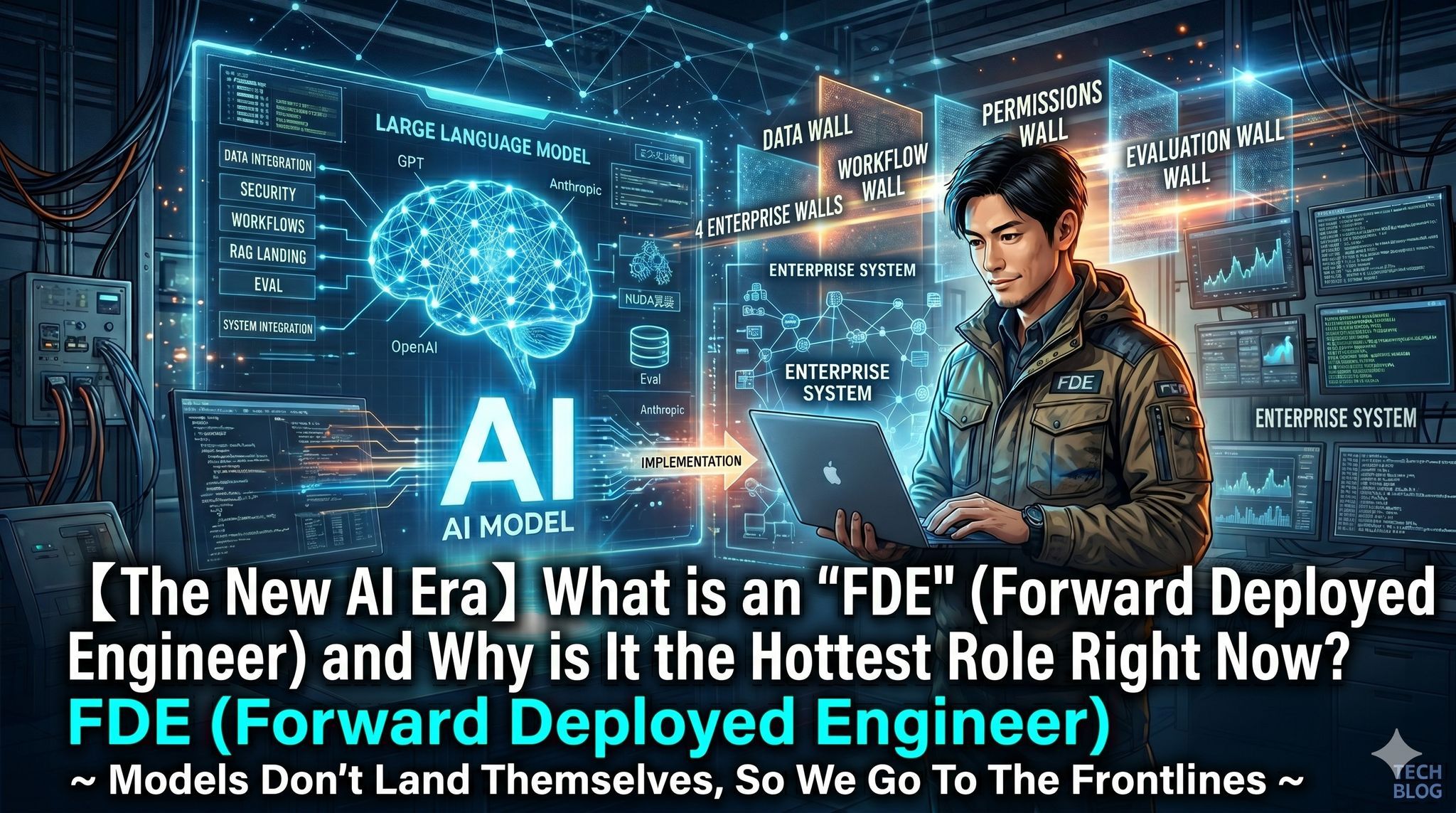
【The New AI Era】What is an "FDE" (Forward Deployed Engineer) and Why is It the Hottest Role Right Now? ~ Models Don't Land Themselves, So We Go To The Frontlines ~
The cutting edge of the AI industry has officially shifted from simply "researching smarter models" to "implementing them to actually work in production." This article unpacks the critical role of the Forward Deployed Engineer (FDE)—the ultimate catalyst for AI's real-world adoption. We will break down the hyper-practical and gritty skillset required for these engineers to physically smash through the "four enterprise walls" of data, security, and complex workflows to inject and operationalize AI directly into corporate infrastructures.

【The New AI Era】What is an "FDE" Forward Deployed Engineer and Why is It the Hottest Role Right Now? Models Don't Land Themselves, So We Go To The Frontlines
Hello world! Have you recently noticed a quiet yet fierce explosion surrounding a specific job title in the AI industry? It’s called the FDE (Forward Deployed Engineer).
If you are thinking, *"Oh great, another overhyped buzzword..."* and are about to close this tab, wait just a moment. This is not just marketing fluff. Moving into 2026, top-tier global AI companies like OpenAI and Anthropic are aggressively pouring massive amounts of resources and engineering talent into their FDE teams.
The paradigm in AI has officially shifted: We are moving away from "how to build the smartest model (Research)" and moving entirely toward "how to make models actually work in production (Implementation)." Today, let’s strip away the glamorous marketing and dive into the messy, muddy, and fascinating reality of the AI world's ultimate problem-solvers: the FDEs.
1. Behind the Shiny Keynotes: The "4 Hard Walls" Where AI Crashes and Burns
"AI models do not land themselves into production."
This is the painfully real truth that every LLM provider is facing right now. No matter how mind-blowing a demo looks during a keynote presentation, and no matter how blazing fast or accurate an API score looks on a leaderboard, the moment you try to inject that AI into a legacy corporate enterprise system, it hits "4 massive walls" and shatters into pieces.
【The 4 Enterprise Walls Blocking AI Implementation】
 ├── ① The Wall of Data (Scattered across CRMs, ERPs, Excel, and messy local files)
 ├── ② The Wall of Permissions (Who can see what? Where are the audit logs and compliance?)
 ├── ③ The Wall of Workflows (Approvals, edge cases, and the fuzzy boundary of liability)
 └── ④ The Wall of Evaluation (In the enterprise world, "it looks okay-ish" means "Fails Production")
- The Wall of Data: Enterprise data does not sit beautifully waiting behind a clean, well-documented API. It is scattered across archaic CRMs, legacy ERPs, decades-old internal wikis, chaotic Excel sheets, and deep inside someone's inbox. Cleaning, piping, and feeding this data into an AI is an exhausting, uphill battle.
- The Wall of Permissions: *"Let's connect the AI to all company data so it can answer employee questions!"*—Say this out loud, and your Chief Information Security Officer (CISO) will instantly faint. Designing granular access controls, maintaining data privacy, and keeping rigorous audit logs for AI outputs requires bulletproof architecture.
- The Wall of Workflows: Real-world operations are a messy web of approval chains, bizarre edge cases, cross-departmental handoffs, and strict legal liabilities. Human business logic is deeply intricate. You cannot simply automate it away with a clever one-liner prompt.
- The Wall of Evaluation: Getting a "Wow, that's smart!" reaction in a controlled staging environment is easy. But what happens in production? How often does the model hallucinate? When it fails, how do you handle graceful degradation or an automated fallback (e.g., handing off to a human)? How do you build a continuous, automated evaluation (Eval) loop?
Smashing through these four walls and physically, seamlessly "forcing the model to actually function inside a client's infrastructure"—that is the exact mission of an FDE.
2. "FDE" vs. Traditional IT Consultants: What’s the Real Difference?
You might ask, *"Isn't this just a fancy new name for an IT Consultant, a Solutions Architect, or a Systems Integration (SI) Engineer?"*
The short answer is: The weight and substance of the ultimate delivery are on completely different levels.
- Traditional Consultants / SIs: Their primary deliverables are usually beautiful slide decks (PPTs), high-level gap analyses, and frameworks on *how* a company should transform. They tell the client what needs to be done.
- Forward Deployed Engineers (FDEs): Their primary deliverable is production-ready, battle-tested code running live in the system. They deliver actual data pipelines, seamlessly integrated business workflows, and measurable business outcomes that show up on a balance sheet.
If a consultant is a military strategist drawing maps in a safe command tent, an FDE is a special-ops engineer who grabs a rifle, drops directly into the client's muddy trenches, and refactors code live under fire. They are hyper-practical, hyper-technical, and obsessed with execution.
3. The Ticket to FDE: A 6-Dimensional Hybrid Skill Tree
If you read this and thought, *"I want in. This is where the money and impact are,"* you need to know that simply writing Python scripts or being good at prompt engineering won't cut it. To excel as an FDE, you must possess a lethal combination of six core capabilities:
① Sharp "Business Bottleneck Discovery"
Clients will almost always approach you with a vague request: *"We want to use AI to automate stuff."* You must possess the intuition to look past the noise and find the real bottleneck (e.g., discovering that the problem isn’t the customer support quality, but rather an inefficient internal routing system or a sluggish approval loop).
② AI Application Architecture RAG & Agents
You don’t need to train a foundational LLM from scratch, but you must be a "Master of Blocks." You need to know exactly how to orchestrate Retrieval-Augmented Generation (RAG), AI Agent frameworks, Tool Calling, and complex workflow engines into a highly reliable, concurrent system.
③ Lightning-Fast "Full-Stack Hacking & Delivery"
From building slick front-end interfaces to hacking together backend APIs and spinning up databases, you need to leverage AI-assisted coding tools to ship a fully functional, production-grade MVP (Minimum Viable Product) in a matter of days.
④ Enterprise Integration & "Legacy Systems Warfare"
Your biggest enemy will be the client's monster of a legacy system—software that was written before you were born. You must architect with enterprise standards in mind: OAuth integration, VPC peering, network isolation, robust error handling, and telemetry/monitoring.
⑤ Rigorous Evaluation & Production Guardrails
Turning "vague AI behavior" into deterministic metrics. You must build custom Eval frameworks, set up automated testing, and design foolproof safety nets (like human-in-the-loop triggers) for when the AI inevitably encounters an anomaly.
⑥ Dual-Language Translation Business ↔ Engineering
You must be able to translate complex technical constraints into concrete ROI (Return on Investment) metrics to convince C-level executives to clear blockers, while simultaneously translating chaotic business operational pain points into clean engineering sprints for your internal product teams.
4. A Cold Reality Check: What the Boom of FDEs Reveals About the AI Industry
As engineers, let’s look at the flip side of this coin with cold, analytical objectivity: "Why are FDEs suddenly in such high demand, commanding astronomical salaries?"
The underlying truth is a bit brutal: It is because current AI products are still fundamentally unstandardized and far too immature to be "plug-and-play."
If AI were truly like electricity or cloud computing—where any business could just flip a switch or install an off-the-shelf SaaS tool—AI companies wouldn't need to deploy their brightest engineering minds to sit onsite at a client's office for months at a time. In that sense, the FDE boom is the ultimate, premium-grade band-aid for the current era of AI transition.
However, this is also where the ultimate moat is built. The FDEs and AI companies who are down in the mud, seeing real enterprise data, getting hit by real operational edge cases, and failing repeatedly are accumulating a massive wealth of "Know-how." This practical, battlefield experience is the ultimate asset. It is the exact data and feedback loop that will allow these companies to build the *next* generation of truly standardized, bulletproof AI products.
5. Conclusion: The AI Second Half is About Execution, Not Demo Hype
For the past two years, the AI world has been caught up in an absolute carnival. We cheered for minor benchmark improvements and gasped at cinematic, highly curated AI video demos. But as we enter the second half of the AI race, the era of flashy parlor tricks is over. We are entering a brutal war of attrition: who can actually make things work in the real world.
- For the Engineers: Being able to write clean code is just table stakes now. Moving forward, the engineers who understand business logic, command client communication, and know how to hard-wire AI into enterprise architecture will see their market value skyrocket.
- For Founders & Business Leaders: Stop paying for "toy demos" that only work under perfect laboratory conditions. Invest your capital into systems that seamlessly dissolve into your existing workflows and yield undeniable, quantifiable efficiency.
"If the model won't land itself, I'll go to the frontlines and force it onto the ground."
If you are a builder who thrives on high stakes, hates corporate monotony, and wants to see your code directly impact the core mechanics of global businesses, the FDE track is, without a doubt, the most exciting battlefield in tech right now.
【Bonus】Want to pivot toward FDE in the next 30 days? Here is your Action Plan:
- Days 1–7 (Identify the Friction): Look at your own daily workflow or ask a friend about theirs. Find one genuinely frustrating, low-efficiency "real business scenario" (e.g., sorting through chaotic vendor invoices or manually triaging bug tickets).
- Days 8–15 (Build the MVP): Leverage AI coding assistants, but don't just stop at a pretty UI. Wire it up to a database, integrate external APIs, and implement a basic auth mechanism. Make it an actual, working app.
- Days 16–23 (Enterprise Hardening): Add permission structures, write robust exception/error handling, and build a basic evaluation script (Eval) to measure the AI's accuracy. Upgrade it to enterprise grade.
- Days 24–30 (Package for Business Impact): Put this into your portfolio. But don't just write a list of tech keywords. Draw a clean architecture diagram and write a clear summary: *"This system reduced processing time by X% and saved Y hours per week."*
Graduate from building "fun little chatbots over the weekend." That is your true Step One toward becoming an FDE.