
What? You Don't Know How to Make a Proposal with AI? Master This Skill with the Latest May 2026 AI Workflow — 5 Steps to Mass-Producing Proposals via "Harness Engineering" Thinking
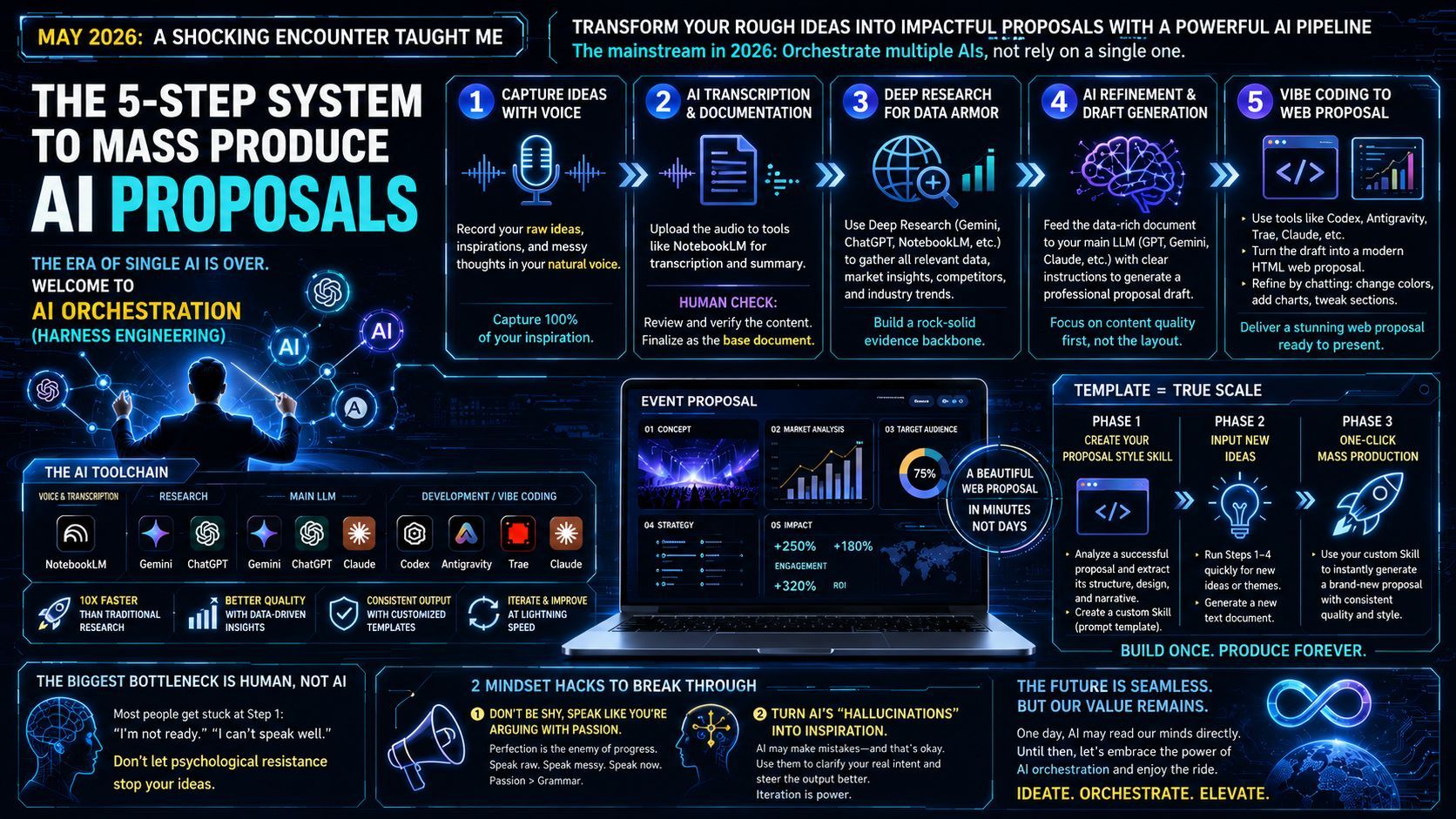
The struggle of "not knowing how to create a proposal with AI" stems from being trapped in traditional ways of using AI. Moving beyond simply throwing in a prompt, this article introduces a concrete 5-step workflow from the perspective of "Orchestration" (Harness Engineering)—coordinating and controlling multiple AIs for the right jobs—to sublimate your raw ideas into overwhelmingly high-quality proposals and web-based reports. It covers everything from capturing the entirety of your thoughts to generating designer-quality web pages, and finally achieving true operational mass-production using custom "Skills."

1. May 2026: A Shocking Encounter with a Fellow AI Professional
The other day, I was chatting with a friend who fights alongside me in the AI business trenches. The moment he said, "I found a great business opportunity," and I replied, "Awesome, let's wrap it up into a proposal right away," his face fell...
...I was flabbergasted. Keep in mind, the time is now: May 2026. In this day and age, where the social implementation of AI has advanced so far that literally everyone is touching LLMs, a guy who is supposed to be at the front lines of business is still getting tripped up here?!
However, this isn't just his personal problem. It's because many people are still trapped in a certain "old stereotype." The ultimate symbol of this is the question: "Which AI tool can I use to generate a gorgeous PPT (PowerPoint) in one click?"
Let me be blunt: If you are looking for that answer right now, you have completely misread the rules of the game (in today's AI scene, even the common sense of three months ago is highly questionable). The pace of evolution in the AI industry today is staggering. The era of throwing a prompt into a single tool and aiming for a one-click fix is over. The modern mainstream approach is "Orchestration" (or Harness Engineering), where a human acts as the conductor (the Executive Director of the orchestra) to coordinate and control multiple AIs, utilizing the right tool for the right job.
Today, I want to share the "5 Steps" to take those raw, gritty ideas inside your brain and sublimate them into a highly polished proposal using the most cutting-edge mindset.
2. 🚀 Manifesting Thought: The "5-Step Pipeline for Mass-Producing AI Proposals"
Instead of relying on a single AI, you build a "pipeline" that connects multiple AIs. This is documentation, 2026-style.
1️⃣ Step 1: Capture "Brain Inspiration" in Bulk via Audio Recording
- Action: Fire up your favorite recording tool on your phone or PC, and dump out the event planning, your initial vision, and all the raw ideas in your head all at once, using everyday language.
- The Engineer's Perspective: The purest form of human "creativity" tends to evaporate the moment you try to convert it into beautifully polished prose. Your absolute priority here is to ignore logic and grammar, and just pack up the raw heat of your emotions and ideas exactly as they are.
2️⃣ Step 3: AI Initial Screening & Documentation
- Action: Feed the recorded audio file into a voice analysis and transcription AI, such as Google's
NotebookLM. - Human Intervention (Check): The crucial part here is "human acceptance inspection." Read the text summarized and organized by the AI to ensure it aligns with your intent. If it looks good, finalize this as your "Base Document."
3️⃣ Step 3: Arming with Data via Deep Research
- Action: Leverage the
Deep Researchfeature in Gemini or ChatGPT, or utilize theDeep Researchcapabilities within NotebookLM. - The Engineer's Perspective: Input the Step 2 document into the AI and command it: "Based on this context, thoroughly research and cover all necessary industry data, competitor case studies, and market background." Instantly, the backbone (evidence) of your proposal will be reinforced at a density and speed 100 times faster than the old era of Googling things yourself.
4️⃣ Step 4: Refinement and "First Draft Generation" by AI
- Action: Pour the data-packed document into your go-to main LLM (Gemini, ChatGPT, Claude, etc.). Give it clear instructions (purpose, target audience, structure) and have it generate the "text" for a professional event proposal.
- Key Point: Don't worry about the layout yet. Focus thoroughly on elevating the completeness of the "content" (the logic of the text).
5️⃣ Step 5: Sublimating into a Web-Based Report via Vibe Coding
- Action: 1. Fire up an AI development tool like
Codex,Antigravity,Trae, orClaude.
- Drop the text from Step 4 straight into it and instruct: "Based on this, build a modern HTML event proposal (web page)."
- Vibe Coding (Conversational Development): Look at the generated screen and refine the design by talking to the AI in natural language, saying things like, "Change the color here," "Turn this data into a graph," or "Fine-tune this section."
- The Goal: Ultimately, you will finish with an overwhelmingly stunning "Web-based Proposal" that you can project onto a screen and present immediately.
💡 Don't sweat it if it flops—just run it back! If the generated output is subpar, there is absolutely no need to feel down. Just run this 1-to-5 pipeline again at ultra-high speed. Once you get a feel for this "factory mass-production" approach, your ideas will infinitely convert into high-quality proposals.
3. 🛠️ Breaking Boundaries: "True Mass-Production" via Templatization
If you stop here, it's just "efficient work." As engineers, we want to abstract this even further and systematize (mass-produce) it.
- [Phase 1] Create Your Unique "Proposal Style Skill"
Use the "Skill-creator" (custom feature creation) of your AI dev tool to analyze your successful index.html. Instruct it: "Completely extract the structure, design, and narrative style of this proposal. Create a dedicated Skill that can automatically generate an HTML proposal of this quality no matter what topic or theme is thrown at it in the future."
- [Phase 2] Injecting New Ideas
When you come up with a different event or a new theme, quickly run through the "First Stage (Steps 1–4)" to prepare a fresh chunk of text.
- [Phase 3] One-Click Mass Production via Dedicated Skill
Activate the "Dedicated Skill" you just made and pour the new text into it. Instantly, a completely different proposal is born, with its design Tone & Manner perfectly unified.
4. 🧠 The Biggest Bottleneck Isn't AI—It's "Human" Psychology
Tool efficiency has been pushed to the absolute limit. However, when you try to introduce this workflow, you will inevitably hit one massive wall. It’s not a lack of AI performance; it’s the psychological resistance of "the human (you)."
Many people freeze at the very first step: "speaking your ideas aloud and recording them." They look for excuses like, "My thoughts aren't organized yet," or "I can't speak well," and reject it out of psychological resistance, claiming, "I can't use something like this."
Here are two hacks on how I overcame this wall:
① "Don't be scared—speak with the energy of yelling in a loud argument"
First, get your energy up. Humans are at their most articulate and their brains run at full throttle when they are trying to shout during an argument (laughs). It doesn't matter if you get tongue-tied, if your grammar is a complete mess, or if it's just a string of random words. Just open your mouth and let the emotions flow.
② "Turn AI 'Hallucinations' into Inspiration"
Aside from the first step, the remaining four are entirely handled by AI. Therefore, the quality of your own recording can be totally garbage. Just dump it on the AI and say, "Just guess based on this for now!" AI occasionally tells plausible lies (hallucinations). Actually, this characteristic makes for the absolute best spice. By seeing the AI's completely off-target output, it triggers your true thoughts: "No, not like that! What I actually want to say is..." This conversely clarifies the direction you need to control (the utilizing of positive and negative prompts). What matters isn't being smart, but the grit to grind through cycles at high speed.
5. 🔮 Conclusion: A Continuous Future and Human Value
Let us cast aside arrogance. Do not treat AI as a magic wand that will perfectly flesh out your vague, un-verbalized anxieties into a flawless form in one click. Grinding through unglamorous, gritty, high-speed iterations—this is the true essence of modern "Orchestration" (Harness Engineering).
Perhaps sometime in the future, an era will come when silicon-based lifeforms (AI) will directly read our brainwaves and automatically execute human intent without even requiring language.
...Though, if such an era truly arrives, the very concept of a "proposal" that we are desperately crafting right now might hold absolutely no meaning in human society anyway (laughs). Until then, let’s fully enjoy riding this wave of AI orchestration!