
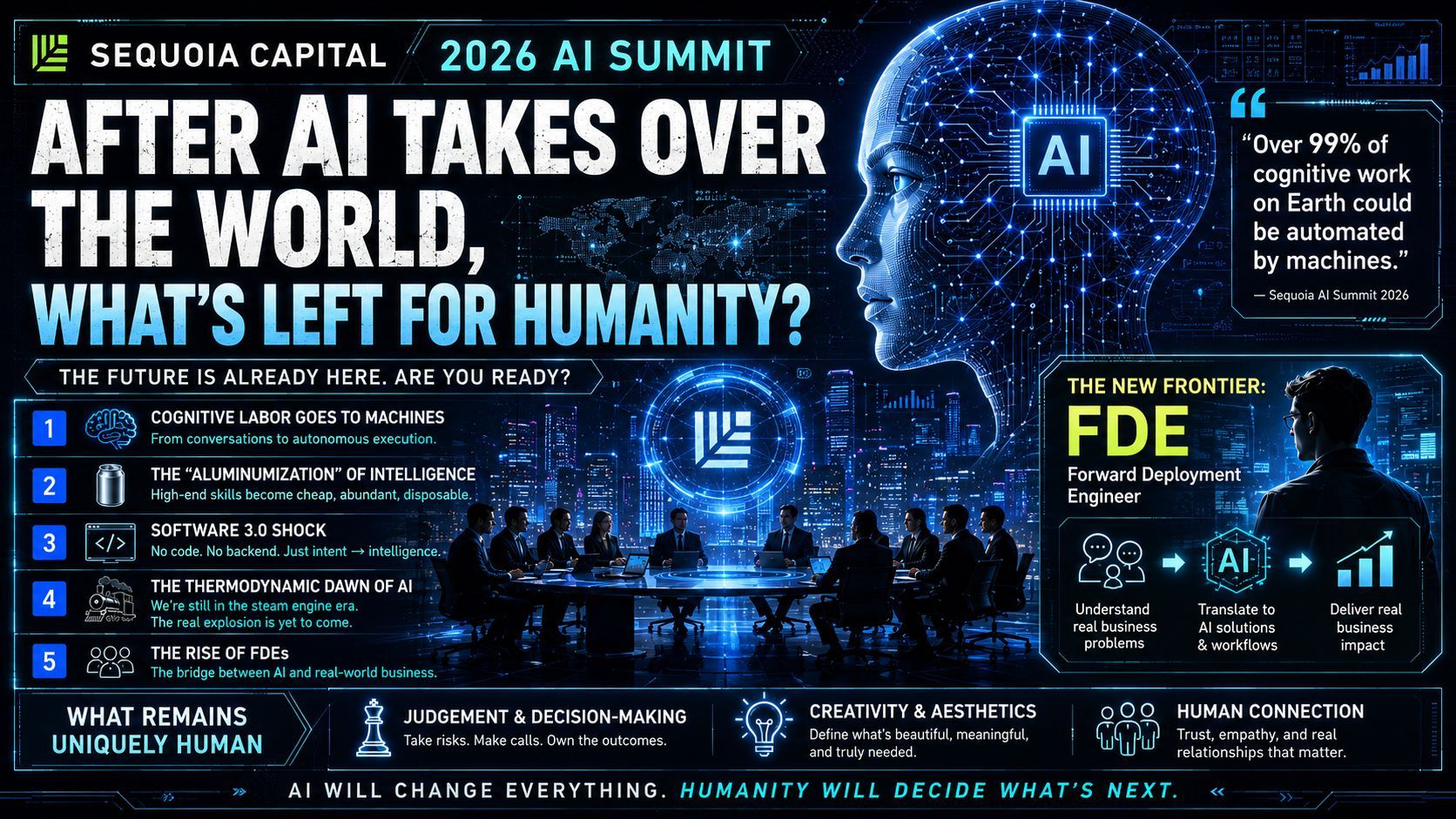
The Dawn of the Cognitive Industrial Revolution: Survival Strategies for the AI Era from Sequoia Capital’s 2026 Summit
Drawing on cutting-edge insights from the Sequoia Capital 2026 AI Summit, this article explores the survival strategies for engineers and business professionals in an era where AI automates cognitive labor. It analyzes the commoditization of intellect, the arrival of Software 3.0, and the rising significance of Forward Deployment Engineers (FDEs) who generate real-world value on the messy frontline of business, ultimately presenting the definitive moat that humans must defend.

Hello, tech community! As we move through 2026, the velocity of AI evolution continues to shatter expectations and redefine the boundaries of what machines can do.
Recently, a seismic event sent shockwaves through the tech elite—Sequoia Capital’s 2026 AI Summit. There were no press releases, no public live streams, and no social media fanfare. Instead, the room was packed with the minds running the world’s technology: CEOs and key figures from OpenAI, DeepMind, Anthropic, NVIDIA, and the most prominent unicorns. It was a closed-door gathering of the brains shaping the future of civilization.
The most profound—and perhaps sobering—takeaway from this summit was that **nobody is debating *whether* AI will change the world anymore. That foundational phase is long gone. The agenda has shifted entirely to the next frontier: “Once AI automates the vast majority of cognitive labor, what is left for humanity?”** This is no longer a distant sci-fi premise; it is a near-term reality blending elements of both a hyper-efficient utopia and a challenging dystopia.
Based on the core insights from the summit, I’ve compiled a deep-dive analysis into what this means for engineers, builders, and business leaders. Here is a survival guide for the next decade of the cognitive shift.
1. The Mechanization of "Cognitive Labor": From Chatting to Executing
"In the foreseeable future, over 99% of the world's cognitive tasks could be completely executed by machines."
Just as the Industrial Revolution used mechanical power (steam engines and electric motors) to replace human muscle (physical labor), the AI revolution is systematizing the "standardized mind" (cognitive labor).
Just as airplanes fly, forklifts lift, and automated warehouses sort goods autonomously, neural networks are becoming the core utility layer for intellectual processing across society.
The critical paradigm shift discussed at the summit is that AI has fully graduated from being a conversational novelty—an eloquent chatbot—to a fully autonomous agent. These agents reason, plan, self-correct, call external tools, and execute end-to-end tasks without human intervention.
Think of it as an intern who went from simply talking about a project to independently building and delivering it overnight. Skills that used to take ten years of legal training or tens of thousands of hours of coding practice to perfect are now being abstracted into a single, high-efficiency API call.
2. The "Aluminization" of Intellectual Assets: The Great Skill Deflation
One of the most striking concepts introduced at the summit was the “Aluminization of Intellect.”
A Quick Lesson in History: In the 19th century, aluminum was a precious metal more valuable than gold. Napoleon III famously served his most honored guests on aluminum plates, leaving the gold ones for lesser royalty. The tip of the Washington Monument was capped with a 100-ounce block of pure aluminum to showcase ultimate luxury. However, with the invention of the Hall-Héroult electrolytic process, the cost of producing aluminum plummeted. Within a few decades, it transformed from a royal treasure into a disposable soda can and everyday kitchen foil.
Today, a parallel phenomenon is occurring with highly specialized cognitive skills:
- Writing boilerplate code, complex financial modeling, legal contract drafting, medical image diagnostics, and exhaustive market research reports...
These intellectual outputs, which historically required advanced degrees or decades of career compounding, are being industrialized and mass-produced at near-zero marginal cost. They are becoming hyper-accessible, on-demand, and highly commoditized.
AI isn't coming for manual labor first; it is systematically compressing the economic moat of high-credential, rule-based white-collar professions.
3. The Arrival of "Software 3.0": The End of Coding as We Know It
The summit heavily reinforced the concept of "Software 3.0," an evolution championed by pioneers like Andrej Karpathy.
Consider a founder wanting to build a language-learning translation app:
- The Traditional Approach (Software 1.0/2.0): You design a frontend, spin up a backend infrastructure, integrate an OCR module, set up relational databases, stitch together various translation APIs, and manage server environments. It’s an intricate, heavy pipeline.
- The Software 3.0 Approach: You take a wireframe sketch or a UI screenshot, feed it directly into a state-of-the-art multimodal foundation model, and provide a series of high-level intent prompts.
In this new paradigm, the explicit frontend code, the backend architecture, and even the database schema disappear into the model itself. The application exists as an abstract concept running within the neural network. Consequently, traditional SaaS architectures built on stitching together rigid APIs and brittle codebases are seeing their foundations fundamentally disrupted from the bottom up.
The Developer's Metamorphosis: From Bricklayer to Chess Grandmaster
With the rise of AI-native environments like Cognition (the creators of Devin) and Cursor, code is transitioning from something humans *write* to something humans *verify and orchestrate*. AI agents are multiplying developer productivity by factors of 100x or more.
"The identity of the engineer has fundamentally shifted. You are no longer the mason laying bricks on the ground; you are the site director commanding an army of digital labor, or a chess player directing pieces across the board."
At the development frontline, because the syntax barrier of programming languages has been flattened, an interesting phenomenon is emerging: experts from chemistry, biology, and the humanities are leaping over the traditional IT barrier, using AI to build highly sophisticated domain-specific products without ever needing to master traditional systems engineering.
4. The "Pre-Thermodynamics" Era of AI: We Are Still Building Steam Engines
Despite the awe-inspiring and sometimes startling capabilities of current AI models, industry leaders at the summit maintained a highly disciplined, sober scientific outlook: "Today’s AI is still in the era of the steam engine before the discovery of thermodynamics."
Historically, humanity built roaring, coal-fired steam locomotives entirely out of empirical observation and trial-and-error long before physicists fully mapped out the laws of thermodynamics (the principles governing energy conversion, entropy, and efficiency).
We are in the exact same phase with Large Language Models (LLMs). We know through brute-force scaling laws that if we add more parameters, feed it higher-quality data, and inject massive amounts of compute, the model becomes exponentially more capable, and emergent reasoning properties appear. **However, the exact scientific boundary of *why* reasoning emerges from these architectures remains an unsolved mystery.**
When the true "thermodynamics of artificial intelligence" is finally mapped out and decoded, we will see an industrial explosion that dwarfs the current hype cycle. Right now, we are merely standing at the mouth of that massive wave.
5. The Future I See:The Rise of the "Forward Deployment Engineer" FDE
While AI is evolving at breakneck speed, the vast majority of enterprise companies—especially legacy giants—remain paralyzed by integration friction. The models are extraordinarily capable, but they are entirely decoupled from the messy, deeply entrenched workflows of actual businesses.
Because of this gap, Silicon Valley is currently engaged in an aggressive talent war for a specialized role: the Forward Deployment Engineer (FDE).
Originally popularized by data-analytics firms like Palantir, frontier AI labs like OpenAI and Anthropic are now offering multi-million dollar compensation packages to capture individuals capable of thriving in this position.
| Attribute | Traditional Software Engineer | Forward Deployment Engineer (FDE) |
|---|---|---|
| Primary Arena | Behind the screen (writing clean, modular code) | At the customer frontline (navigating messy enterprise realities) |
| Core Mission | Implementing features based on defined specs | Translating ambiguous business friction into AI architectures |
| Key Skillset | Pure algorithmic logic, systems design | Deep empathy, domain translation, high communication, grit |
The FDE serves as part translator, part elite architect, and part business strategist. They sit directly with enterprise leadership and operational teams, taking a vague mandate like *"we want to use AI to streamline our logistics"* and translating it into precise prompt structures, retrieval-augmented generation (RAG) pipelines, and agentic context boundaries.
They do not measure success by the aesthetic elegance of a codebase; they measure it by whether an AI model can be successfully embedded into the complex, real-world machinery of an enterprise to generate verifiable economic value. As pure technical infrastructure commoditizes, the premium shifts entirely to those who can build the bridge between silicon and reality.
Conclusion: The Final Human Moat
No matter how advanced AI becomes, it isn't evolving to become "more human." Instead, it is optimizing along a trajectory native to silicon-based intelligence—a logic entirely distinct from carbon-based life (much like when NASA used generative AI to design spacecraft antennas, resulting in bizarre, organic, alien-looking structures that humans would never conceive, yet performed with unprecedented efficiency).
In a world where cognitive execution approaches zero marginal cost, the traits that remain uniquely ours constitute our ultimate economic and existential moat:
- Judgment and Accountability: The capacity to weigh ethical nuance, take calculated risks under high uncertainty, and carry the ultimate responsibility for outcomes.
- Taste and Intent: The authority to define what is beautiful, what matters, and what problems are actually worth solving.
- High-Fidelity Human Connection: The uncompromised trust, empathy, and emotional resonance that can only exist between two conscious human beings.
When the camera was invented, realistic portrait painting was disrupted out of existence. Yet, that disruption didn't destroy art; it liberated it. It forced humanity to push past literal replication and discover Impressionism, Cubism, and Modern Art—unlocking higher dimensions of human expression.
As these ultra-powerful AI engines take their place alongside us, we are being handed an unprecedented historical opportunity. We are being asked to step away from mechanical, rote execution and rediscover what truly makes our contribution valuable. Lift your hands from the keyboard for a moment, look at the restructuring landscape, and decide how you want to play your next move on the board.