
The Antidote to AI Anxiety: Ditch the Obsession with Mastering Tools and Fuel Your Journey with "Business Sense"
Equipped with high-performance AI tools like Claude Code and Codex, yet trapped in "AI dread"—feeling like you don't know what to build or that you're just messing around? This article warns against the trap of "Vibe Coding," where developers only scratch the superficial surface of tech, and instead outlines a blueprint for true survival and value creation. Shift your focus from pure programming skills to sharpening your resolution on other people's real-world pain points, and learn the exact steps to weaponize AI to solve concrete business challenges.

Lately, if you look at tech communities or social media, you’ll notice a new kind of "modern disease" spreading like wildfire. If I had to give it a name, I’d call it "AI Tool Existential Dread Syndrome."
The other day on Xiaohongshu (RED), I came over a brutally relatable post:
*"Lately, I’ve been hit by massive AI anxiety. I’ve already installed Claude Code and Codex. Sure, they’re amazing at knocking out my daily tasks, but I feel like using them just to do my current job is a waste... How can I use them to create alternative value? Any good ideas for a solopreneur venture, a micro-business, or just bringing meaningful change to daily life?"*
This is so real. It’s like buying a top-tier supercar (AI), using it exclusively for your daily grocery run (routine work), and then stressing out: *"Man, am I not even utilizing 10% of this machine's potential?"*
I replied to that post, and luckily enough, it became the top-voted comment. Today, I want to elevate the core philosophy behind that answer and talk about how developers (and even non-developers) can survive—and actually create value—in the age of AI.
1. Step One: Wrap AI Around Your Desire to Make More Money
When learning AI, too many people start with the most tedious, academic route—finishing a Python textbook today, memorizing a prompt engineering handbook tomorrow.
Listen to me: stop this dry, academic self-torture right now. Humans don’t truly master a new tool unless they are driven by a visceral desire (like making cold, hard cash).
The first training method I recommend is aggressively utilitarian, incredibly raw, and insanely effective: make AI your personal career strategist to double your income.
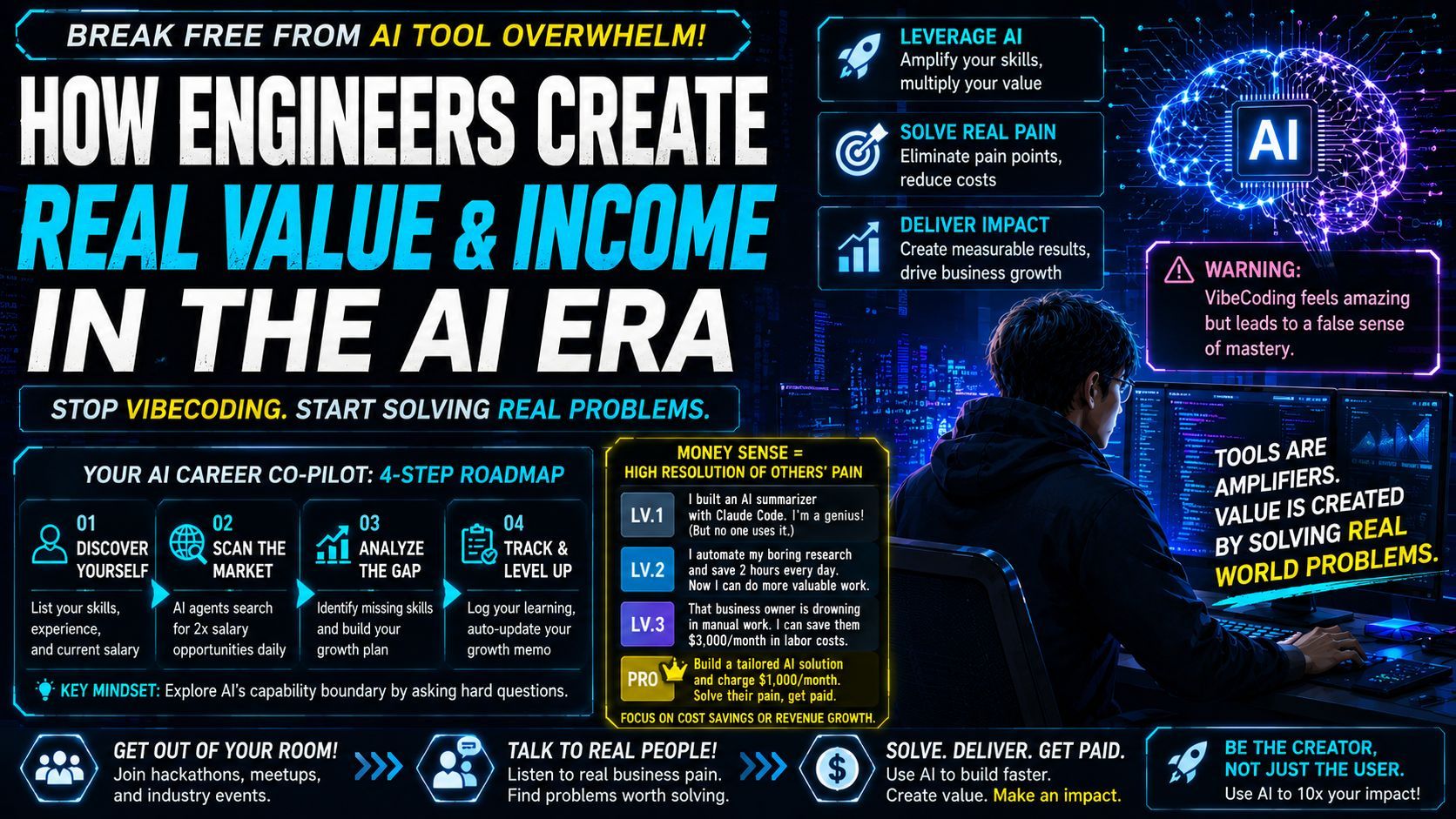
【The Framework】Turning AI into Your Career Advisor in 4 Steps
- The Full Exposure: Honestly tell the AI your current skill set and your exact current salary.
- Scouting the Field (Agentification): Command a web-search-enabled AI: *"Listen up. Every morning at 8:00 AM, scour the web and find job openings that match my current skill set but pay double my current salary."*
- Gap Analysis: Have the AI ruthlessly critique those high-paying listings: *"Where do I fall short? What specific skills do I need to grind to actually lock down this offer?"*
- Automate the Growth Memo: Use AI Tool, Go study the items on that checklist, then report your progress back to the AI. Have the AI write and maintain a "Growth Memo" to track your daily progress toward that milestone.
💡 The Core Insight: Testing the "Capability Boundary" In this loop, you are cross-examining the AI with raw survival questions. Through this intense back-and-forth, you’ll naturally discover where its answers are brilliant and where it’s just hallucinating. Gaining a gut-level feel for this Capability Boundary is what true AI literacy looks like.
2. Management Chronicles: Stop Boxing Talent In—Feed Their Ambition with the Latest AI Tech
This philosophy isn’t just for personal growth. In my own company, when training teams for the new FDE (Frontier Development Engineer) role, I use the exact same logic.
In today's tech ecosystem, managing people with a defensive mindset—like *"If I train them and they get too good, what if they quit?"*—is painfully short-sighted. If you're stingy, you won't attract top-tier talent anyway.
As a manager, my stance has always been: "I will give you the latest, top-tier AI tools, abundant computing resources, and cutting-edge research environments. Sharpen your teeth here until they’re razor-sharp. If you get so good that you want to hop to a bigger stage, that means you have grand ambitions. I'm happy to have contributed a great engineer to society; I won't hold you back."
Only when leaders provide that level of environment and vision will team members proactively think about how to use these new tools to bring maximum value to the company. Why? Because they know every step they take here exponentially jacks up their own market value.
3. Beware the Sweet Trap of "Vibe Coding"
Now, let's look at a slightly harsher reality from a developer's perspective. Recently, the term "Vibe Coding" has taken the tech world by storm.
※ What is Vibe Coding? A phenomenon where a developer doesn’t even look at the low-level code architecture. Instead, they just kick back, feed prompts to an AI, and watch the AI furiously rewrite files in the background to make the system run. It's all about the "Vibe."
Honestly, it feels amazing. It’s a total dopamine rush. You type a single line in Claude Code, watch code spew out, and a working app appears in minutes. It’s incredibly easy to fall into a grand illusion of omnipotence: *"Holy crap, I’m a prodigy programmer!"*
But there is a massive landmine buried here: "Making a program run" and "making that thing profitable" are two completely different universes.
Here is the brutal truth: In the AI era, the value of simply "writing code that runs" is plummeting. Why? Because the thrill of "making a cool app" can now be experienced by literally anyone with an AI and a few spare hours. The omnipotence brought by Vibe Coding is often just a short-lived narcotic.
4. The Survival Metric: From "Look What I Built!" to "Look What I Saved the Boss!"
So, how do you actually make real money through solo development or micro-SaaS in the AI era?
The answer: You must cultivate your "Business Sense." The essence of business sense isn't about how flashy your tech stack is; it’s about how high your resolution is regarding someone else's pain.
Remember one thing: no matter how powerful AI gets, software itself does not automatically generate revenue. Money only changes hands when your software "drastically cuts costs or massively boosts revenue for some business owner." Only then does the trade-off occur, and money enters your pocket.
The Evolution of Business Sense
- Lv.1 (The Normie Mindset):
*"I used Claude Code to build a trendy AI summarizer! I'm so smart!"* (*Reality: Nobody uses it except you.*)
- Lv.2 (Intro to Business: Substituting Yourself):
*"Doing market research manually for two hours every day is miserable. I'll write an automation script with AI to save myself two hours daily. Now I can use those two hours to take on freelance gigs."*
- Lv.3 (The Elite Pro: Substituting the Boss):
*"I know a business owner in a traditional industry whose team still manually enters messy data into Excel every day, working crazy overtime. If I use AI to build a custom data pipeline for them, it will save them $3,000 a month in labor costs. Great. I'll whip this together with AI in 3 days, package it as a SaaS, charge him $300 a month, and he will happily throw his credit card at me."*
Your target audience should never be the cutting-edge geeks in the tech bubble. It should be the real, gritty business fields that haven't tasted the fruits of AI yet, where people are still suffering through legacy processes. Take your AI-fueled, warp-speed development capabilities, drop in via a tactical paradigm shift, and laser-focus on helping them cut costs and increase efficiency.
That is the absolute fastest path to monetization for individuals in the AI era.
Summary: Step Away from the Monitor, Head to Hackathons and the Real World
To anyone drowning in AI anxiety: staring at a Claude chat box alone at home will only narrow your vision further.
Get out there! Go to offline hackathons, tech meetups, or even networking mixers in completely different industries. Go see how other developers are actually turning AI products into cash flow. Listen to what business owners with deep pockets are actually stressed about and what they are willing to pay for.
Find comrades, find real pain points, and then weaponize your AI against them.
Move from being a bystander consumed by tools to an insider creating value with them. Wake up from the illusion of Vibe Coding. In the age of AI, it’s time to chase the money.
If you enjoyed this article, please share, and leave a comment! Facebook Linkedin
What is the "real-world business problem" that is causing you the most pain right now that you'd love to solve with AI? Let's chat in the comments.