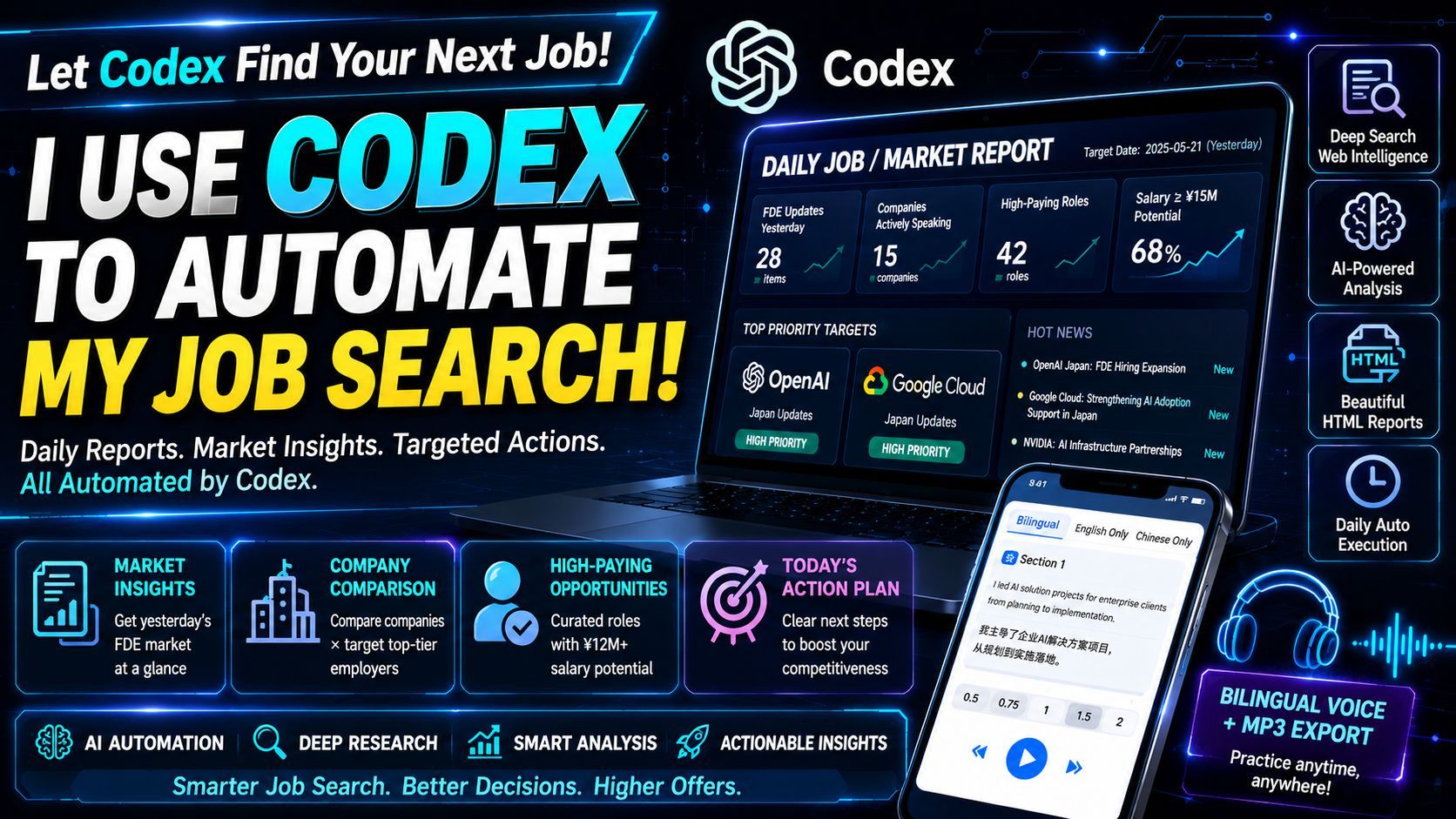
Practice Lecture 1: Generating Daily Job Search & Market Overview Reports with Codex
This article reveals specific methods for advanced task and learning automation using the AI Agent "Codex." It covers everything from automatically generating market research reports for FDEs (Forward Deployed Engineers) and building custom web-based tools for English pitch practice based on your resume, to synthesizing MP3 audio files for on-the-go learning.

Here is the English translation of the blog post, keeping the original enthusiastic tone, clear formatting, and technical layout:
Practice Lecture 1: Generating Daily Job Search & Market Overview Reports with Codex
In my previous post, I shared my perspective on "letting Codex help you find a job." Well, talk is cheap—actions speak louder than words. Today, I'm going to share what I have actually been doing.
1. Using Codex’s "Automation" Feature to Generate Daily Job Search/Market Overview Reports
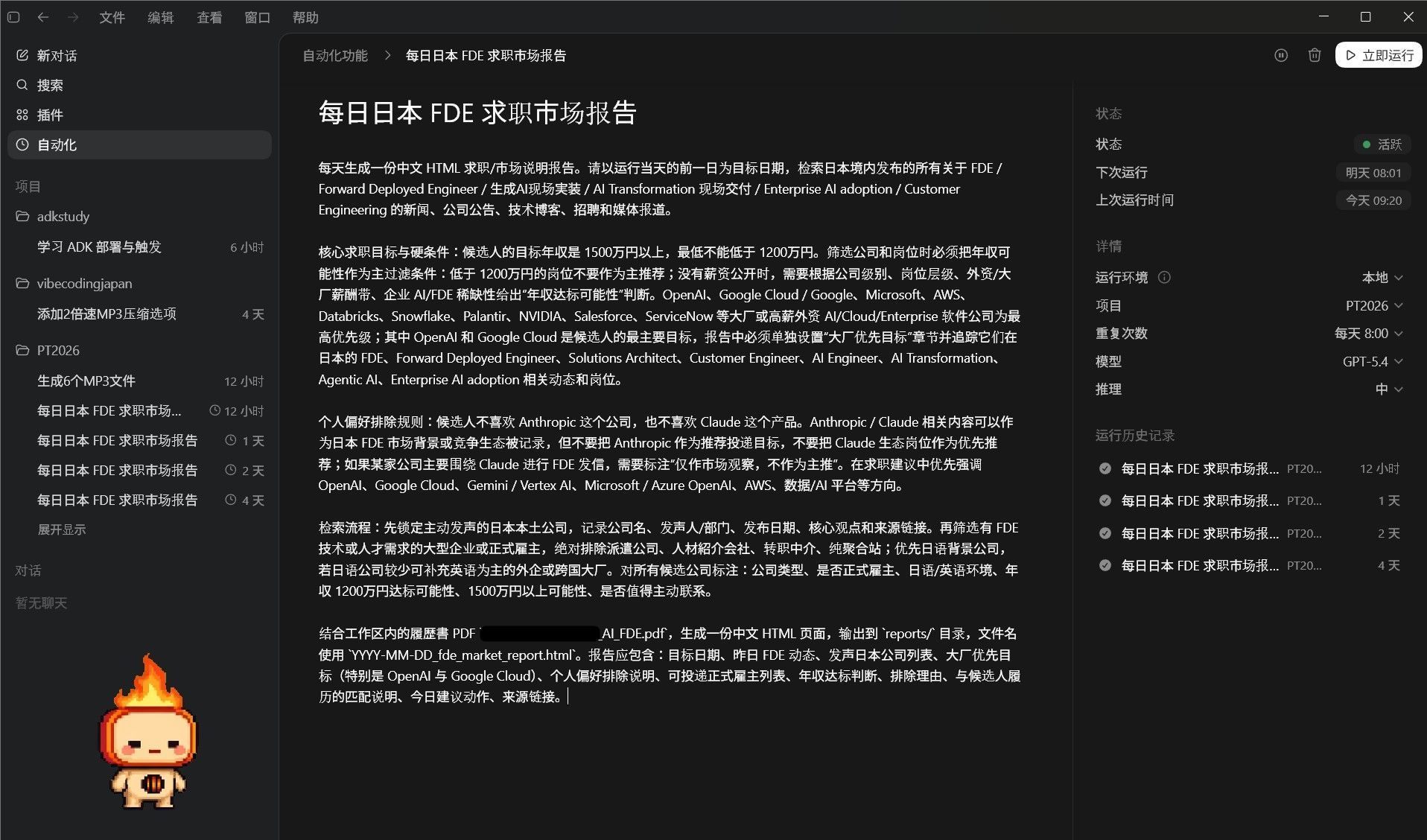
First, just like I introduced before, I use Codex's "Automation" feature. I feed my resume (a PDF file) and the prompt below into Codex, letting it generate content regarding my FDE (Forward Deployed Engineer) job hunt every single day.
Generate a daily Job Search / Market Overview Report in Chinese HTML format. Target the day prior to the execution date. Retrieve all news, company announcements, technical blogs, job postings, and media coverage published in Japan regarding: FDE / Forward Deployed Engineer / Generative AI Field Implementation / AI Transformation Field Delivery / Enterprise AI Adoption / Customer Engineering.

Core Job Search Targets & Hard Criteria: The candidate's target annual salary is 15,000,000 JPY or above, with a hard minimum of 12,000,000 JPY. When screening companies and roles, salary potential must be used as the primary filter: positions below 12,000,000 JPY should not be recommended as primary options. When salary information is not publicly disclosed, estimate the "probability of meeting the salary criteria" based on company tier, role level, foreign-capital/big-tech compensation bands, and the scarcity of corporate AI/FDE talent. Big tech or high-paying foreign AI/Cloud/Enterprise software companies such as OpenAI, Google Cloud / Google, Microsoft, AWS, Databricks, Snowflake, Palantir, NVIDIA, Salesforce, and ServiceNow are the highest priority. Among them, OpenAI and Google Cloud are the candidate's primary targets; the report must include a dedicated "Big Tech Priority Targets" section to track their FDE, Forward Deployed Engineer, Solutions Architect, Customer Engineer, AI Engineer, AI Transformation, Agentic AI, and Enterprise AI adoption-related dynamics and job openings in Japan.

Personal Preference Exclusion Rules: The candidate dislikes the company Anthropic and the product Claude. Content related to Anthropic / Claude can be recorded as market background or competitive ecosystem context for Japan's FDE market, but do not recommend Anthropic as an application target, and do not prioritize roles in the Claude ecosystem. If a company primarily focuses on FDE outreach centered around Claude, mark it as "For market observation only, not recommended." In the job search advice section, prioritize directions like OpenAI, Google Cloud, Gemini / Vertex AI, Microsoft / Azure OpenAI, AWS, and Data/AI platforms.

Retrieval Process: First, target active Japanese domestic companies that are publicly vocal. Record the company name, spokesperson/department, publication date, core insights, and source links. Next, filter for large enterprises or official direct employers that have a demand for FDE technology or talent. Absolutely exclude dispatch agencies, recruitment agencies, headhunters, and pure job aggregators. Prioritize Japanese-language environments; if domestic options are sparse, supplement with English-centric foreign companies or multinational big tech. For all candidate companies, label: company type, whether they are a direct employer, Japanese/English language environment, probability of reaching 12,000,000 JPY, probability of reaching 15,000,000 JPY+, and whether they are worth proactively contacting.

Combine this with the resume PDF `xxxxxx_AI_FDE.pdf` in the workspace to generate a Chinese HTML page. Output it to the `reports/` directory using the filename format `YYYY-MM-DD_fde_market_report.html`. The report should include: target date, yesterday's FDE dynamics, list of vocal Japanese companies, big tech priority targets (especially OpenAI and Google Cloud), personal preference exclusion notes, list of apply-ready direct employers, salary criteria judgments, exclusion reasons, matching alignment with the candidate's resume, suggested actions for today, and source links.
Now, let’s take a look at what Codex actually generated for me.
1. Overview & Execution Conclusion + Yesterday's FDE Dynamics
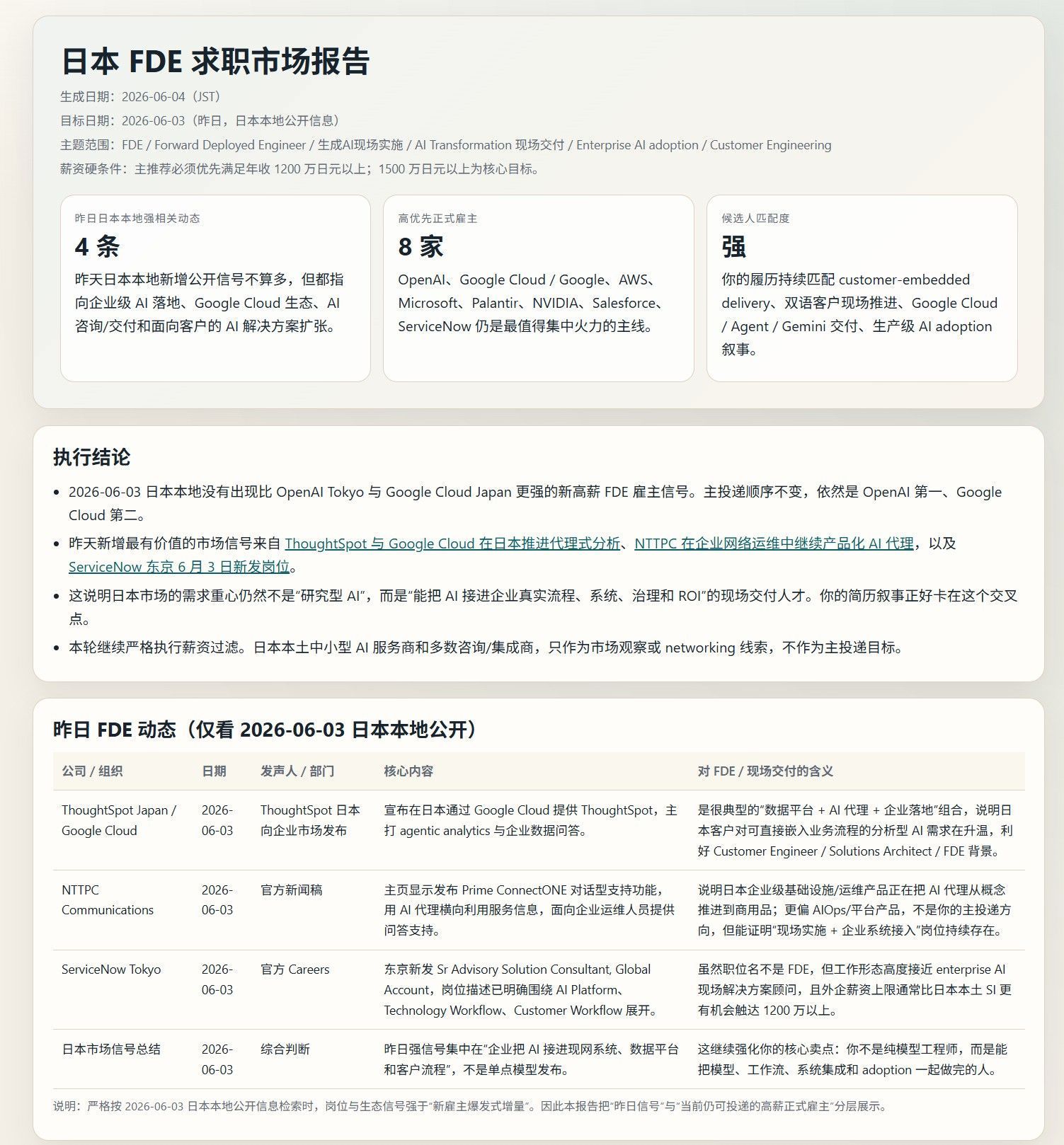
This allows me to quickly grasp market trends. To be honest, I was blown away by this summary. While finding a job is the ultimate goal, understanding *why* society is creating these roles and *which* companies are pushing for them turns out to be incredibly vital. It not only shows me the landscape of the entire Japanese market, but by observing the strategic layouts of major companies, it allows me to analyze and think ahead about my next move.
For example, if Company A makes a move, its rival Company B is bound to react. If that's the case, I might want to wait a bit because Company B's work culture has historically been better than Company A's... Or, if Company C does something, and Company C connects Company D and Company E, and my current target is Company E—then waiting a few days until Company C's philosophy sinks in before pitching to Company E might increase my win rate... and so on. (Wow, I feel like my brain just leveled up!)
2. Vocal Companies List vs. Big Tech Priority Targets
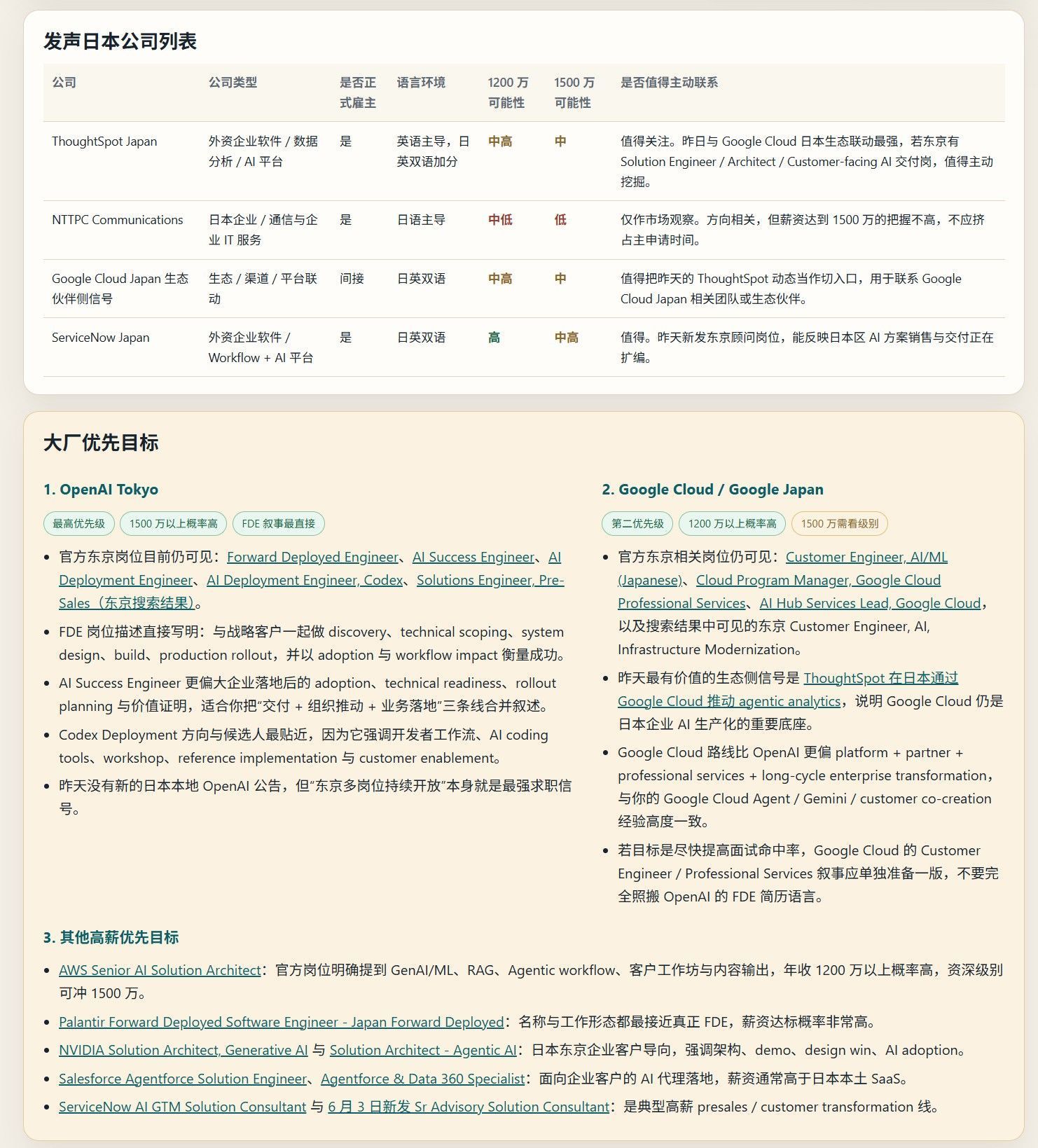
By comparing these two sections, you can faintly guess the upstream and downstream relationships of the entire market. Furthermore, seeing the listed salary ranges allows me to infer how much capital a company is injecting, which in turn reflects how much importance they place on driving this specific initiative (AI/FDE).
3. List of Apply-Ready Direct Employers
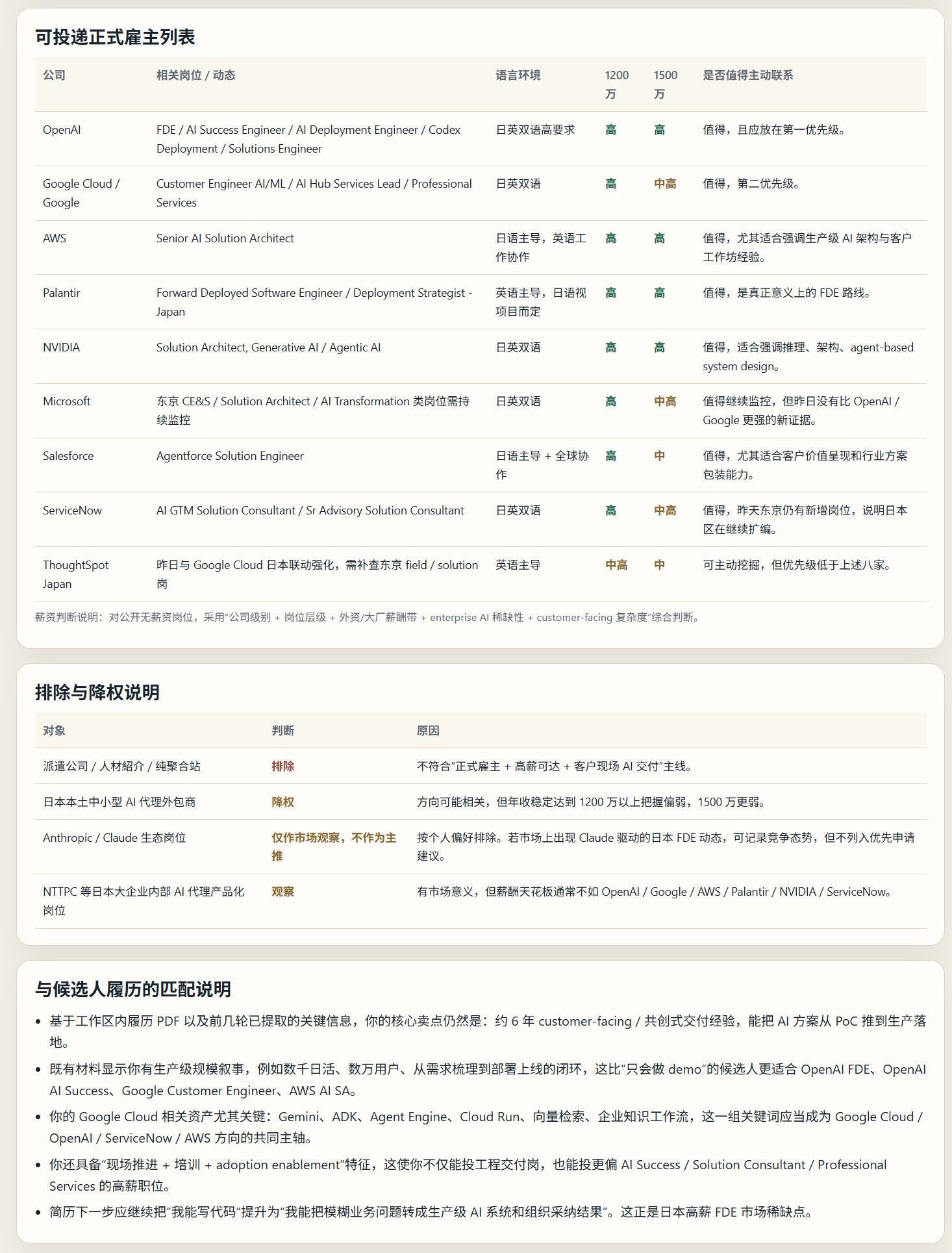
Based on my resume and the latest job openings from major companies, it analyzes whether I've got what it takes. This is amazing and really boosts my confidence.
4. Today's Suggested Actions
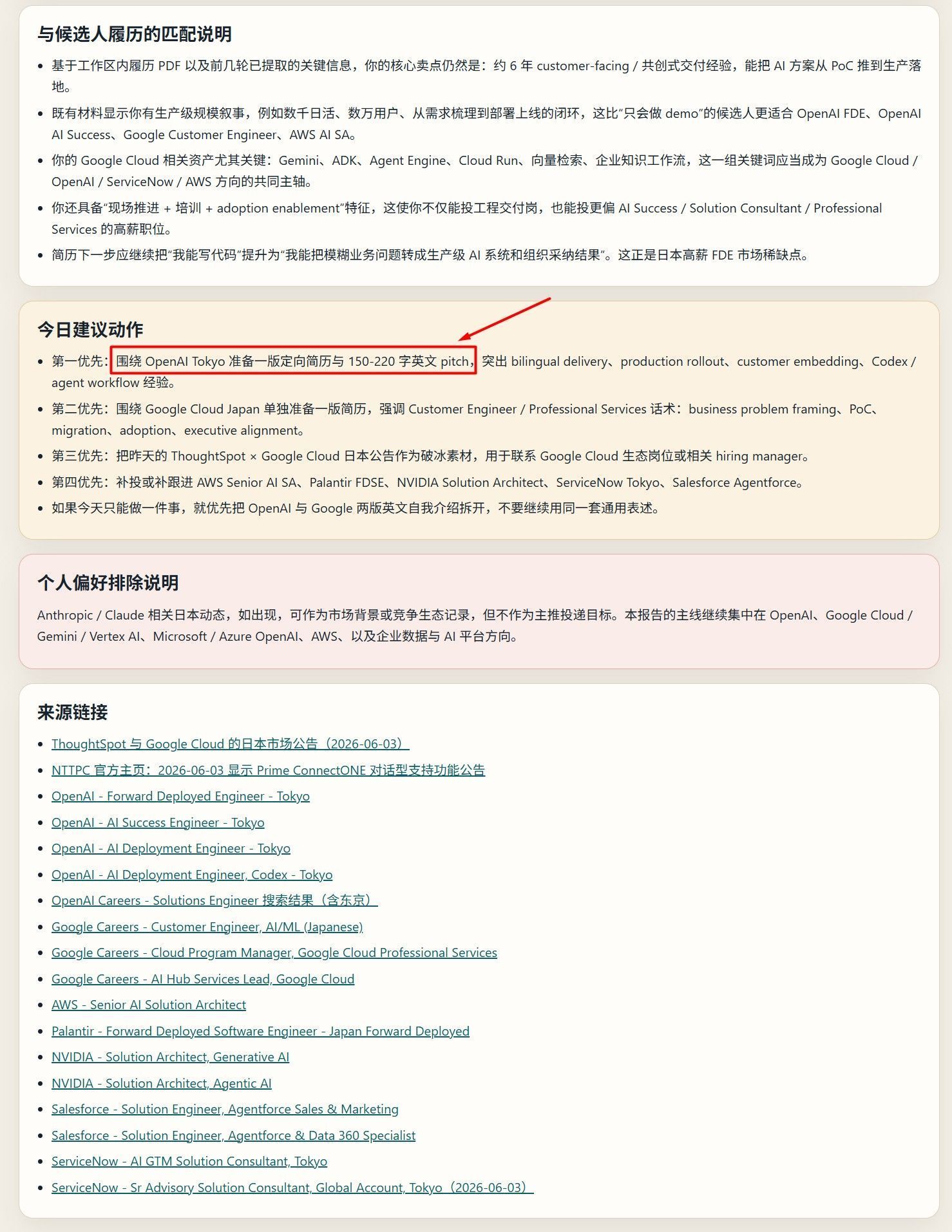
I am incredibly grateful for this section. It directly guides me on what I need to work on and improve.
Summary: What I Have Learned
Y-Axis What AI can do:
- Even if my screen is locked and I'm asleep, as long as the Codex program on my computer isn't closed, the scheduled tasks will automatically run for me without interruption.
- Codex is incredibly good at web scraping—it digs deep and hits with high accuracy.
- Codex can build HTML pages, makes them look great, and automatically names the files based on the date.
- Codex is fantastic at summarizing. It doesn't just casually dump web information into text; it follows a certain methodology to make the synthesized information highly professional.
- Every time Codex runs, it recalls context from previous interactions.
X-Axis What humans can direct:
- Give the AI a topic, and it can perform Deep Research entirely on its own.
- Deliver information to me in a beautifully formatted HTML report.
- Remember my background, remember things I *don't* like, and factor all of that into its research and reporting.
- Ask the AI for advice. Don't just tell it what to do; listen to what it suggests I should do.
2. Next Move: Upgrading Myself Based on the Guidance
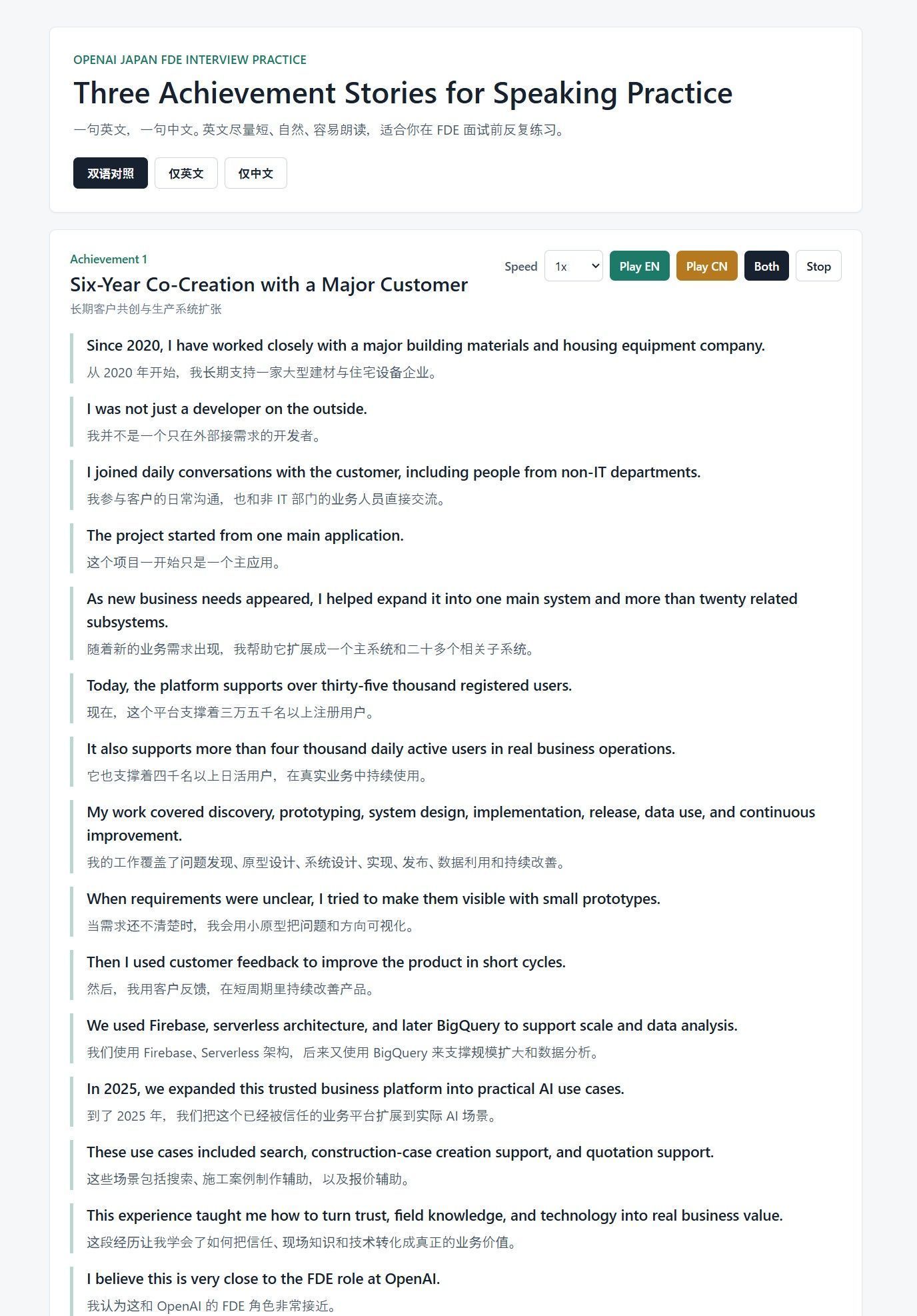
In the *Daily Job Search / Market Overview Report* generated by Codex, it suggested that I prepare an English pitch. But... wait, what?! I don't know how to do that! No worries. Like I said in my last article, if there's something you don't know how to do, just use Codex to build it for you.
So, I used the following prompt to tell Codex to help me write a pitch. The coolest part? I had it create a feature that allows bilingual switching and a text-to-speech readout.
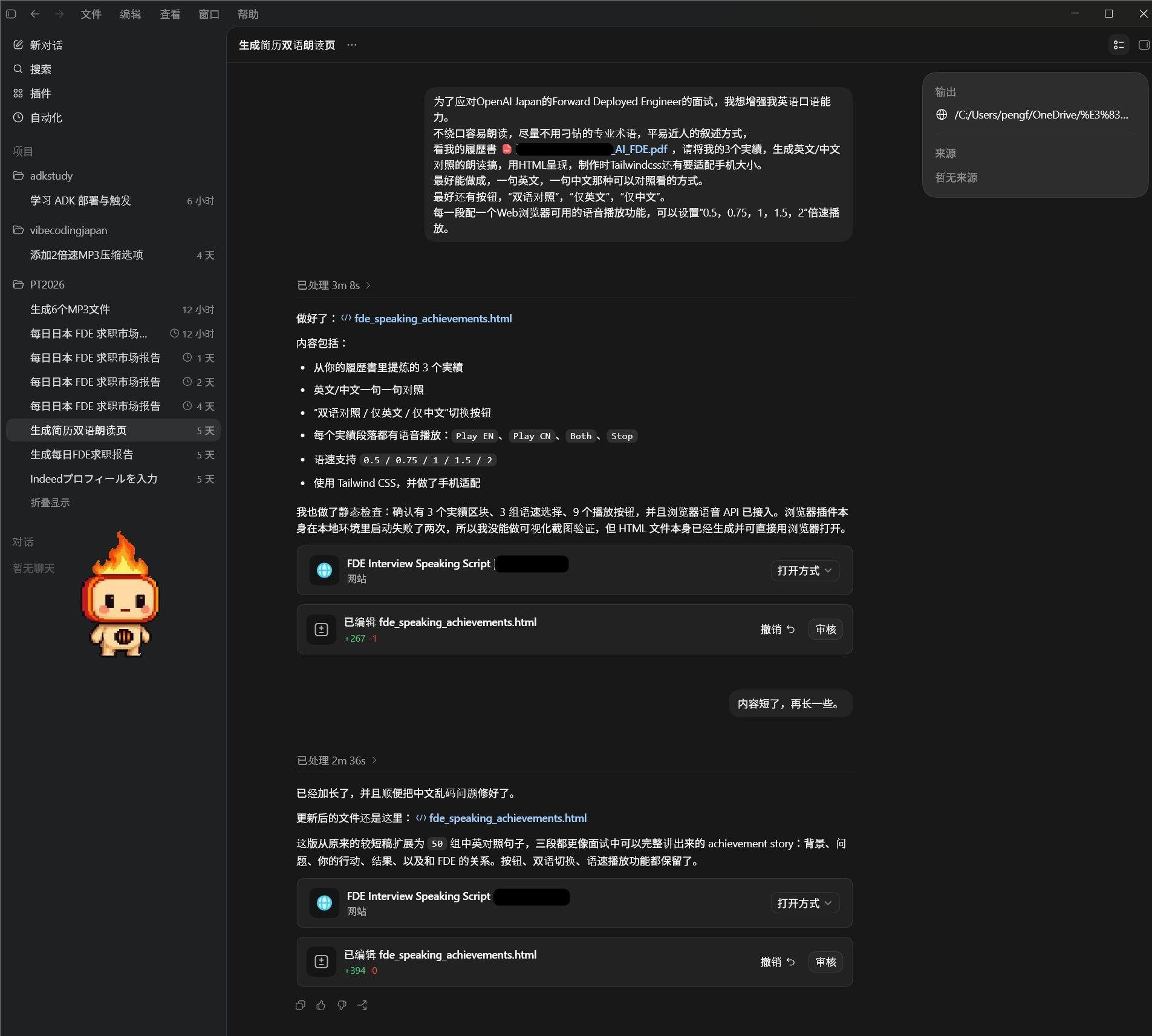
I want to improve my spoken English to prepare for a Forward Deployed Engineer interview at OpenAI Japan.
Keep the phrasing smooth and easy to read aloud, avoid overly obscure technical jargon, and use an approachable narrative style.
Review my resume xxx_AI_FDE.pdf and take my 3 core achievements to generate a bilingual English/Chinese speaking script presented in HTML. Use Tailwind CSS and make it mobile-responsive.
The ideal format is a side-by-side or line-by-line comparison: one sentence in English, one sentence in Chinese.
Include toggle buttons for "Bilingual," "English Only," and "Chinese Only."
For each paragraph, equip a web-browser-compatible audio playback feature with adjustable speeds: "0.5x, 0.75x, 1x, 1.5x, 2x."
To my absolute amazement, Codex actually pulled it off.
Y-Axis What AI can do:
- Not only can it summarize and organize text, but it also handles bilingual translation seamlessly.
- It can build a functional Web-based audio playback interface.
X-Axis What humans can direct:
- Take a single document, have the AI break it down, and rewrite it into multi-language information—all completed in one go.
- The generated webpage can be paired with an audio readout function. Plus, it costs zero money and doesn't consume API tokens because it utilizes the browser's built-in text-to-speech features.
3. Cranking Up the Difficulty: I Want to "Listen" to My English Pitch While Working Out
Sitting in front of a computer using a multi-language readout to practice my English is great, sure. But I wanted to ramp up my learning intensity. For instance, during my early morning cycling sessions or evening workouts at the gym, I wanted to immerse myself and listen to my pitch on the go. So, I boldly threw this instruction at Codex:
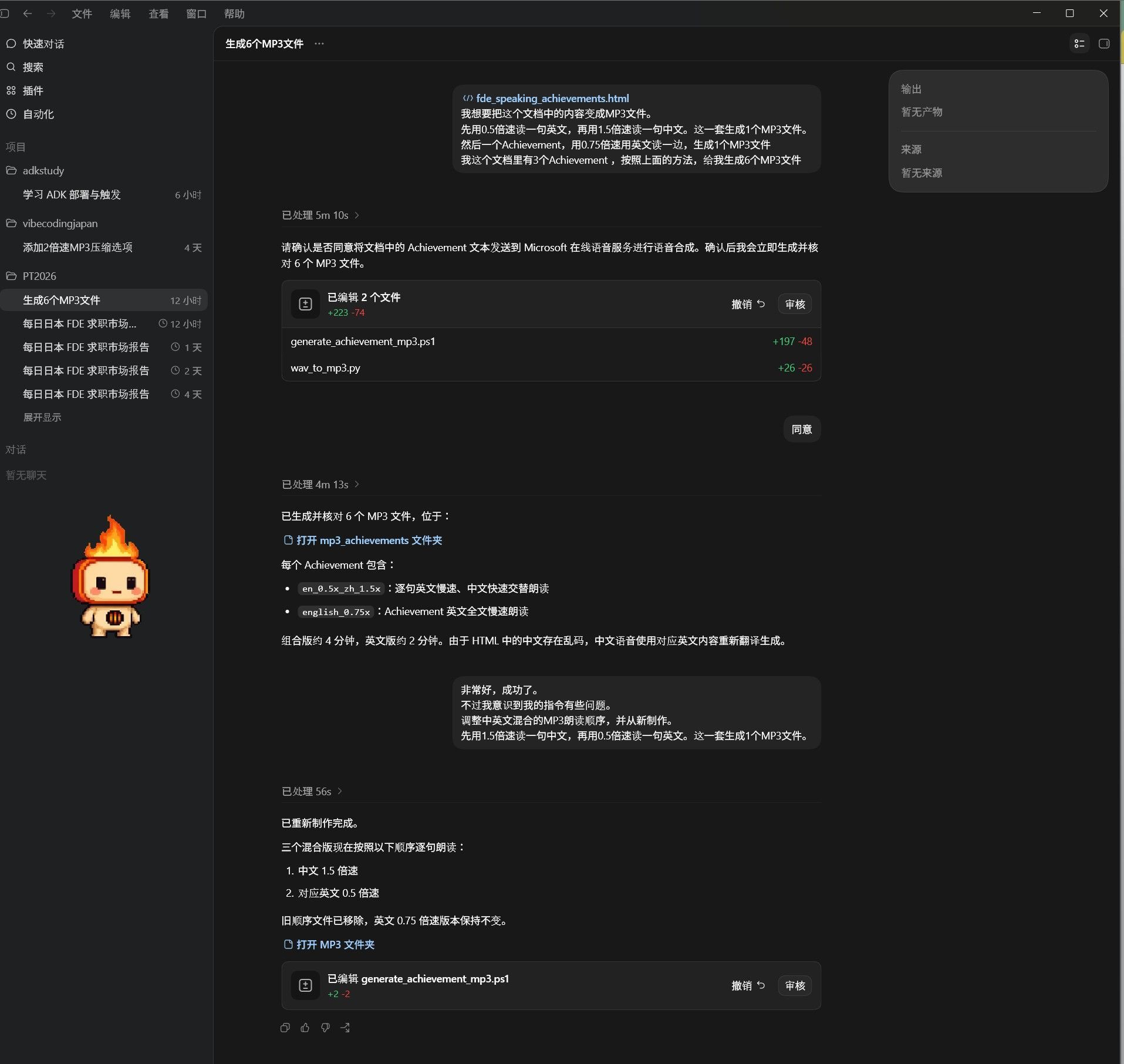
fde_speaking_achievements.html
I want to turn the content of this document into MP3 files.
First, read a Chinese sentence at 1.5x speed, then read the corresponding English sentence at 0.5x speed. This sequence should generate 1 MP3 file.
Next, read an entire Achievement in English at 0.75x speed to generate 1 MP3 file.
There are 3 Achievements in this document, so follow the method above to generate a total of 6 MP3 files for me.
Wow, I couldn't believe it—this actually worked too! Codex is absolutely incredible!!!
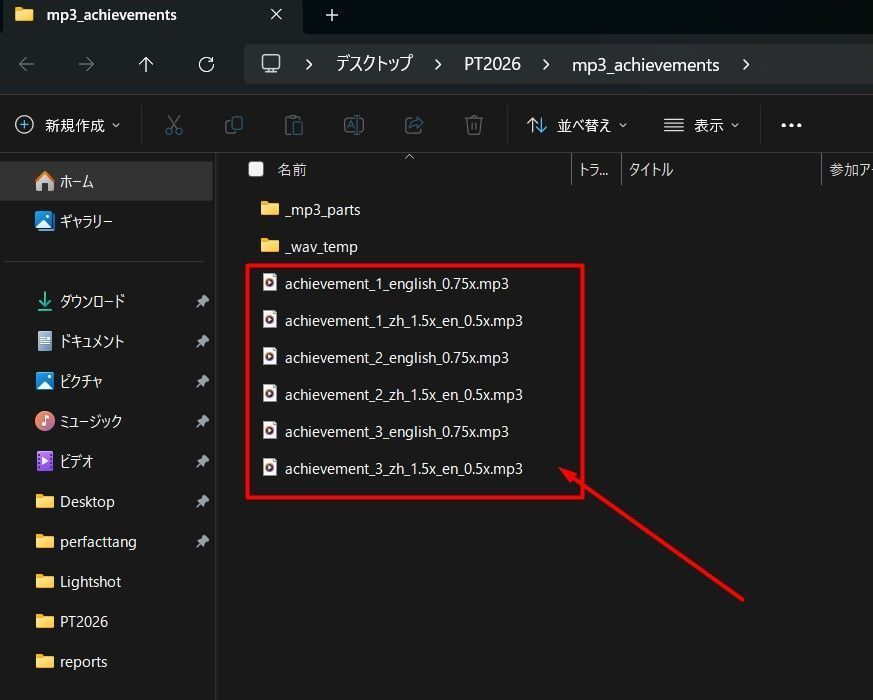
I transferred those 6 MP3 files to my phone, and now I can listen to them wherever I go.
Y-Axis What AI can do:
- It can convert specified text into MP3 files at a specified speech rate.
- It can mix multi-language readouts into a single MP3 file.
- When executing this on Windows, Codex autonomously figured out how to utilize the "Microsoft Online Text-to-Speech Service" for voice synthesis. Shockingly, this is completely free and insanely fast (makes me wonder why I spent so much effort messing around with ComfyUI and TTS models before... *cries in a corner, lol*).
X-Axis What humans can direct:
- Directing text to be converted into audio formats with precise conditions.
Summary
The above is a step-by-step methodology I've built out with Codex over the past two weeks. Through this hands-on application, I've not only solved real-life bottlenecks but also leveled up my skills in controlling AI Agents.
Rest assured, everyone, I won't stop at just this one article. Moving forward, things are going to get even more magical and advanced.
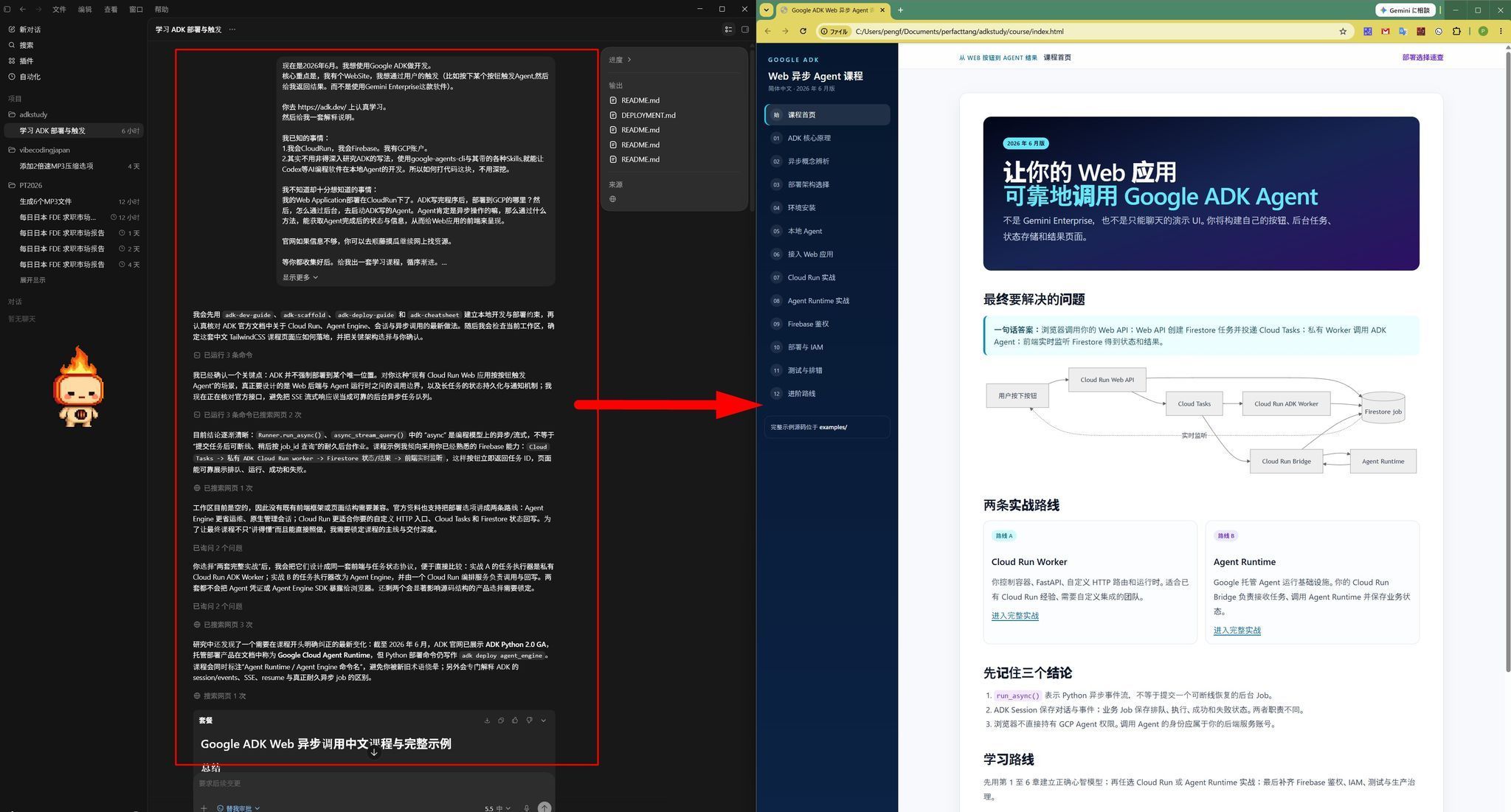
Sneak Peek for the Next Issue: I'm going to have Teacher Codex build me a complete learning website for the Google ADK (Agent Development Kit). As the student, I will personally verify whether the learning blueprint written by Codex is actually viable. ※ *I'll explain how to use features like Skills integration in detail next time. Stay tuned!*