
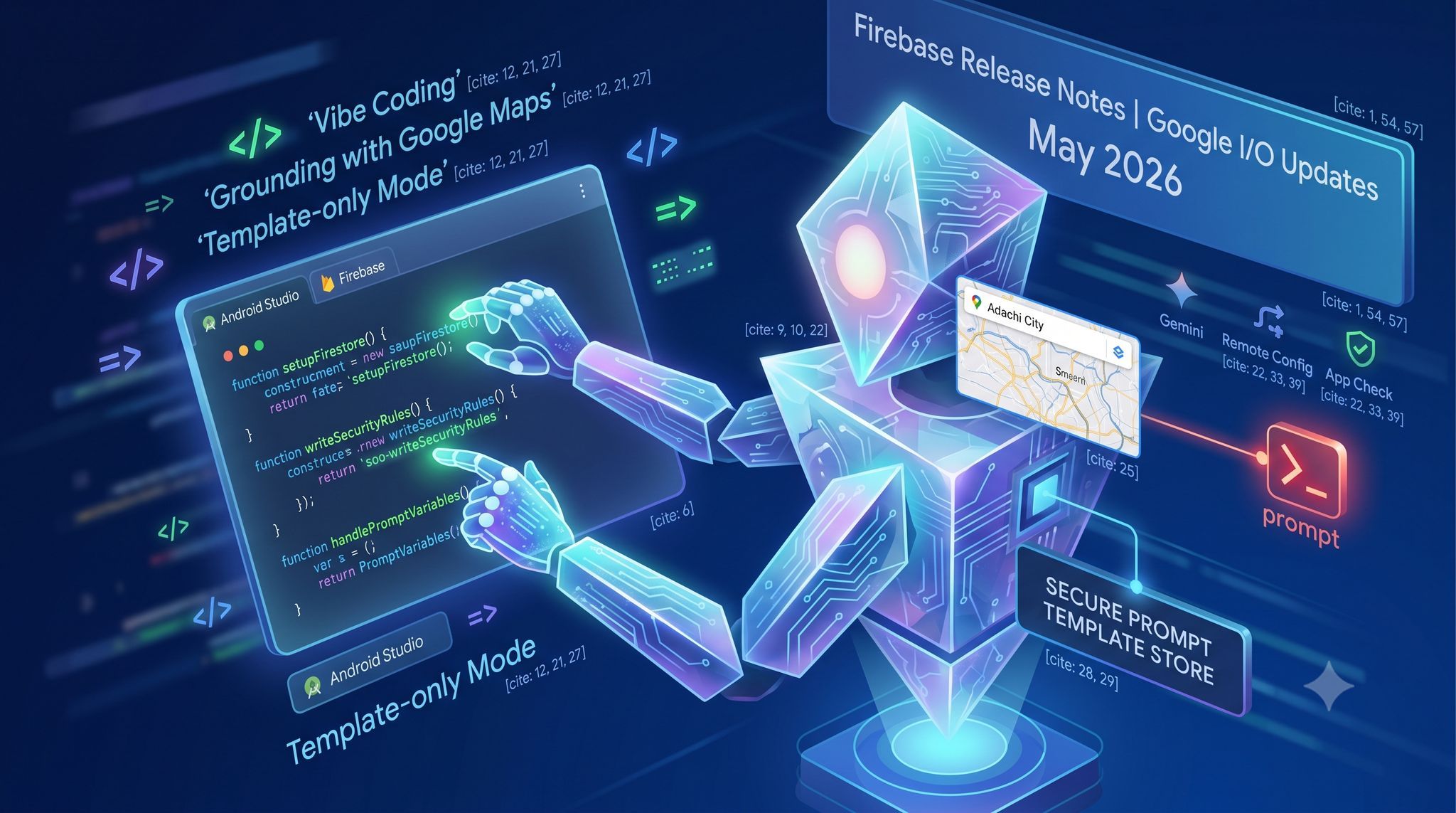
The AI-Native Evolution of Firebase: Unveiling the Future of "Vibe Coding" and Developer Impact at Google I/O
A deep dive into the latest Firebase updates announced at Google I/O from an engineer's perspective. We explore the transformation of the development experience through AI agent integration ("Vibe Coding"), enhanced AI accuracy via Google Maps grounding, and robust prompt protection with Template-Only Mode—uncovering how this next-generation development environment seamlessly bridges the gap between automation and security.

Google I/O has just wrapped up, and this year Firebase has once again delivered a wave of heavy-hitting updates that are bound to get any developer's adrenaline pumping! If you didn't have the time to watch the keynotes, don't sweat it. We are going to break down how Firebase is evolving into an "AI-native development environment," while taking a deep dive into its hardcore security and infrastructure upgrades from a professional engineer's perspective.
1. Towards the Utopia of "Vibe Coding": Deep Integration with AI Agents
The absolute highlight of this release is the extreme integration between Firebase, AI agent platforms, and IDEs. We are moving past the era of just "letting AI write code" and stepping into a reality where AI agents can manage infrastructure setup and security rules out of the box.
One-Click Synergy: Anti-gravity & Android Studio
Firebase is now integrated with Google quantum gravity. On the agentic platform "Anti-gravity," developers can utilize a new onboarding flow featuring a one-click Firebase setup that automatically installs all necessary components. Additionally, Android Studio has leveled up. Android developers can now use a specialized mode to get agent skills for Firebase with absolutely zero extra setup.
- What the Agents Can Do: AI agents can set up Firestore and Firebase Authentication, generate Firestore code, and write security rules completely out of the box.
- Expanding to Mobile: This capability has been expanded to Android, iOS, and Flutter. By giving coding agents highly specialized context, you can integrate Firebase with higher accuracy and lower token usage.
💡 Developer's Insight As long as you have "Agent Skills for Firebase" pre-installed in your local environment, you can export apps built in Google AI Studio directly to Anti-gravity with a single click of the Export button. The source code and relevant Firebase configurations travel with it. Being freed from the tedious "ritual" of initial infrastructure setup is a massive win for developers everywhere.
2. Firebase iLogic Upgrades: Arming AI with "Real-World Context" and "Bulletproof Security"
Firebase iLogic, which allows you to bake AI logic directly into your applications, has received some incredibly practical upgrades. The most eye-catching feature here is Grounding with Google Maps.
Crushing AI Hallucinations with Real-World Map Data
You can now connect a Gemini model to geospatial data from Google Maps to build location-aware features.
- Reduces Hallucinations: Responses are grounded in Google's database of over 250 million real-world places and businesses, making the AI vastly more reliable.
- Live, Dynamic Data: The model can answer questions using real-time information, such as current business hours.
- Builds User Trust: It seamlessly integrates rich visual context like interactive map widgets, photos, and streetview.
Protecting the Backend: "Template-Only Mode"
When exposing AI features to the frontend, a major headache for architects is prompt injection or prompt theft (IP leakage). The newly introduced Template-Only Mode enforces Firebase iLogic to only execute prompts securely stored on the server, completely ignoring arbitrary prompts sent from client apps.
- IP Protection: By pulling your prompts off the device and keeping them secure on the backend, you safeguard your intellectual property.
- Defeating Prompt Injection: The client can only fill in specific variables, allowing you to add extra validation to ensure they match what your prompt expects.
- No-Store Hotfixes: You can update your prompt system instructions and model configurations directly in the Firebase Console without having to push a new app version to the stores.
⚠️ Critical Migration Reminder If you are currently using Imagen models to generate images, take note: you must migrate to the Nano banana models by June 24, 2026, as the Imagen models will be shutting down soon. We highly recommend setting up Remote Config so you can dynamically update and switch to the latest models (like Gemini 3.5 Flash) directly in the Console without publishing a new app version. Additionally, App Check now features replay attack protection via one-time tokens to prevent malicious actors from draining your Gemini API quotas.
3. Infrastructure & Debugging: The Boundary with Google Cloud is Melting Away
Firebase was once viewed as an isolated MBaaS tailored purely for mobile and web frontends. Today, its integration into the broader Google Cloud ecosystem is deeper than ever.
Full-Stack Architecture in a Few Clicks
Following last month's integration with the Application Design Center, Firebase has launched a new Firebase Full-Stack App Essentials Template in Google's application template catalog. This template bundles Firestore (with security rules), Firebase Auth, and Firebase iLogic. With just a few clicks, you can have a fully configured Firebase stack running right alongside your other Google Cloud infrastructure. Furthermore, deploying web apps to Cloud Run is now a one-click affair, and it is completely free of payment registration for your first two Firebase-enabled apps on the Google Cloud Storage tier.
Web Developers Rejoice: Crashlytics for Web is Coming Soon
The highly anticipated Crashlytics for Web is finally on the horizon. Built directly on top of Google Cloud's observability suite, it promises a massive upgrade to web debugging.
- End-to-End Tracing: Once available, you will be able to perform advanced, end-to-end debugging seamlessly between your client and server.
- Early Access: If you want to get your hands on this early, a private preview signup form is currently active.
Summary: How Should Engineers View This Shift?
Looking at the entirety of Firebase's May updates, the underlying philosophy is crystal clear:
"Lock repetitive implementation, boilerplate code, and infrastructure wiring inside the cage of AI and full-stack templates, so that human engineers can spend their valuable energy crafting core user experiences (and refining higher-level prompts)."
From mitigating prompt injection (Template-Only Mode) to preventing API quota abuse via App Check replay protection, Firebase is actively paving over the security potholes that come with real-world AI deployment. This marks the transition of AI development from a "conceptual toy" to an enterprise-ready powerhouse.
Time to open up your IDE, jump into the Firebase Console, and see exactly what these new AI agent skills can do for your workflow!
For full documentation, migration guides, and the Crashlytics private preview form, check out the links listed in the official Firebase blog and release notes description.