
Next-Gen AI Coding with "Cline": Shattering Vendor Lock-In and Liberating Development
This article explores "Cline," an open-source AI coding engine designed to eliminate the vendor lock-in and code review bottlenecks that have emerged alongside the evolution of AI coding. Cline’s defining feature is its ultimate extensibility—independent of any single model, it leverages an SDK that allows developers to seamlessly embed it into CI/CD pipelines and various IDEs. Beyond concrete benefits like slashed task completion times and reduced costs, Cline offers a glimpse into a developer-driven future, showing how "Agent Orchestration" can automate the entire development process to revolutionize the engineering experience.

"The model that was the absolute strongest last week is already outdated this week."
Hey everyone, is the recent pace of generative AI evolution moving so fast it's leaving you breathless? You find an AI tool, think "Wow, this is amazing!", and end up relying heavily on that specific provider. Then, a few months later, a cheaper and smarter model comes out, but you’re locked in and can't switch... This kind of experience has become a total cliché in the AI community.
Today, from a hardcore engineer's perspective, we will look into Cline—an open-source AI coding engine that completely shatters this "AI tool vendor lock-in problem" and radically liberates the development experience—as well as the SDK that powers it.
1. What's the Issue with Existing AI Tools?
By now, having AI write code is becoming the norm. However, engineers on the ground are facing brand-new bottlenecks.
- Review Bottlenecks: Because AI generates code at breakneck speeds, the time spent "writing code" has decreased, but now the time spent "humans reviewing code" has become the new efficiency bottleneck.
- The Limits of "My Personal IDE" Environments: If you rely heavily on powerful AI tools that only function as extensions for specific IDEs (like VS Code), you can't bring those benefits into cloud development environments. As a presenter once put it, "Emacs isn't just pre-installed waiting for you on top of a cloud environment" (laughs). Tools that can only be used locally run the risk of hindering the scalability of the entire team.
2. The Impact of Cline's "Open Choice" Philosophy
An early-stage Silicon Valley startup has developed the perfect solution to these challenges, and it's drawing massive attention: Cline.
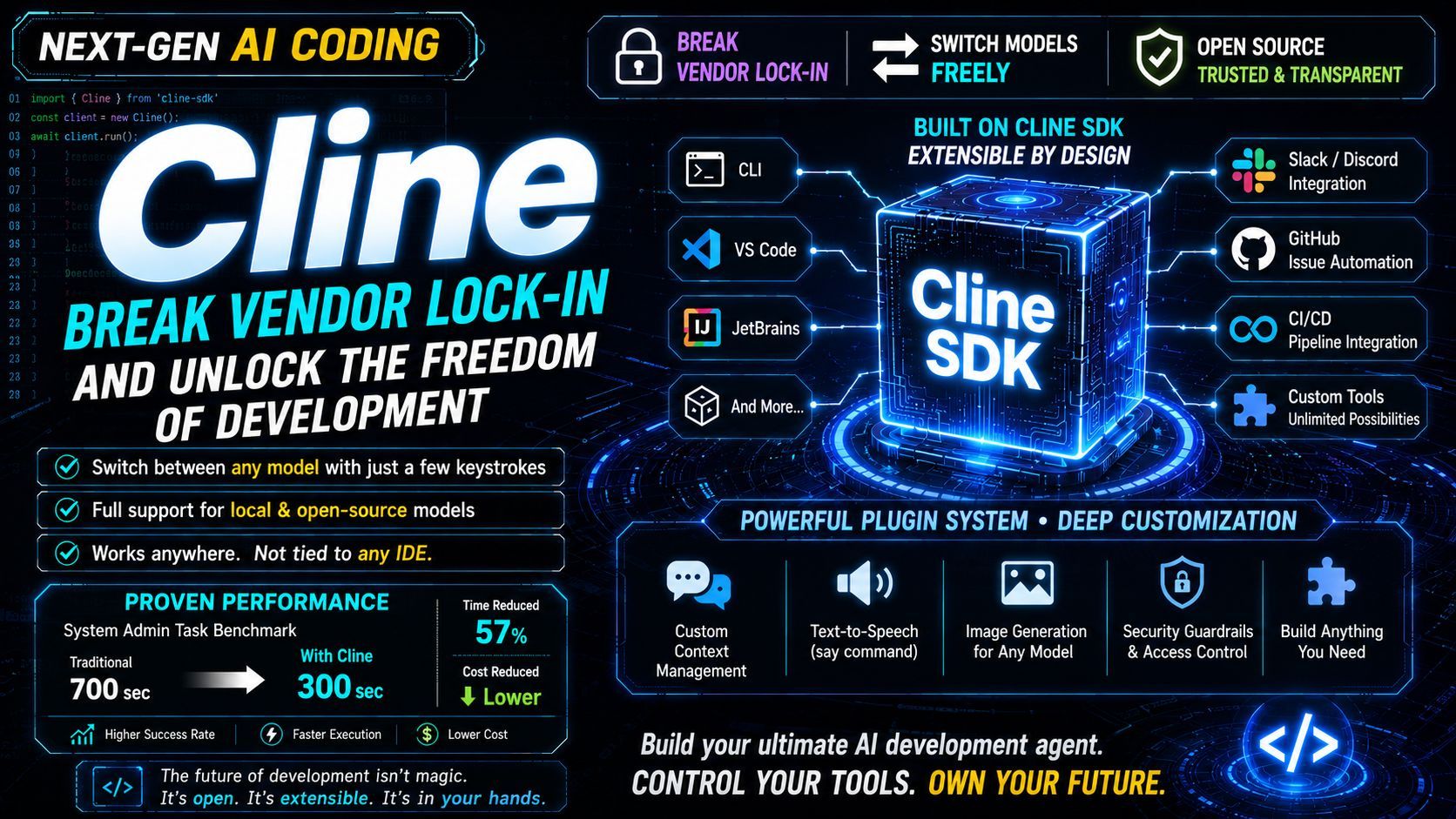
Cline's core philosophy is "Open Source, Open Choice." Instead of being tied down to a specific model or provider, you can switch to your favorite model with just a few keystrokes.
"The best model for a product manager to write specifications is different from the best model for a system administrator to execute tasks. That's exactly why being locked into a single model is a huge risk."
Furthermore, for environments with strict confidentiality requirements where cloud APIs cannot be used, Cline fully supports running open models on local infrastructure.
3. The Real Hype: The Ultimate Extensibility of the "Cline SDK"
The reason Cline doesn't just stop at being a "handy IDE extension" lies in the Cline SDK running under the hood. All surfaces—whether CLI, VS Code, or JetBrains—are built on top of this SDK.
What makes this so insane is that you can seamlessly bake AI agents right into your entire development process, like your CI/CD pipelines. Plus, you can easily install it via npm in seconds.
Next-Level Plugin Extensibility
Many tools claim to be "extensible," but Cline allows customization right from the foundational layer. You can achieve deep extensions that can't be handled by the MCP (Model Context Protocol) alone:
- Custom Context Management: When you hit the token limit of an AI model, you can overwrite the "conversation compression algorithm" with your own logic (for example, deleting only specific messages).
- An AI that actually speaks: One absolute mad lad built a plugin that fires off the Mac
saycommand to make the computer speak out loud in sync with the AI's output. - Image Generation on Unsupported Models: For models that don't natively support image generation, you can add tools that call external components to generate images for you.
- Security Audit Wrapper: You can overlay a custom security filter that hooks into accesses to specific files or secrets, automatically blocking them or logging the activity.
4. A Pro's Perspective: Benefits and "Hurdles to Clear"
[The Upside: Overwhelming Performance and Flexibility] Cline extends the possibilities of AI infinitely beyond the IDE, integrating with Slack and Discord, and automatically handling GitHub issues. Furthermore, in system administration task benchmarks, tuning for faster speeds and better tool-calling reliability slashed task completion times in half—from 700 seconds down to 300 seconds—delivering incredible performance while cutting costs.
[The Downside & Caveats: A True Test of Architecture Design Skills] Because the degree of freedom is so high, setting up complex workflows heavily relies on the designer's technical taste and skill. For instance, you can absolutely build a sophisticated multi-agent configuration, assigning different prompts and models for "planning," "coding," and "reviewing" to run agents in parallel. However, this requires "Agent Orchestration" skills that go way beyond simple prompt engineering.
5. Conclusion: The Future of Dev Experience Isn't "Magic"—It's "Continuous Technology"
The future of AI coding isn't sci-fi magic where a single omnipotent AI handles everything automatically.
It's about leveraging massive amounts of development data to improve model performance, picking the absolute best model for the job, and extending the tools with your own hands to automate the entire process. This is a gritty, boots-on-the-ground, yet incredibly thrilling future of continuous technology.
Refusing to adopt agents just because you're "worried about the quality of code written by AI" is completely missing the point. Rather, building the mechanism to embed AI into the entire process and scale it is exactly where tomorrow's engineers will show their real worth.
If you're hesitant to introduce AI because you're afraid of vendor lock-in, try Cline first and experience its overwhelming freedom for yourself. The next thing you find yourself coding might not be the app itself, but your very own, ultra-powerful, dedicated development agent.