
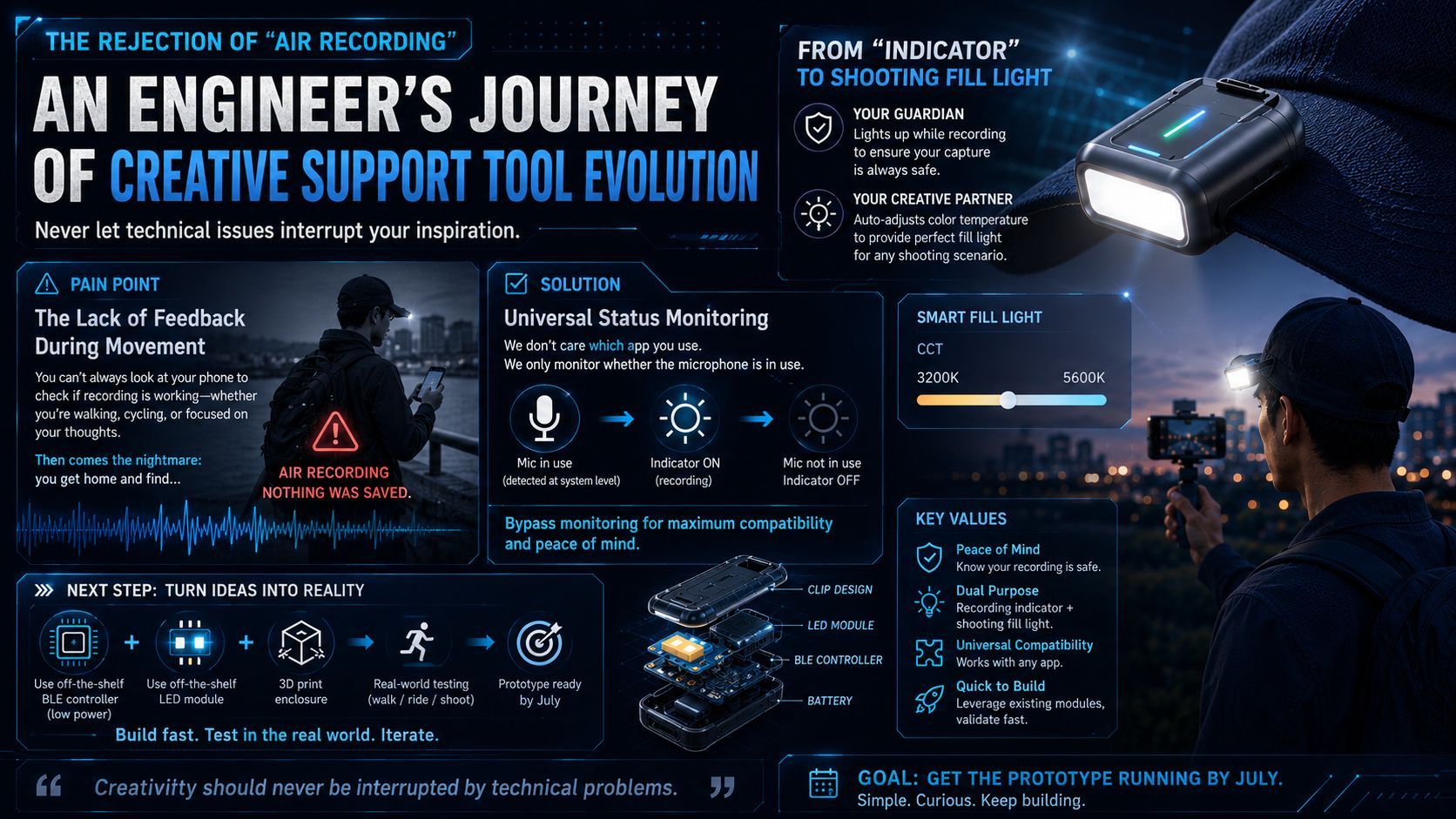
Preventing "Air Recording": A Hardware Project to Visualize Microphone Status
A developer shares a project to solve the frustrating issue of "air recording"—speaking into a phone that isn't actually recording. The solution is a wearable hardware device that monitors system-level microphone status, serving as both an indicator and an auxiliary light. By avoiding custom software and using standard BLE controllers with rapid prototyping, the goal is to create a tool that ensures reliable feedback during creative processes. The prototype phase targets a July completion date.

Rejecting "Air Recording": The Evolution of an Engineer's Creative Assist Tool
As a creator, have you ever experienced a "terrifying moment" like this: inspiration strikes during your morning walk, or thoughts flow while cycling, and you pour your heart out to your phone, believing you've recorded a world-changing idea. Yet, when you get home and open the recording app, you discover—it didn't record.
Maybe the software crashed, or the microphone disconnected. Regardless of the reason, the frustration caused by this "air recording" is something only those who have experienced it can truly understand.
Pain Point: "Lack of Feedback" Restricted by Mobility
In mobile scenarios, we cannot constantly stare at our phone screens to confirm the recording status. This is not only unsafe but also disrupts the rhythm of creation. We need a non-visual dependent confirmation mechanism—a way to intuitively feel that "it is indeed working," even when outdoors, in a pocket, or busy with other tasks.
This is the original intent behind a prototype project I have been conceptualizing recently. Rather than relying on expensive or complex wireless devices, I am more focused on a solution that provides stable status feedback.
Technical Insight: Generality Beats "Reinventing the Wheel"
During this process, I overturned my initial "closed development" idea. I originally planned to develop a dedicated recording app to match my hardware, but upon calm reflection, I realized this not only increases the user's learning curve but also violates the original intent of creative tools: who would be willing to give up their preferred recording app just for a light indicator?
Thus, I turned to a more elegant solution: generic status monitoring.
The design logic of the hardware is reverse control: it shouldn't care about what software you are using; it only needs to care about "whether the microphone is being occupied." If the system level detects that the microphone is active, the indicator light turns on; otherwise, it turns off. This is a "bypass monitoring" approach, which ensures compatibility while completely resolving the anxiety of recording interruptions caused by "wireless device battery death/software crashes."
Evolution from "Indicator Light" to "Fill Light Gadget"
Just like any great prototype (just kidding), the project went through interesting evolutions during the conceptualization phase.
Initially, I only thought about making a small device to clip onto a hat or glasses, purely to serve as a "reminder." But upon further thought, as a blogger, whether shooting vlogs or daily videos, what is often most lacking during filming is not a "prompt," but light.
Since we are building something that can light up, why not turn it into a fill light that aids in filming?
This shift in design philosophy transformed the originally single-purpose "recording status indicator" into:
- Dual Identity: It is a safety guardian during recording (light on means recording) and a fill-light companion during filming (providing ambient light).
- Intelligent Interaction: When the microphone is occupied, it automatically turns on and can even adjust color temperature (e.g., pure white light, warm yellow light) to meet different lighting requirements, truly achieving two goals at once.
Next Step: Rejecting "Armchair Theory"
Now, my desk (or rather, my brain) is filled with various ideas for mounting methods, like whether to fix it to a hat brim or a backpack strap? But these are all "premature optimizations."
The thing engineers fear most is getting stuck in the "PCB circuit board design quagmire" and failing to implement anything. To validate this idea, the strategy for the next steps is very clear:
- Refuse to reinvent the wheel: Directly purchase off-the-shelf BLE (Bluetooth Low Energy) controllers and LED modules.
- Rapid Prototyping: Use 3D printing to create the housing, get the thing built, and take it out to use.
Only by using it in actual walking and cycling scenarios can we discover the real problems hidden behind the code logic. I have set a goal for myself to have the prototype running before July.
Creation should not be interrupted by technical glitches. This is not just a small experiment about hardware; it is an exploration of "how tools can better serve human inspiration." Keep it simple, stay curious, and see you in July.