
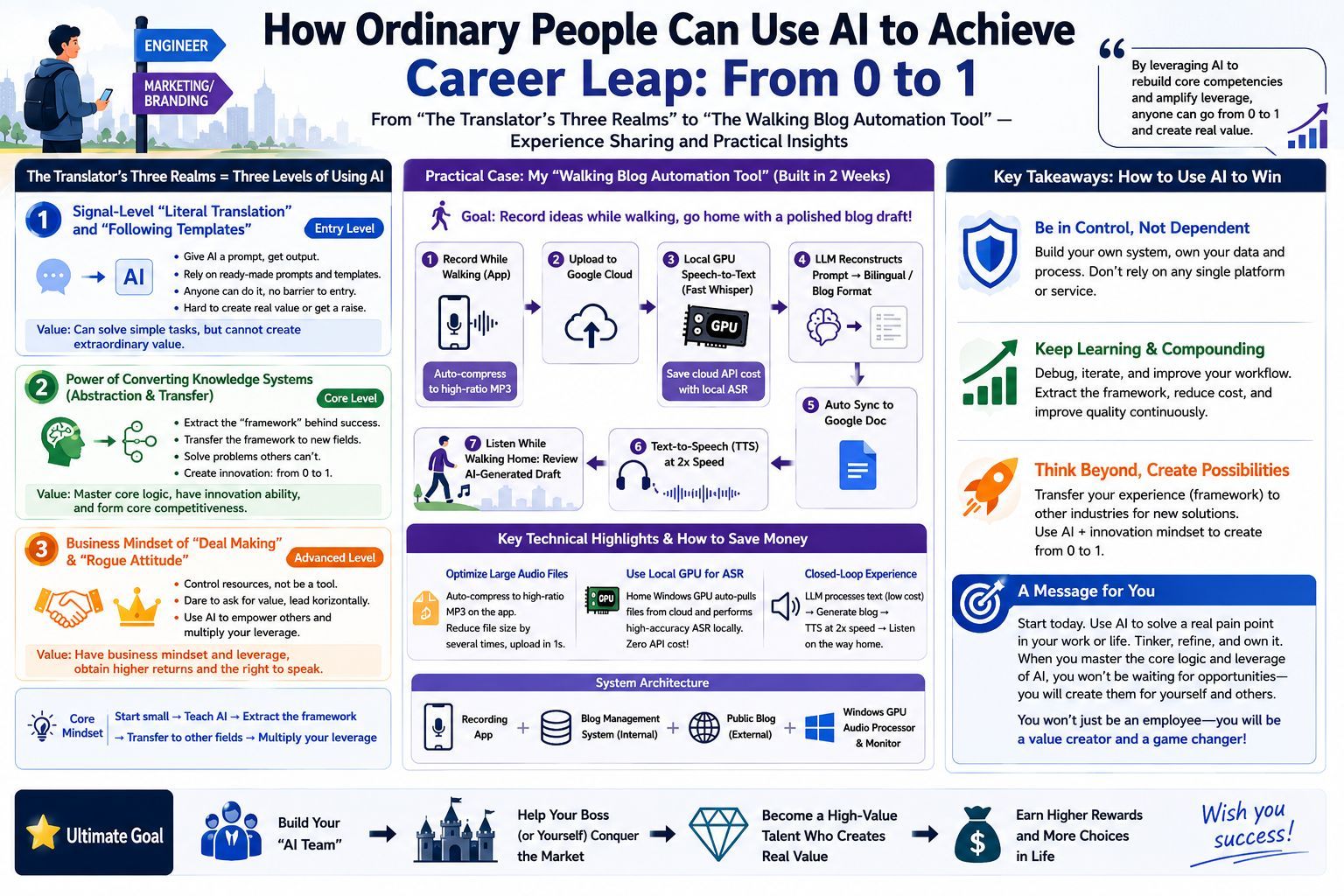
How an Everyday Person Can Leverage AI for a 0-to-1 Career Leap: From the "Three Realms of Translation" to a "Walking Blog Automator"
Addressing a query on pivoting from engineering to marketing, this post explores rebuilding core competitiveness in the AI era. Drawing on an old interpreter's "Three Realms" theory, it emphasizes shifting from literal prompting to transferring underlying logical frameworks and adopting a strategic business mindset. The author details a practical example: using Vibe Coding and Codex to build a fully automated "voice-to-blog" pipeline in two weeks, demonstrating how to solve real-life pain points with local GPU power.

Recently, a young friend on Xiaohongshu threw a fascinating question my way:
"I’m currently working as an assistant engineer in a certain industry, and the pay isn't great. I want to pivot to a marketing specialist role and handle brand promotion. How can I use existing AI resources to level up, especially when it comes to pulling off a '0-to-1' innovation, and bump up my salary along the way?"
This is an incredibly representative dilemma. Nowadays, everyone is hyping up AI, and new "playbooks" and "god-tier tools" are popping up left and right. Plenty of people binge-watch tutorials, mess around with Vibe Coding for a bit, build a Pomodoro timer or a simple landing page, and then what?
"I built a little alarm clock... but what is it actually good for?" It is completely normal to feel this kind of confusion.
As a veteran who entered the tech industry in 2005 and witnessed several major IT revolutions—shifting from C/S architecture (VB Winform) to B/S architecture (Web dev), surviving the massive layoff of J2ME programmers when the iPhone arrived, transitioning from PHP/Java to Cloud Native and Serverless, and now dealing with AI—I’ve figured out a thing or two about navigating tech disruptions.
Today, I’m not going to bore you with the same old prompt engineering tricks you see everywhere. Instead, I want to use the "Three Realms of Translation" passed down to me by my father (a veteran interpreter from the 1990s), combined with a "walking blog automation tool" I cobbled together over the last two weeks using Vibe Coding, to strip away AI's superficial layers and show you how to use it to rebuild your core competitiveness.
Part 1. The Old Interpreter’s "Three-Layer Theory": Which Layer Are You on in the AI Era?
To give you some context, my father was a English interpreter who eventually became the Deputy Secretary-General of the Translators Association of China. Back in the '90s, when I was in the third grade, he used to take me with him to conferences across the country. On those slow, green-skinned trains, when he had nothing better to do, he would explain his self-styled "Three Realms of Professional Interpretation."
Looking back, these three realms align so flawlessly with how we understand and apply AI today that it feels like a divine coincidence.
The First Layer: Signal-Level "Literal Translation" and "Rote Routines"
The 1st Realm of an Interpreter: Upon hearing the sound waves of a language, the brain doesn’t go through a sluggish process of "checking the dictionary, dissecting grammar, and reconstructing literal meaning." Instead, it directly captures the speaker's intent and outputs it into the other language system within a fraction of a second.
If you are learning a foreign language and your brain is still stuck doing 1:1 word matching between Chinese and English, you will completely freeze the moment you encounter ancient idioms or local slang.
Mapping this to the AI Era:
This is your baseline AI user. You throw a prompt at AI, and the AI spits out a result. You follow an online tutorial to have AI write a piece of copy or deploy a pre-coded Pomodoro page.
You feel like you "know how to use AI." But I'm sorry to break it to you: this layer is just entry-level. If you can generate it with one click, anyone else can too. This kind of basic, zero-barrier operation brings no real added value, let alone a higher salary.
The Second Layer: Knowledge System Transferability Abstraction & Transfer
The 2nd Realm of an Interpreter: The world is filled with specialized fields—medicine, law, finance, heavy industrial machinery. No matter how smart interpreters are, it’s impossible for them to take college-level courses in all these disciplines. So how do they manage to sit in the simultaneous interpretation booths at the United Nations?
The answer is Knowledge System Transferability.
Looked at cross-sectionally, while the specific knowledge points of different industries vary wildly, the underlying logical "skeletons" are identical.
The causal, analytical logic used to argue "pathology and clinical manifestations" in medicine might be the exact same logic used to argue "legal clauses and judicial precedents" in law.
Great interpreters don’t memorize scattered "meat" (industry vocabulary) in their heads; they memorize the "skeletons" (frameworks of thought). When they encounter a specific logical flow, they instantly apply the skeleton and flesh it out with the specialized terminology (the meat) they just looked up or heard on the spot. The listener understands them instantly.
Mapping this to the AI Era:
This is your true entry point for "0 to 1."
The real skill lies in this: Take an area you are deeply familiar with (like your original engineering field), train an AI to accomplish a task, and meticulously observe exactly how the AI successfully handles that process.
- When it succeeds, extract that successful "cognitive experience" (the skeleton).
- Then, take that framework and cross over to apply it to a field you aren't familiar with (like the marketing, branding, or copywriting roles you want to pivot into).
When you use this strategy to solve problems in a new domain that others are stuck on, innovation (0 to 1) is born naturally.
💡 A Quick Tech Tool Interlude:
Many people ask me which AI tool is best to use. Right now, Trae (for the domestic Chinese market) and Codex (for global use) are fantastic options to practice with. The Trae team in China, in particular, is incredibly sincere, and their control logic is top-tier (though the overseas version is currently a bit pricey, T_T). Don't be afraid of AI making mistakes; it is precisely through the process of "tweaking, bug-fixing, and training the AI" that you truly absorb its underlying way of thinking.
The Third Layer: The "Broker" Business Mindset and the "Ruthless Attitude"
The 3rd Realm of an Interpreter: In Northeastern Chinese slang, this is called *duifangzi* (resource matching, brokering deals).
After the economic opening in the 1990s, many in my father’s generation dived into business and took up foreign trade. Back then, many factory bosses would take my father abroad to negotiate deals. Thanks to his exceptional language skills and social savvy, he was a master at the dinner table and secured countless massive contracts from Europe and America for those factories.
Regrettably, however, many pure tech-oriented or translation-only professionals ended up getting the short end of the stick—because they were "too decent, too straight-laced" (they weren't ruthless enough). They worked tirelessly to close massive deals on the promise of equity, only for the boss to toss them a few thousand bucks as a "translation fee" and send them packing while the boss grew the empire.
Mapping this to the AI Era:
If you want to change your destiny, relying purely on "being great at tech" won't cut it.
If you study AI for ages just to show up at work acting like, "I can do anything, boss, please bring me along," the boss will indeed bring you along for everything. But that will also become your glass ceiling—you are still just being relentlessly exploited.
You must shift your mindset:
- Don't be the tool; be the person who controls the resources.
- Establish a "ruthless attitude": dare to demand money, and dare to take horizontal leadership.
- Get others to work for you (or your system), and use AI to empower those workers, multiplying your leverage exponentially.
Money is paid to "the person who can get things done and monetize," not to the "AI prompt technique" itself.
Part 2. Case Study: How I Spent Two Weeks Vibe Coding a "Walking Blog Automator"
We all understand the theory, but how do you actually Start?
My advice: Start with a pain point in your daily life, no matter how small or seemingly insignificant.
1. The Pain Point: The Conflict Between a Fitness Coach and Writing Habits
Recently, I wanted to take better care of my health, so I hit the gym. My coach told me: "You have to do cardio first thing in the morning. Walking is fine, cycling is fine."
But I usually write articles and code, meaning I sit all day long. My health metrics were an absolute mess.
I thought: Since I have to walk for an hour every morning, can I brainstorm my articles or even draft them *while* walking?
Every phone has a recording app; I could just talk into my phone during my walk. However, the traditional workflow was excruciatingly painful:
- Record audio using sports earbuds while walking.
- Go home and drag a several-hundred-megabyte audio file from my phone to my PC.
- Drop the audio file into NotebookLM.
- Write a mountain of prompts to filter out small talk and extract an outline.
- By the time I finished polishing it, I realized I had been sitting at my desk for two hours anyway.
This whole ordeal wasn't just annoying because I was sticky from working out and couldn't drink my protein shake right away; those two hours of tedious micro-operations completely ground down my "creative passion."
2. Iterating My AI Automation Pipeline
"Since I know how to use AI, why don't I write the perfect voice-to-writing system of my dreams myself?"
I didn't achieve it overnight. I spent about two weeks utilizing Codex for some Vibe Coding—constantly tweaking, messing around, and iterating—until I finally built a "three-in-one" super writing closed loop:
[ Record on Phone While Walking (App) ]
       || (Auto-compressed to high-ratio MP3)
       /
[ Google Cloud Server (Listens for upload) ]
       || (Triggers home Windows GPU)
[ Local GPU Audio-to-Text (Fast Whisper) ]  <=== (Saves on cloud API costs!)
       || (LLM Prompt Restructuring: Generates Bilingual / Blog format)
[ Auto-sync to Google Doc ]
       ||
[ 2x Speed Text-to-Speech (TTS) Broadcast ] ===> [ On the walk home, listen to the AI-generated rough draft via earbuds ]
💡 Technical Details & Troubleshooting Guide The Good Stuff:
- The Large File Transfer Problem: If I talk too much, the file gets too big for the AI to analyze easily, and uploading takes forever.
- My Solution: The exact millisecond the app saves the audio, it uses an algorithm to compress it into a high-ratio MP3 while processing it technically during compression. The file size shrinks down to a fraction of its original size instantly, uploading in one second.
- Cost Control for "Stingy" Programmers: Cloud speech-to-text (STT) and LLM APIs charge by the token. Writing ten-thousand-word articles every day would bankrupt me.
- My Solution: I deployed a status listener script on a Windows GPU machine at home. The moment Google Cloud detects a new audio upload, my home computer automatically pulls the audio back locally and runs high-precision audio recognition (ASR) using my local graphics card (at zero cost).
- The Ultimate Closed-Loop Experience (Listening to the Draft):
- After the text is recognized locally, it calls the LLM (which is incredibly cheap because it's only processing text now) to generate a beautifully formatted Markdown blog post based on my exclusive template.
- The coolest part: I built a Text-to-Speech (TTS) feature. Before I even walk through my front door, I get a push notification on my phone. I open my custom app, and it reads the AI-organized blog post back to me at 2x speed!
- During the last 5 minutes of my walk home, I’ve already listened to the whole article through my sports earbuds. I know exactly what sounds good and where the AI went off track. I walk inside, have a sip of my protein shake, do a quick manual polish, and hit publish!
I broke this system down into four sub-systems: a recording control client, an internal blog management system, an external public-facing display blog, and the home Windows GPU audio conversion and monitoring system.
Part 3. Summary: Don't Become "AI Cattle" Waiting to be Harvested
If I had just used Gemini out of the box, thrown my audio in, and let it generate a perfect paragraph, this whole project would have had nothing to do with me. The second that platform hiked its prices or banned my account, I would have become helpless cattle waiting to be harvested.
But through this process of constant "tinkering" and "debugging" (for instance, I'm currently figuring out how to elevate app permissions to push to Google Play because Samsung's folding phones keep killing the recording permission when the screen folds shut), I learned:
- How to design a cross-device, cross-platform automation workflow (Pipeline).
- How to coordinate local compute (GPU) with the cloud to minimize commercialization costs.
- How to capture and abstract the "semantic flow" of AI across different tasks.
Just imagine: now that I’ve successfully built this voice-to-blog automation system, what happens if I take the "cognitive experience (the skeleton)" I just unlocked and combine it with a different industry's "meat"? For example, what if you installed this recording setup in the physical showrooms of an interior design group? The moment a consultation with a visiting client wraps up, an automated renovation plan generated entirely from the recorded conversation is printed out and placed right in front of them... Wow! Haha, let your imagination run wild, everyone!
Let's circle back to the assistant engineer friend from the beginning: You want to pivot to marketing and branding, and you want a high salary. I recommend that starting today, you use AI to solve one actual pain point in your work or life.
Go tinker with it, train it, and make it submit to you through trial and error.
Once you master this playbook of "abstracting the underlying logic and using AI to multiply your leverage," it won't matter what industry you enter—you will possess the ability to go from 0 to 1.
At that point, you won’t be begging a boss to take you along. You'll be marching in with an entire, hyper-efficient "AI army" to help a boss conquer new territory—or to become the boss yourself.
Finally, wishing you—and everyone here—the absolute best of success!