
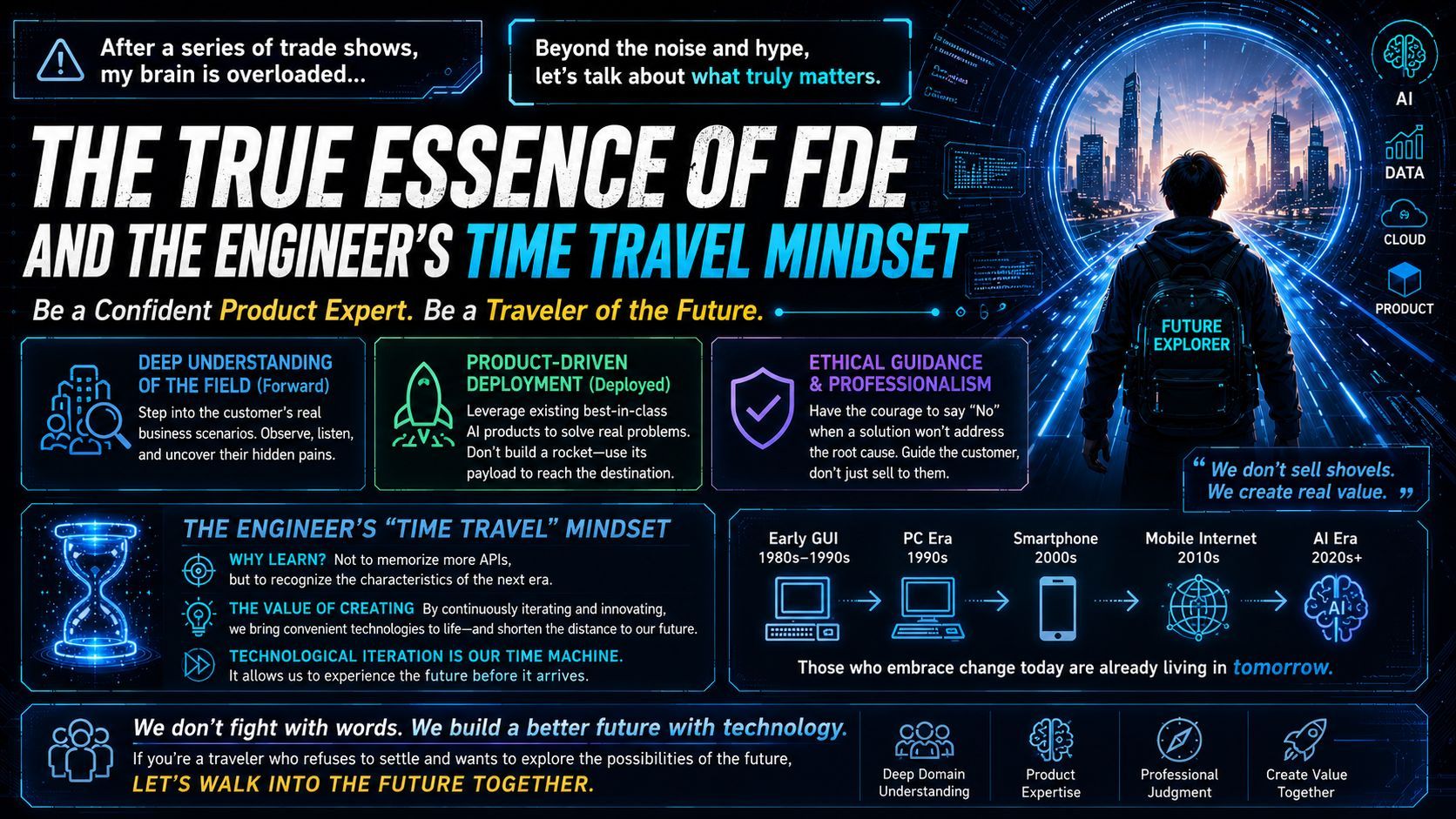
The Essence of FDE Engineering and a Future-Oriented Learning Mindset
Reflecting on the aftermath of recent trade shows, this post redefines the role of a "Forward Deployed Engineer (FDE)". It argues that true FDE is not just fulfilling requests, but deeply understanding client pain points and providing product-driven, expert-led solutions. Furthermore, it explores the concept of continuous learning as a "time machine" that allows engineers to experience the future today. This is an invitation for those who reject the status quo and seek to build the future together.

Having just wrapped up a series of intense exhibitions this week, I find myself in a state of "mental overload." In an industry flooded with gossip, hype, and aggressive debates, everyone seems far more interested in discussing which company is failing or which trend is dying, rather than engaging with genuine technical substance.
However, as a technologist, even amidst the noise, I want to step back from these surface-level issues and reflect on some deeper insights from this week. This is not just about how we work, but about how we choose our stance in this era.
When we talk about "FDE," what are we really talking about?
I have been reflecting on a concept lately: FDE (Forward Deployed Engineer). Many misunderstand this role, believing it simply means "doing whatever the client tells you." In the midst of the AI-driven IT transformation, this "vendor-first" mindset is not only outdated but profoundly irresponsible.
The essence of an FDE is not merely about executing orders. It is about:
- Forward: You must step into the client's real-world business scenarios. Observe what they do every day to uncover the true, hidden pain points that have been masked.
- Product-Driven Deployment: Blindly developing from scratch is often inefficient. The core competence of an FDE lies in using existing, advanced AI products to solve client problems. It is like not having to build a rocket yourself, but knowing how to utilize the rocket's payload capacity to solve a client's "resource extraction and transportation" problem.
- Professional Ethics and Guidance: Even if a client insists on buying a specific product, if your professional analysis shows it cannot solve their core issue, you must be brave enough to say "no." We must guide our clients, not just force sales. If we only sell to make a profit, how are we any different from "selling shovels"? A true FDE should analyze and clarify issues together with the client, delivering value through professional judgment.
Therefore, to be an FDE, you cannot just be an executor; you must be a confident product expert. You must understand your product better than your client, and you must understand their pain points better than they do.
The Engineer's "Time Travel": Why Must We Keep Learning?
Many people ask me, "Why do you push yourself to learn new things? Why not just stay in your current comfort zone?"
This boils down to two different philosophies of life.
One is to enjoy the present. This is the world built by the wisdom of our predecessors—with electricity, roads, and the internet. Choosing this lifestyle is perfectly fine, as it relies on the fruits of those who came before us.
But I prefer the other: being a traveler of the future .
Looking back at the history of IT—from the early GUI and PC eras to smartphones, mobile internet, and now the AI era—those who began experimenting with smartphone applications in 2010 were, in effect, experiencing "life ten years later" at that time. This is much like those who researched automobile prototypes 100 years ago; through technical iteration, they experienced the convenience of modern transportation in advance, spiritually transcending time.
Technical iteration is the "time machine" we equip ourselves with.
- The Meaning of Learning: It is not just about mastering another API, but about identifying the characteristics of the next era.
- Creating Value: When you land convenient technologies through continuous iteration and innovation, you are effectively shortening the distance between yourself and the future.
Conclusion: Walking with the Future
Returning to the topic at hand: Why do I share these ideas? Because in this industry, I am looking for those who are willing to walk toward the future with me.
We do not debate the noise; we focus on how to use deep technical accumulation to accelerate things that make life more convenient. If you are also a "traveler" who refuses to stand still and longs to experience the possibilities of the future within this short life, then I welcome you to join this exploration.