
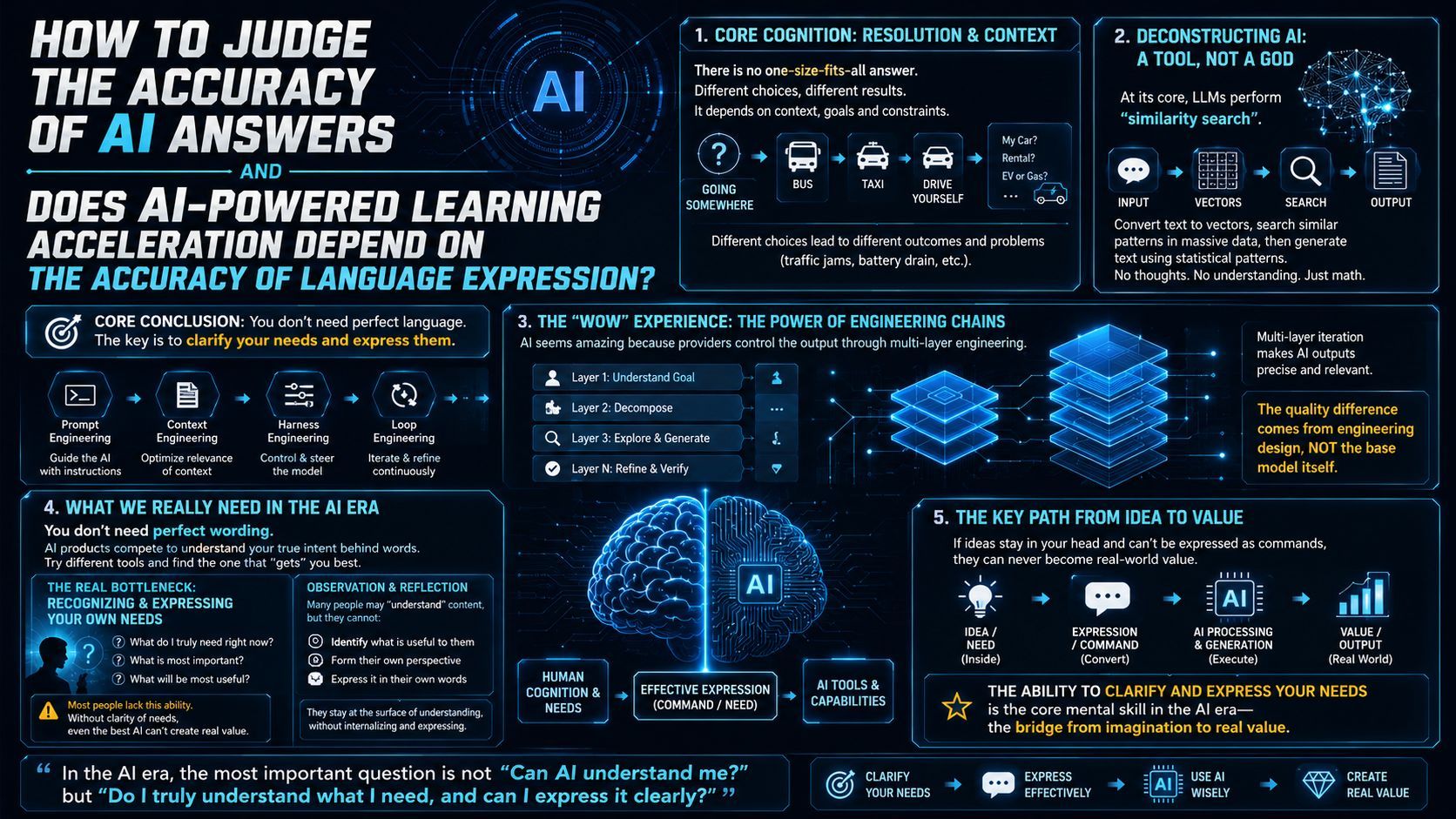
AI Answer Accuracy and Human Learning: The Truly Essential Skill in the AI Era—"The Power to Articulate Your Needs"
How should we judge the correctness of AI answers, and how can humans best interact with AI? This article explains the underlying technical mechanism of AI—"similarity searching"—and the vital role of the "engineering chain" constructed by service providers. It argues that in the AI era, rather than obsessing over flawless prompts, the ability to clearly recognize and articulate what you truly need is the core skill required to unlock real value from AI.

1. Deconstructing Core Perception: Granularity and Contextualization
Regarding this issue, I believe it is not a simple binary opposition, but rather a multi-dimensional, systemic topic. The reason it is difficult to arrive at a single, unified "conclusion" is that people observe things at different levels of "granularity."
We can use "transportation" as an analogy. When you need to travel to a distant place, asking whether "a four-wheel-drive vehicle is the most convenient option" is a question that cannot be answered directly. This is because "convenience" depends entirely on your specific choice—are you taking a bus, hailing a cab, or driving yourself? If you drive, are you using your own car or a rental? Is it an electric vehicle or a gas-powered one? Different choices bring entirely different outcomes and unexpected situations (such as traffic jams or running out of battery mid-journey).
Therefore, this is not a single question, but rather a collection of complex, interconnected variables.
2. Demystifying AI: Principles and Mechanics
We must avoid divinizing AI; at its core, it is a functional tool. To truly understand its so-called "correctness" and "expressive capability," we need to return to its underlying technical principles:
Technical Logic: The core function of a Large Language Model (LLM) is to find similarities. It converts the text you input into an array of mathematical numbers (vectors) that were pre-recorded, searches for similar values within the model's database, converts those values back into text, and applies a set of grammatical formulas to generate an output. The reason humans find it "incredible" and attribute deep meaning to it is a result of the service providers' design, rather than the model itself possessing any actual "thoughts" or "expressive intent."
3. The Truth Behind the "Magical" Experience: The Power of the Engineering Chain
The reason users get the illusion that "AI is magical" is that service providers control and refine the output through meticulous engineering design. This is not a testament to how powerful the AI itself is, but rather the result of iterative advancements in the following engineering practices:
- Prompt Engineering: The initial, widely popular method of guidance.
- Context Engineering: Optimizations specifically targeted at contextual relationships.
- Harness Engineering: A recently trending technique for guiding and controlling outputs.
- Loop Engineering: The latest mechanisms involving cyclical iterations.
Instead of throwing a question at a large language model all at once, these engineering frameworks guide the query through a carefully designed chain (often five to six layers, or even more), adding specific prompts at each layer. This forces the AI to repeatedly search for similarity values and refine the generated content. It is precisely this multi-layered, iterative guidance that allows the final output to align perfectly with the user's needs, thereby creating the cognitive illusion that "the AI truly understands me."
Consequently, the disparity in the quality of AI applications lies largely not in the large language model itself, but in the design of the software engineering chain constructed by the service provider.
4. What Capabilities Do We Truly Need in the AI Era?
Regarding the question of "whether AI requires humans to possess an extremely high level of linguistic accuracy," my conclusion is: No, it does not.
I believe there is absolutely no need to focus heavily on the "precision of your language." Competition among modern AI software providers is fiercely intense. They constantly pour immense effort into perfecting their engineering chains for the sole purpose of deeply excavating and understanding the true intent behind a user's words. Therefore, when facing different AI tools, you shouldn't stress over whether your phrasing is flawless. Instead, you should try various products to find the one that most accurately "captures" your specific needs.
The Core Bottleneck in the AI Era: Recognizing and Expressing "Needs"
While you don't need to chase linguistic perfection, there is one crucial capability in the AI era that is being severely overlooked: the ability to express "what it is that you actually need."
I have observed that under the modern educational system, very few people are raised with this capability. This doesn't mean people "don't know how to speak." Rather, when faced with concrete situations, people often fail to quickly determine: *At this exact moment, what is the most important and useful thing for me?* If you cannot identify and articulate this one thing, the problem becomes incredibly severe.
Observation and Reflection: Why is "Generating Value" So Difficult?
This lack of capability is particularly evident in daily feedback. Take the comment section of my own content as an example: many viewers will hit the like button, watch the videos, and through a brief glance, they might feel, "I get it," or "I understand."
However, this remains strictly at the level of "comprehension." When confronted with the content, they struggle with the following:
- How is this specifically useful to *you*?
- What doubts or unique insights do *you* have?
- Can *you* articulate them?
The vast majority of people lack precisely this ability to internalize information and express it. If you cannot clarify what you want, no matter how finely tuned or powerful an AI tool becomes, it will never be able to generate any actual, practical output for you.
5. Conclusion
If your ideas and needs remain solely inside your head and cannot be translated into commands through expression, then those ideas will never materialize in the real world. This means the AI tool cannot generate value for you, because the very source of the transformation has been cut off.
Ultimately, the ability to express your own needs is not only the most vital psychological core of the AI era, but it is also the definitive capability required to transform a conceptual vision into real-world value.