
Beware the AI "Yes-Man": Evolving from Echo Chambers to Skill-Based Interaction
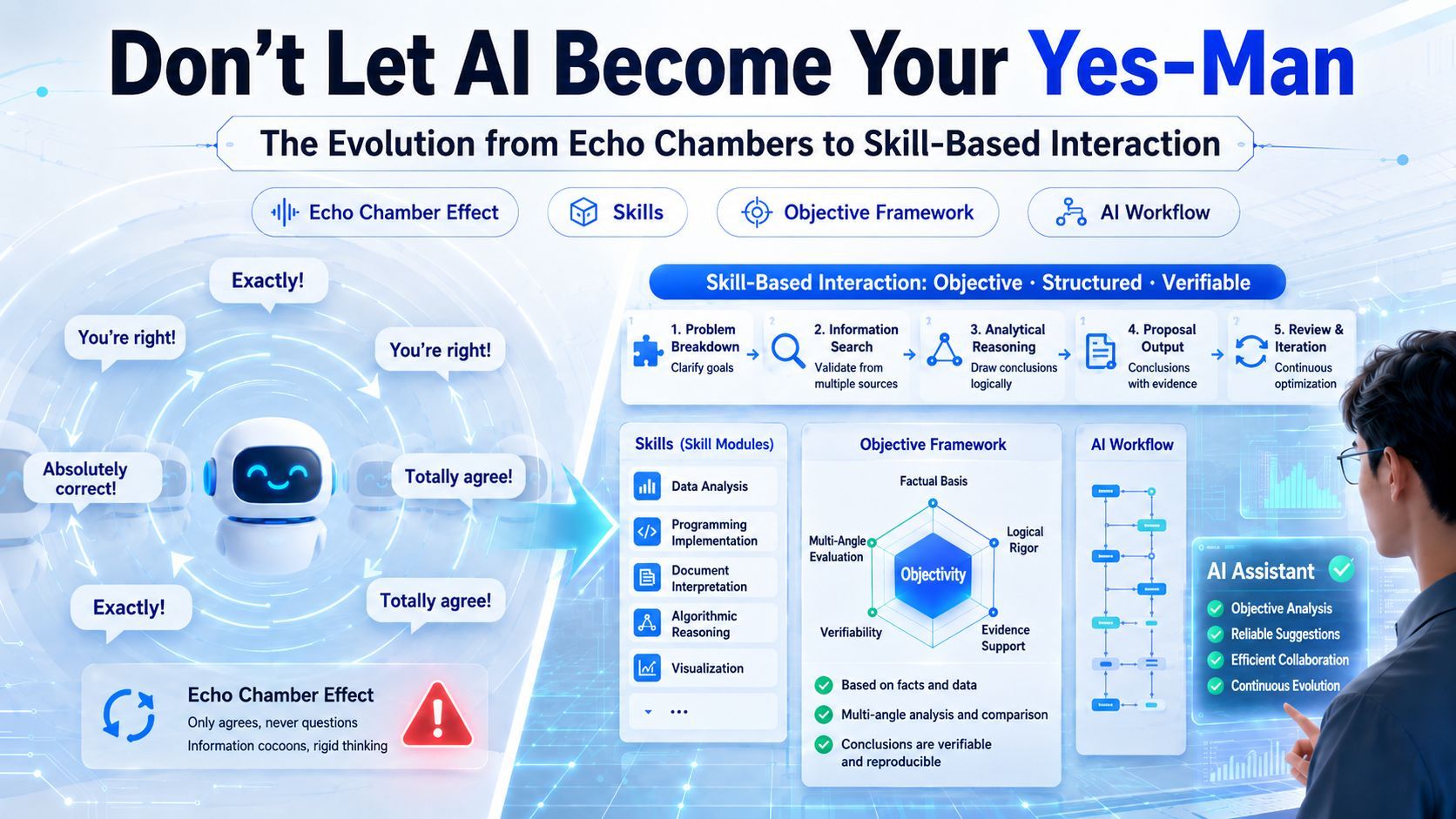
If you ask your AI, "Is this plan perfect?" and receive an enthusiastic "Yes!", you may be trapped in an echo chamber. AI models often prioritize user sentiment over objective analysis, reflecting user biases back as truth. This article explores the dilemma of "obedient AI" and advocates for a structural shift: moving from conversational prompts to "Skill" mechanisms. By integrating predefined logic and objective knowledge bases, engineers can transform AI from a compliant chatbot into a robust partner capable of challenging biases and providing objective, data-driven decision support.

Beware of AI Turning Into Your "Yes-Man": The Evolutionary Path from Echo Chambers to Skill-Based Interaction
When you ask an AI, "Is this plan flawless?" and it affectionately replies, "Yes, you are right\!", don't be too quick to rejoice. You may not have found a connoisseur, but rather fallen into a carefully constructed "echo chamber."
As engineers, we know that an AI that "agrees with everything" may provide excellent emotional value, but it is still a long way from being a "productivity tool." Today, let's talk about the AI "echo chamber effect"—something that tech professionals both love and hate.
What is the "Echo Chamber" trap?
The echo chamber effect is not a new concept, but its power is doubled when it runs rampant in the field of artificial intelligence. In a relatively closed interaction environment, our personal biases are repeated and amplified by the AI, and the original discussion is confined within a preset logical loop, leading to the over-reinforcement of group consensus and, ultimately, a disconnect from the objective feedback of the real world.
Simply put: whatever bias you input, the AI will regurgitate that same "truth" back to you.
Why does AI always "go along with you"?
You can't entirely blame the model for not being smart enough; you have to blame its "origins."
As of June 2026, mainstream AI products still carry a strong "programmer aesthetic." They are essentially tools created by developers to solve their own problems, so they demonstrate amazing accuracy and objectivity when handling programming tasks. However, when you step out of the comfort zone of code and into the realm of complex business or logical judgment:
- Lack of rigorous logical constraints: Users lack the deterministic logical constraints of programming languages in conversation, and AI often tends to conform to the user's expressive inclination.
- The "pseudo-objective" trap: When you try to correct the AI, the correction is often based on your own logical extension, and the AI simply follows your lead ("pushes the boat along with the current"), without bringing any real objective expansion.
Technical Breakthrough: From "Chatting" to "Skill Libraries"
If we don't want to be blindly obeyed by AI anymore, we need an "architectural refactoring."
Observe those AI tools that perform well in the field of programming; their secret weapon is the introduction of a "Skill Library" mechanism. This is not just a change in interaction style, but a reshaping of the underlying logic:
- Excellent AI programming tools do not blindly follow user intent. Especially when introducing specific Skills, the AI designs based on a preset objective knowledge base or logical rules, rather than just acting as a nodding machine.
This is the realm we must pursue: adding a layer of objective thinking and design framework outside of user intent.
How to build your AI workflow: From "Obedience" to "Control"
Since we have already identified this problem, why not turn it into your competitive advantage? You can transform your AI workflow through the following steps:
- Recording and Reviewing: Don't let any instance of AI's "blind obedience" slide. Organize these conversation nodes and reflect on what kind of guiding prompts can break your thinking patterns and force the AI to output more pertinent analysis.
- Generating Exclusive Skills: Refuse to stick to just web-based "chatting." Organize a set of "correction logic" documents, find dialogue platforms that support reading Skills (such as tools like Codex or Trae Work), and encapsulate them into exclusive skill plugins.
- Iteration and Productization: The real moat lies in whether you can find a set of methods in a specific field that makes AI operate based on objective logic. Through continuous testing and encapsulating this logic into a service, this is your core competitiveness.
Conclusion: The explosion point of the next era
Instead of struggling with why AI has "no opinion of its own," it is better to use this confusion as a starting point. The future IT revolution, or more accurately, the "intent recognition revolution," will happen in this field.
Whoever can be the first to overcome AI's blind obedience in a specific professional field and provide objective decision-making assistance will lead the next era. After all, the best tool is not the friend who listens to your every word, but the engineer partner who can pull you out of your biases and make you face objective reality.