
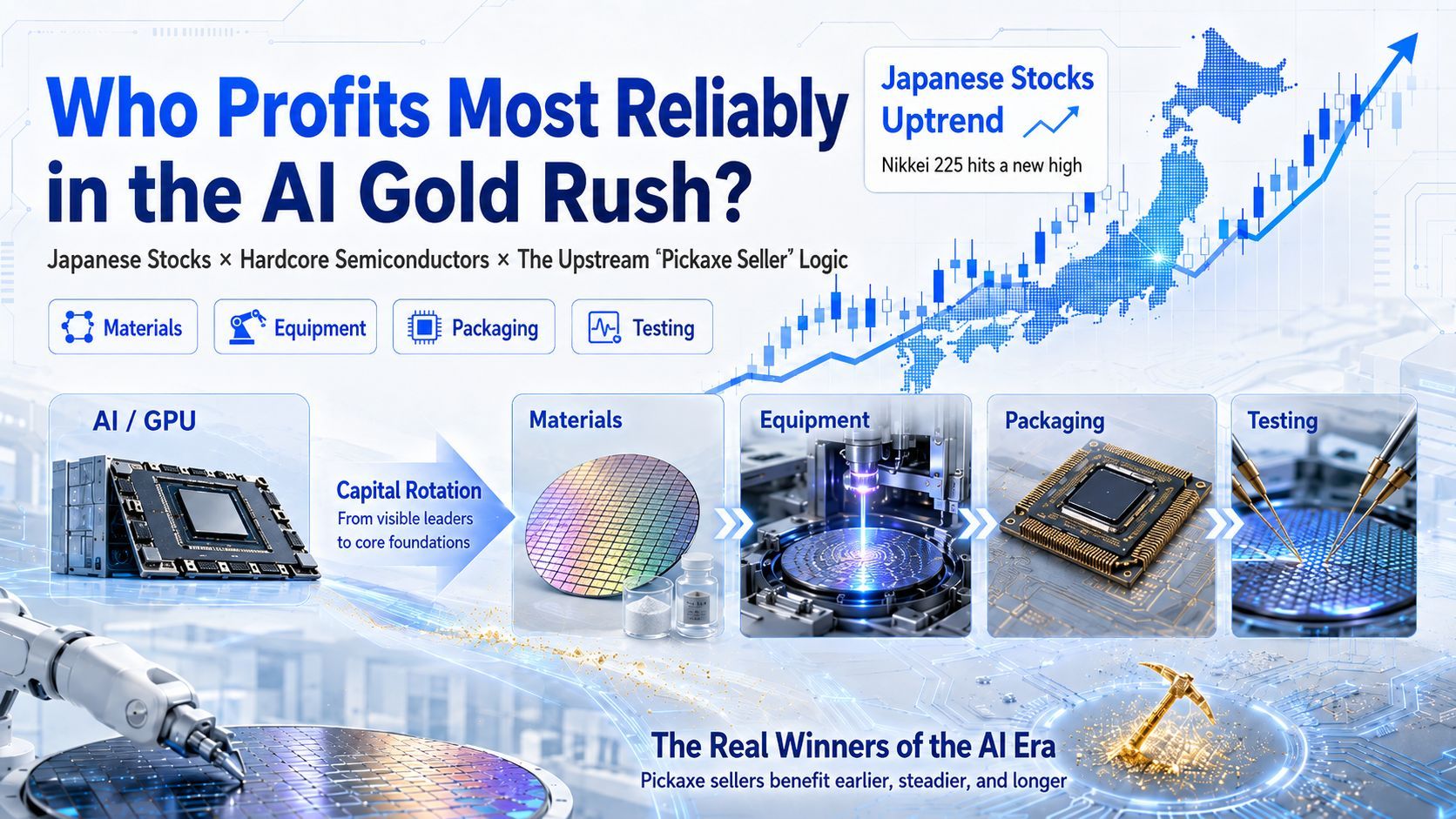
The Physical Foundation of the AI Gold Rush: Why Japan's Semiconductor Sector Holds the Edge
Beyond Silicon Valley's AI boom, the Japanese market stands out. The AI industry is fundamentally reliant on physical "foundational materials"—wafers, manufacturing equipment, and advanced packaging. This article analyzes, from an engineering perspective, why Japanese firms have become essential, bottleneck-defying nodes in the global semiconductor supply chain, securing a formidable economic moat in the age of AI.

Reading Notes

Original Title:
"What is the Capital Buying? Japanese Stocks Have Already Given the Answer"
http://xhslink.com/o/9GQ45nHBI1K

Original Author:
@刘璐的投资笔记 (Liu Lu's Investment Notes)
https://xhslink.com/m/1yM1s4NSchT
If you have been keeping an eye on global capital markets lately, you might be experiencing some "cognitive dissonance." The spotlight of the tech industry is clearly fixed on those large language model and GPU manufacturers in Silicon Valley, yet it is the Japanese stock market that is quietly reaching new historical highs.
As an engineer, I rarely look for inspiration in financial news, but this time, the performance of the Japanese market has triggered an interesting logic: the AI gold rush is ultimately returning to the challenge of the physical limits of "underlying materials."
The True Logic of the "Pickaxe Sellers": When Faced with Physical Laws, Code is Sometimes Powerless
In the software industry, we are accustomed to rapid iteration, canary releases, and bug fixes. However, when you enter the world of semiconductor manufacturing, such "flexibility" ceases to exist.
The AI chips currently being sought after involve extremely complex manufacturing processes, involving wafer fabrication, lithography, etching, deposition, cleaning, testing, and packaging. It is like a relay race with zero tolerance for error; if any link fails, the yield rate drops off a cliff. Japanese companies play critical roles in these links—roles where "without them, the chips simply couldn't be made."
- Lithography and Silicon Wafers: Shin-Etsu Chemical is not just a simple supplier; it is the cornerstone of global semiconductor materials. Without high-quality silicon wafers and lithography materials, even the most advanced AI chip architectures would remain on the drawing board.
- Equipment and Testing: Giants like Tokyo Electron and Advantest control the "pulse" of the entire production line.
- Advanced Packaging: As GPUs become increasingly larger, ABF packaging substrates have become the most indispensable "bottleneck" in the industry chain, responsible for connecting everything precisely.
For engineers, what is most impressive is not that they "can produce it," but the incredibly high barrier to validation. Stability, yield, and production line compatibility all require long-cycle validation. Once they enter the supply chain of Samsung, TSMC, or Intel, this "deep binding" acts almost like a lifelong contract in a physical sense.
Engineer's Perspective: This is like relying on an SDK in software engineering that runs at the foundational level and is nearly impossible to replace; you possess an incredibly deep moat. Japanese semiconductor companies have locked in their core position in the AI industrial chain precisely through these "underlying SDKs."
The Evolution of Global Capital Investment: From Calculation Illusions to the Physical Base
We can view the process of global capital digging for AI as a "recursive call":
- Phase 1 (Finding the Entrance): Capital buys the computing power leaders (Nvidia), with everyone embracing the most visible products first.
- Phase 2 (Infrastructure): Capital spreads to servers, networks, optical modules, and storage links.
- Phase 3 (Returning to the Origin): Capital begins to extend to the most upstream and scarcest bottlenecks, such as equipment, materials, and advanced packaging.
Japan is in the "core zone" of this third phase. Global capital is currently buying not just an index, but the bedrock of AI infrastructure—the key links that remain "hard rigid demand," no matter how much AI models "roll" (compete) or how much architectures change.
Conclusion: More Than Just Market Trends, It Is the Return of Industrial Logic
Although any market hitting historical highs may face short-term volatility or even the risk of profit-taking, the industrial traction behind it cannot be ignored.
The AI trend is no longer limited to a single aspect of computing production. As industry competition intensifies and the demand for computing power becomes more frenzied, the "interrogation" of precision and process stability of upstream materials becomes stricter. In short, the more the AI industry competes, the more significant the importance of Japan's upstream materials and equipment becomes.
For those of us surfing the digital wave, this grand drama reminds us that no matter how dazzling digitalization may seem, ultimately, all computing performance relies on the support of the physical world. This is not just a rise in the stock market; it is a return to the essence of technology.