
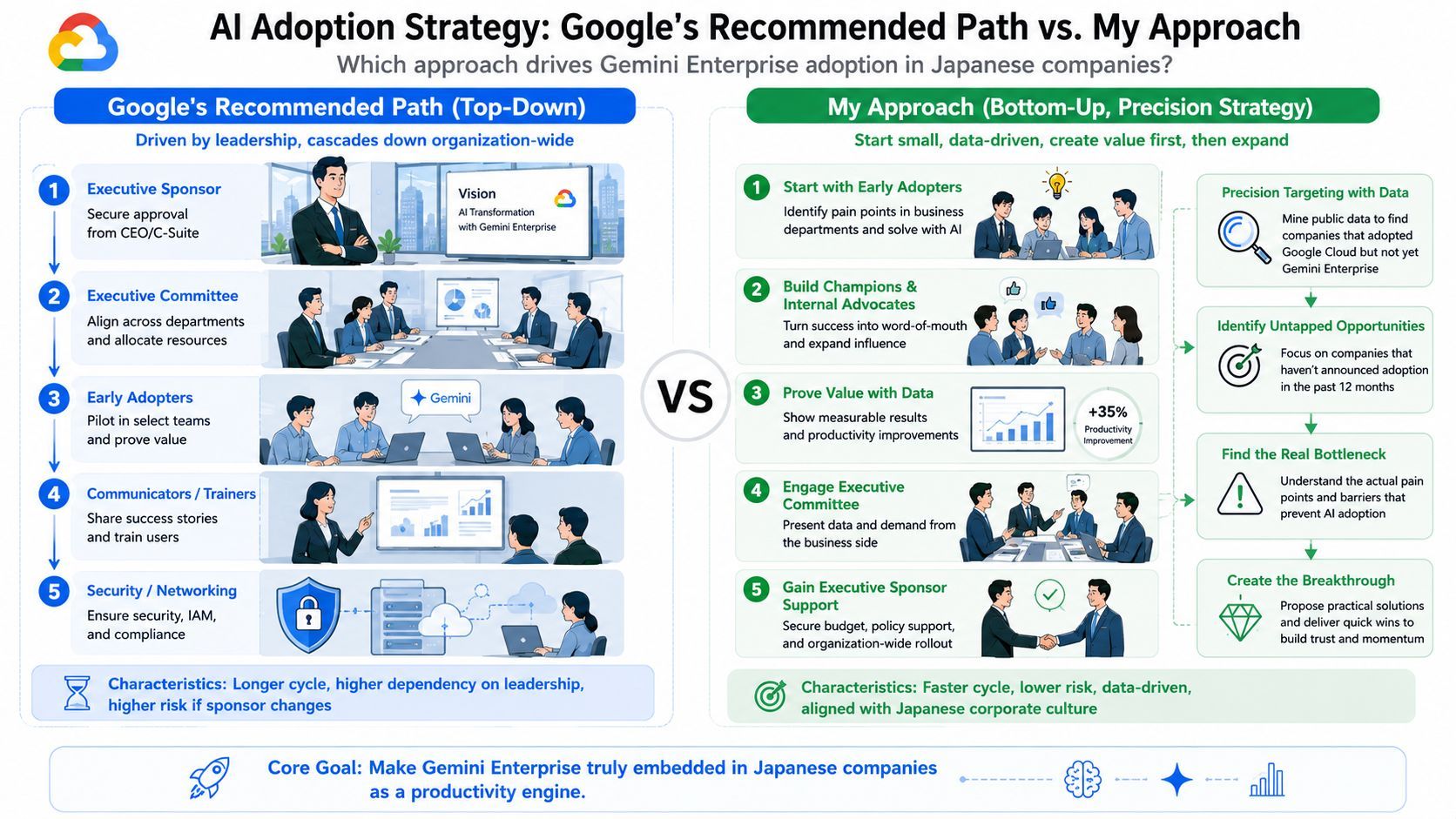
Overcoming Organizational Barriers in AI Implementation: A Bottom-Up Approach and Engineering Strategy for Japanese Enterprises
Deploying corporate AI products effectively requires establishing solid organizational sponsorship rather than focusing solely on technical setups. Addressing environments where standard Western top-down models struggle against stability-oriented Japanese corporate cultures, this article introduces practical strategies for engineers, exploring a bottom-up methodology starting with early adopters and utilizing open data mining to pinpoint real implementation bottlenecks.

Google AI Implementation: You Need a "Reliable Sponsor" More Than Prompt Tuning
As engineers, we often have a professional instinct: when faced with a new technology (like Gemini Enterprise), our first reaction is to "get a Hello World running, check the API documentation, and then optimize prompts to the extreme." But when we shift our gaze from the code repository to enterprise-level deployment, we often hit an invisible wall—not a wall of technical capability, but one of organizational structure and processes.
Many AI projects shine during the POC (Proof of Concept) phase but go silent after launch. This isn't because the model isn't smart enough, but because we overlook the most important "human-computer interaction"—the sponsorship strategy within the organization.
To make Gemini Enterprise more than just an expensive "chatbot" and truly an enterprise productivity engine, you need to address your "human dependencies" first.
Technical "Human Middleware"
When deploying Gemini Enterprise, it is naive to focus only on technical configuration. You need to build a comprehensive "Sponsorship" mechanism to ensure the project survives after delivery.
Why is sponsorship critical? It solves these "non-technical pain points" that frustrate engineers the most:
- Resource and Permission Acquisition: Without a strong sponsor, you might not even be able to request necessary Cloud project permissions and API whitelists.
- Removing Resistance: Change always comes with friction. A sponsor is that key figure who helps "clear the obstacles."
- Ensuring Sustainability: Preventing the project from becoming an "orphan." When initial enthusiasm fades, only a deeply involved sponsor can ensure the project's long-term viability within the organization.
Engineering Perspective: Who is Your "Core Dependency"?
We can view project stakeholders as a complex dependency tree. If a node is missing, the entire system collapses. Here are the "critical roles" that must be configured:
1.Executive Sponsor: A leader with Root access.
This is your "project lifeline." Without them, the project goes nowhere. They aren't just providers of funding; they are the "evangelists for change." You need to find a senior, well-known, and influential executive (like a CEO or C-Suite member) and ensure there is a "leadership redundancy" plan in case of personnel changes.
2.Executive Committee: Load balancing at the business layer.
They are the hub connecting technology and business. They are responsible for synchronizing visions across departments and "scaling" the project's influence by sharing success stories.
3.Early Adopters: The best test engineers.
These people aren't necessarily technical experts, but they are pioneers in solving pain points. They can help accelerate the conversion process and build word-of-mouth among "novice" user groups.
4.Security and Networking Team: The essential middleware.
Don't wait until the last minute to find them! Involve the security team on day one to configure Workforce Identity Federation and IAM. This is to avoid the embarrassment of being shut down by a "security audit" at the last moment before launch.
Don't Let the Project Become a "Black Box": Best Practice Checklist
Just as we write unit tests during development, enterprise AI deployment also requires a strict "launch checklist."
- Prepare a "Golden Dataset": Do not try to train the model with vague expectations. You need to submit a "Golden Dataset" containing search queries, expected responses, and citations. This is the benchmark for evaluation and prototyping.
- Implement Two-Stage Evaluation: Start with "automated quantitative benchmarking" (against your Golden Dataset), then proceed to "qualitative User Acceptance Testing (UAT)."
- Blended Search Demonstration: Show stakeholders how Gemini can search across isolated sources like Drive, Calendar, Jira, or Github. This is the "magic moment" that best demonstrates the value of AI.
- Maintain Transparency: Even a 15-minute daily stand-up can greatly improve project progress alignment.
Conclusion
Technical deployment is just the tip of the iceberg, while organizational change is the foundation buried deep underwater.The success of Gemini Enterprise relies not just on tuning model parameters, but on a complete sponsorship strategy.
As engineers, our value lies not just in writing excellent code, but in building an organizational environment where AI can truly function.
Stop Copying the Textbook: How to "Ground" Gemini Enterprise Implementation in Japan
Here is my perspective based on what I learned above about how to drive the deployment of Gemini Enterprise through a high-level "Executive Sponsor."
The logic of the document is absolutely airtight: secure CEO buy-in first, establish an executive committee, bring in early adopters, sort out security and networking, and finally achieve enterprise-wide implementation.
But if you have struggled and crawled through real business environments, especially in the Japanese market, you might—like me—chuckle bitterly at these suggestions. This is a "perfect script" written for a parallel universe.
Why does the "Google style" struggle to adapt to Japan?
This methodology is essentially a product of "American elitism." It assumes that organizational structures are flat, decision-makers are forward-thinking, and change is encouraged. However, in the Japanese workplace ecosystem, we often face a completely different scene:
- "Maintaining stability" is the primary productivity: Japanese corporate culture often leans towards seniority-based systems and risk aversion. In this environment, innovation often means "breaking the old order," which can upset many people's "cheese" and even trigger various workplace dramas involving "psychological discomfort."
- It's not just a technical issue; it's social engineering: Try innovating! Rank-and-file employees might immediately invoke labor laws in response. When "stability" becomes the ultimate metric, proactive promoters are easily viewed as "overachievers" or even ostracized.
So, as engineers and operators working on the front lines, should we give up on promoting Gemini Enterprise, or should we change our approach?
The Engineer's Perspective: Look Beyond Technology, Focus on the "Breakthrough Point"
If you don't want to watch this lucrative opportunity be snatched away by foreign companies, we need a smarter, more "engineered" implementation strategy. If a direct "Top-Down" approach doesn't work, why not try a precise "Bottom-Up" strike?
1. Change the "Priority," Implement a "Wide-Net" Strategy
The original Google path is: Executive Sponsor → Executive Committee → Early Adopters → Communicators/Trainers → Security and Networking.
This is too slow and high-risk. My suggestion is to do the exact opposite:
- Start with "Early Adopters": Don't wait for top management. Organize study sessions directly within business departments. Use AI tools to solve a few repetitive, manual tasks effectively so that everyone experiences the "this is amazing" moment, thereby building word-of-mouth from the bottom up.
- "Communicators and Trainers" first: Cultivate a group of seed players capable of continuously producing success stories. This is far more reliable than taking a PowerPoint to try and "con" the CEO.
- Only then move to the "Executive Committee" and "Sponsor": When business departments are already dependent on Gemini, what you show senior management is not a "vision," but "productivity data." At this point, getting their endorsement becomes a logical next step.
2. Precise Sniping: Use Data to Find the "Ones That Got Away"
Don't run around like a headless chicken. As engineers, what are we best at? Data analysis.
- Mine public information: Use AI crawling tools to retrieve companies that have declared the adoption of Google Cloud since 2018.
- Lock in the Target: Investigate whether they have officially announced the adoption of Gemini Enterprise within the last year. If the answer is "No," then congratulations—this is your "treasure trove" waiting to be developed.
- Find the pain points: Companies that haven't adopted AI yet usually aren't doing so because they don't want to, but because their previous partners were "unreliable." Your entry point is to ask: "What are the current obstacles?"
Conclusion: Refuse to Be a "Useless" Middleman
Some channel sales for Google Cloud might be missing these low-hanging fruits because they aren't deep enough. This is the opportunity for people like us to carve out our own space.
Remember, technology never exists in isolation. No matter how good Gemini Enterprise is, if it isn't combined with local business psychology or an understanding of the "air" (Kuki) in the Japanese workplace, it is just an expensive API.
Therefore, instead of complaining about the rigidity of policies, be the engineer who holds the data, understands human nature, and dares to use "atypical" methods to ground technology in reality. After all, in this era of change, only those who can solve "resistance" deserve the title of "technology innovator."