
An Engineering Guide to Organizational Change: The "Last One Mile" Strategy for AI Implementation
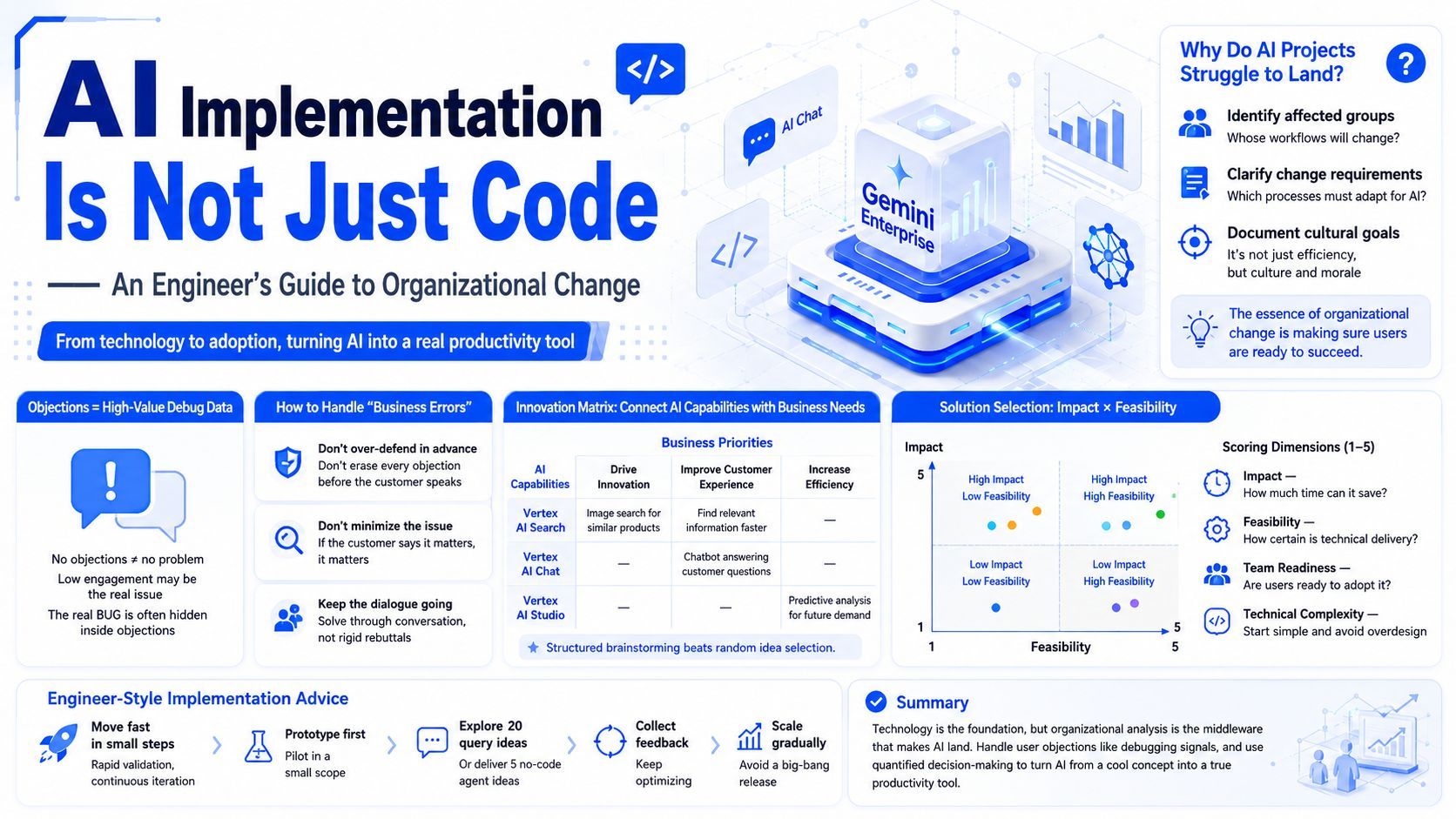
This article explores the critical "last mile" of deploying AI solutions, emphasizing that user adoption is just as important as technical implementation. From an engineer's perspective, it outlines how to perform needs audits, treat user objections as valuable feedback, and use an "Innovation Matrix" to map business needs to AI capabilities. By avoiding "big bang" releases and prioritizing solutions based on impact and feasibility, organizations can successfully transform AI from a conceptual tool into a practical productivity asset.

AI Implementation Is More Than Just Code: An Engineer’s Guide to Organizational Change
As an engineer, we are most adept at defining APIs, optimizing latency, training models, or building complex architectures from scratch. However, if you have ever pushed an AI solution—especially a powerful tool like Gemini Enterprise—into production, you surely understand that no matter how elegant the code, if users do not adopt it, all investments in compute power are wasted.
Why do your AI solutions struggle to "pass the level"?
We often fall into a cognitive trap: believing that as long as Gemini's capabilities are strong enough, the business will naturally embrace it due to the technical dividends. The reality is that organizational change is like a complex distributed system upgrade—the user is the most critical node.
The essence of organizational analysis is evaluating how change impacts end-users and ensuring they possess the skills and knowledge required for success. This means that before deploying any model, we must conduct a "requirements audit":
- Identify affected groups: Who will change their workflow due to AI integration? What support do they need?
- Determine change requirements: Which rigid organizational processes need to become flexible for AI?
- Document cultural goals: This is not just about efficiency gains; it is about employee morale and uncovering opportunities for innovation.
"Objections" are actually high-quality debug data
In technical development, errors are the basis for optimizing code. Yet, when driving organizational change, we often avoid "objections" out of fear.
This is a massive cognitive bias. The document specifically notes that if potential clients have no objections, it often indicates they have very low engagement. True "bugs" are often hidden within the objections.
How should we, as engineers, handle these "business errors"?
- Do not be defensive: Do not try to eliminate all objections before the client even speaks. This appears arrogant and may introduce new problems they had not considered.
- Do not downplay issues: If the client says it is a big problem, it is a big problem. Do not try to brush it off by saying "it doesn't matter"; you are simply burying a trap for yourself.
- Maintain dialogue: When dealing with objections, do not rush to provide a "perfect answer" to overwhelm the other party. Try telling a story and resolving issues through conversation; it is more persuasive than a blunt conclusion.
The Innovation Matrix: How to map AI capabilities to business needs?
When we have a tech stack like Gemini Enterprise, the next step is often confusion: what should we do first?
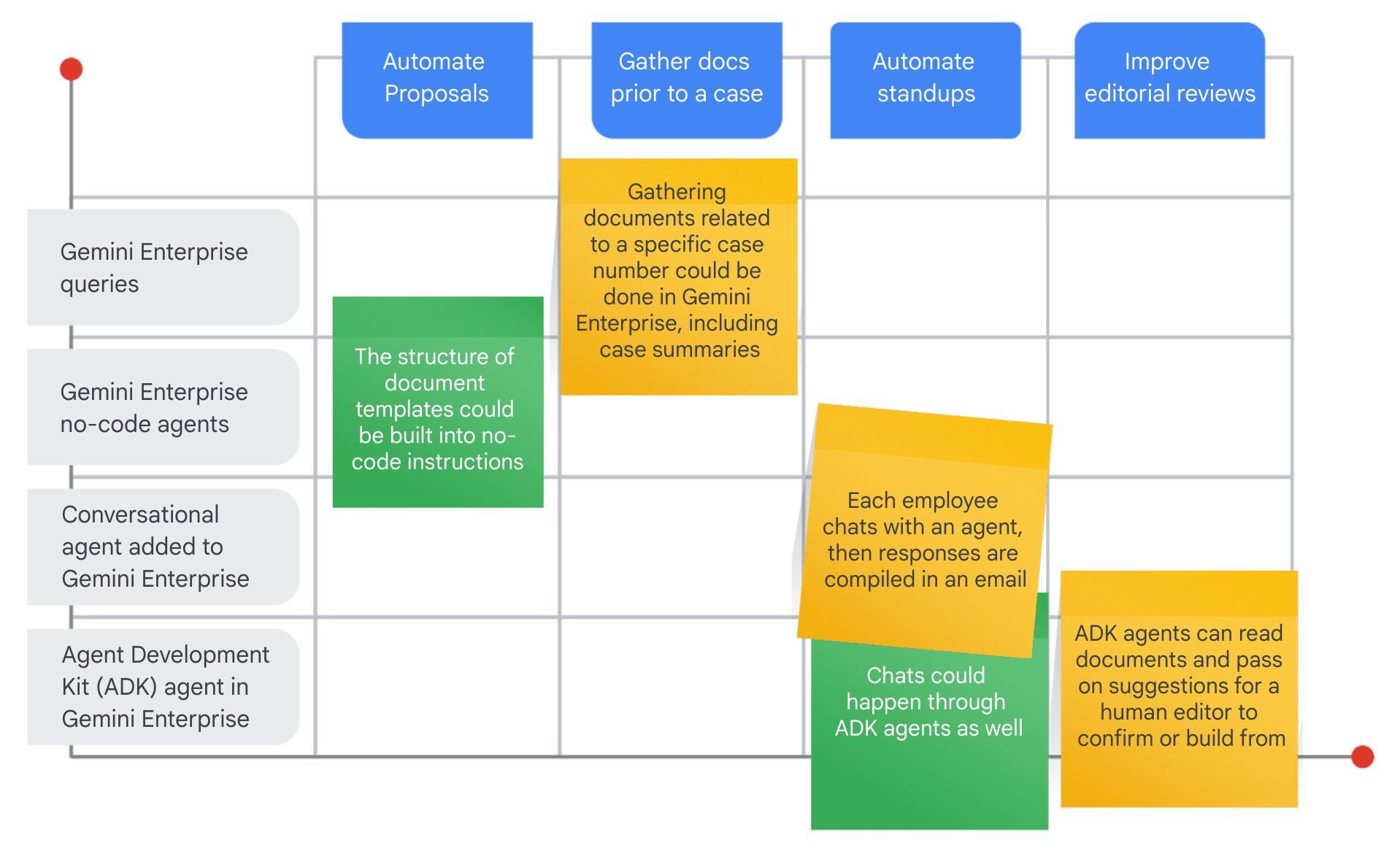
I recommend using an Innovation Matrix. This is a simple 2D planning tool: the horizontal axis represents business priorities (e.g., proposal automation, improved editing reviews), and the vertical axis represents AI technical functions (e.g., Gemini search, no-code agents).
We can understand this through a vivid example: a manufacturer of artificial flowers used an innovation matrix to collide business needs with AI capabilities:
- Driving Innovation + Vertex AI Search: They developed an image search tool, allowing customers to upload photos to find similar arrangement plans.
- Enhancing Customer Experience + Vertex AI Conversation: They built an AI chatbot to instantly answer questions regarding the care of artificial flowers and the ordering process.
- Improving Efficiency + Vertex AI Studio: They fine-tuned models to analyze customer data and accurately predict future style requirements.
This structured brainstorming is far more efficient than making decisions based on guesses.
Screening solutions: Balancing impact and feasibility
When the wall is covered in sticky notes, the real challenge begins. As engineers, we must introduce quantified evaluation logic. Do not try to solve all pain points at once; score ideas based on Impact and Feasibility.
I suggest establishing evaluation criteria using a 1-5 scale:
- Impact: How many labor hours were actually saved?
- Feasibility: How high is the technical certainty of achieving the goal?
- Team Readiness: Is the user team truly prepared to accept this new system?
- Technical Complexity: Prioritize simple initial use cases to avoid falling into a complex architectural mire from the start.
Finally, here is an "engineer-style" implementation suggestion: do not attempt a "Big Bang" release. Plan a small-scale collaborative program with prototypes, such as exploring 20 query ideas or delivering 5 no-code agent solutions first.
To summarize:
Technology is the hard foundation, but organizational analysis is the "middleware" that allows AI to truly land. The next time you promote a new technology, try handling user objections as calmly as you would handle code bugs, and use an innovation matrix to quantify your decisions. That is the correct posture for turning AI from a "cool concept" into a "productivity tool."