
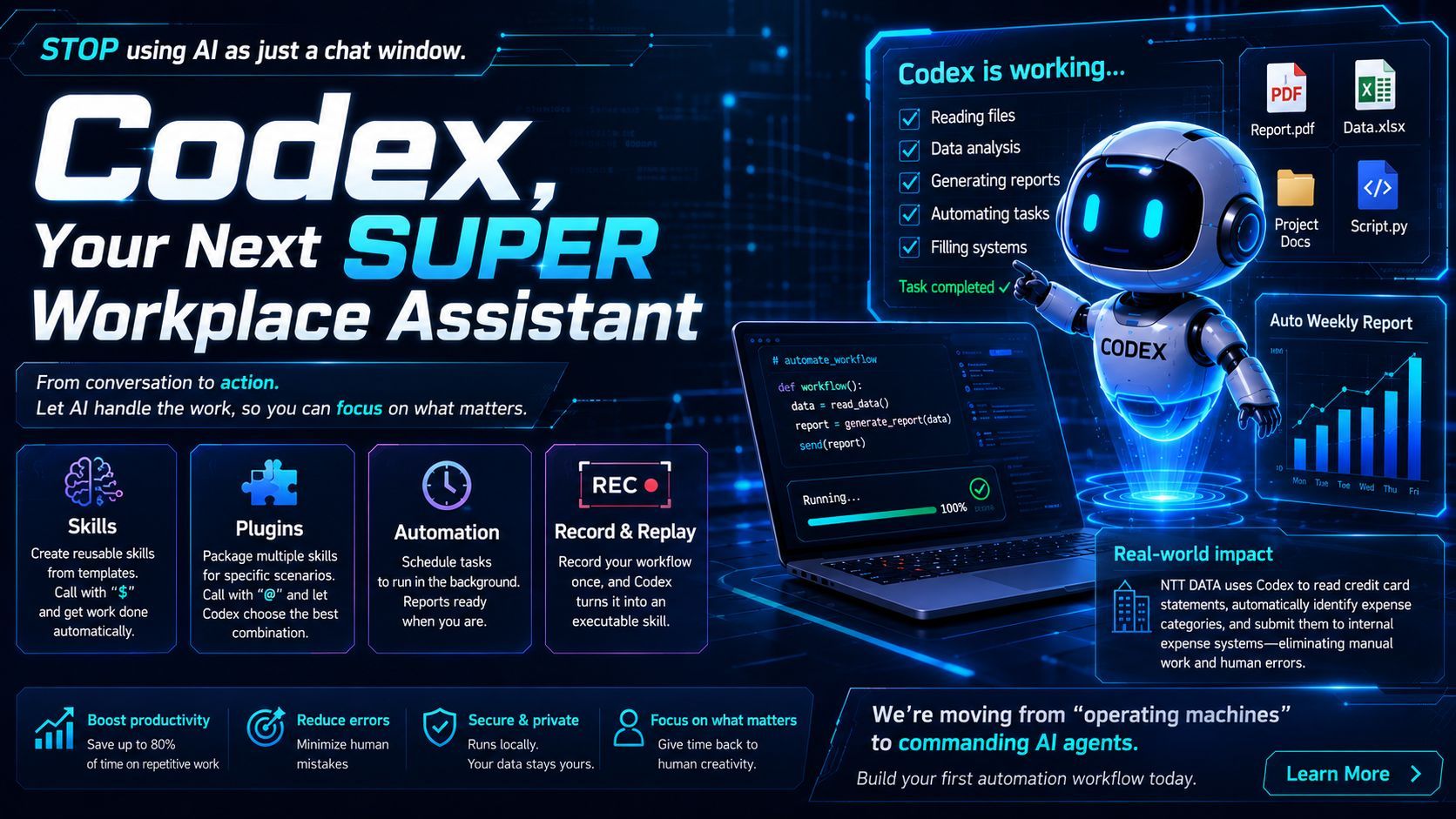
Codex: A New AI Agent for Automating PC Workflows
This post explores OpenAI's "Codex," an AI agent that operates locally on your PC. Unlike standard chatbots, it automates repetitive tasks via custom skills, plug-ins, and recording features. Using an NTT Data case study, we demonstrate how to shift from manual operation to directing AI agents for efficient, automated business workflows, allowing professionals to focus on creative tasks.

Stop treating AI just as a chat window: Codex, your next "super" workplace assistant
In an era where AI models update every six weeks and yesterday's common knowledge becomes outdated news, it is normal to feel exhausted. You may already be accustomed to seeking inspiration in the ChatGPT chat box, but do you feel a subtle "gap"? That sense of helplessness where you think, "AI is powerful, but I still have to handle my specific business tasks myself."
OpenAI has clearly recognized this pain point. To bridge the gap between technology and reality, they have introduced a non-developer-oriented AI agent tool: Codex. This is not just a chatbot; it is an "action-taker" that can truly dive into your computer and take over repetitive tasks.
Why it is a "game-changer"
Many people ask: ChatGPT is already quite useful, so why do we need Codex?
If ChatGPT is a knowledgeable "strategic consultant," then Codex is an agile "executive specialist" capable of working directly within your computer's file system. The core difference lies in the "interaction mode" and "business depth":
- ChatGPT (Strategic Consultant Mode): Best for creative brainstorming, article polishing, translation, and impromptu consultation. It excels at handling single-shot tasks and is suitable for various mobile terminals.
- Codex (Executive Specialist Mode): This is its home field. Codex runs on local PCs, capable of reading and analyzing large-scale PDFs or complex spreadsheets. Its core strength lies in "fully automated repetitive office work."
OpenAI did not stop at the "conversation" level. Instead, they embedded AI into your workflow through three dimensions: "context injection," "tool orchestration," and "continuous optimization."
Say goodbye to complexity, "encapsulate" your business like a programmer
What excites me as an engineer about Codex is the design logic of "Skills" and "Plugins." This is the process of "modularizing" complex business processes.
- Skills: Imagine not needing to write long, repetitive prompts like "please organize this data into a weekly report" every time. You only need to have Codex learn the template once to generate a "Skill." When calling it later, you simply enter $ in the dialog box, and the AI will automatically extract data from your local system based on your rules and generate an accurate document.
- Plugins: These are an advanced version of Skills. You can package multiple skills for specific scenarios into a "Plugin." By calling with @, Codex automatically selects the best combination to handle the task (e.g., "Sales Weekly Report" or "Financial Statement").
Combined with "automation" functionality, you can even set scheduled tasks. For example, you can set it to run every Friday at 15:00, where Codex automatically grabs the week's data and writes the report, leaving it ready on your desk for you to send when you return from your meeting.
Features you won't want to live without
In addition to the core automation logic, Codex's recent updates are tailored for professionals:
- Record & Replay: This is the pinnacle of "teaching a man to fish." You don't need to learn scripting; simply demonstrate the workflow on your screen (e.g., copying data from a CRM system to Excel), and Codex "records" it and converts it into an executable AI skill. This significantly lowers the barrier for non-technical users to use AI.
- Codex Pets: These are more than just decorations. While they look like cute pets, they act as "status reminders." They notify you when you need to perform an approval or when a task is completed—both practical and therapeutic.
- Enterprise Case Studies: Just look at the case with NTT DATA. By feeding credit card bills directly into Codex, the AI accurately identifies transport and meal expenses and automatically fills them into the internal reimbursement system, eliminating the "human error" and "dull labor" of financial reimbursement.
Conclusion: From "man operating machine" to "man commanding agent"
We are entering an era where everyone can command AI agents. It is no longer a matter of you typing requests to AI in a browser line-by-line; rather, AI is silently working in your local system with your authorization.
If you want to delve into the details of this technology or start building your first automated workflow, check out this OpenAI-における-Codex-活用方法.pdf.
Remember, the evolution of tools is intended to return time to work that truly requires human creativity. You only need to take that first step to define your "skills," and leave the rest to Codex.