
Hackathon Landmine Avoidance Guide: A Reflection on Engineering Best Practices
Reflecting on a recent "disastrous" hackathon experience, this guide offers actionable advice for organizers to avoid common pitfalls. The post critiques issues such as over-marketing, unqualified judges, poor scheduling, and communication breakdowns that alienate participants. It emphasizes that the core of a hackathon is technical exchange and value creation, not a promotional show. Respect for engineers and their workflows is presented as the most essential element for successful, high-quality events.

As an engineer deep in the world of code, attending a hackathon should be a celebration of technical exchange. However, a recent hackathon I experienced in Japan was so "disastrous" in its execution that I felt compelled to sit down and write this review for teams planning similar events in the future.
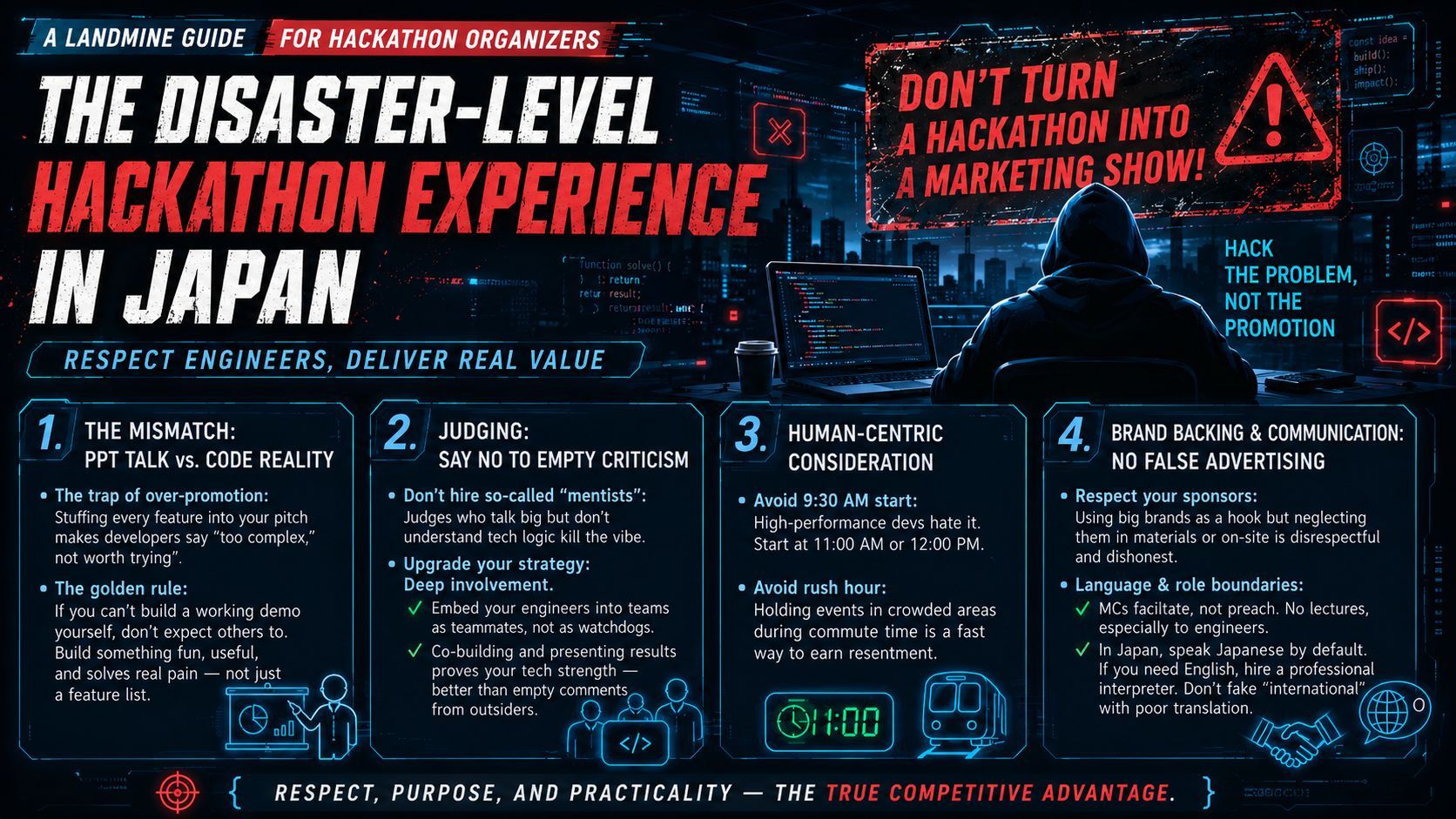
What is the core of a hackathon? It is the collision of technology and the thrill of problem-solving. If it devolves into a mere "vendor marketing show," the result is predictable: developers will vote with their feet, and the event will become a laughingstock. Below is a "Survival Guide" I summarized , which I hope offers some insights to my peers.
1. Pain Point: When "PPT Presentations" Meet "Code Reality"
Many events commit a fatal error at the start: trying to "educate" developers with grand narratives.
- The Danger of Over-Promotion: Organizers often try to cram an entire product line's features into the opening demo. This not only makes the content bloated but also triggers developer resistance, making them feel the project is too complex to engage with.
- The Golden Rule for the Engineer's Perspective: "If you cannot build a demo yourself, do not expect the participants to do it." Organizers must personally complete an effective demo within the time limit. This demo must be interesting, practical, and solve real pain points, rather than just stacking features.
2. Judging Mechanism: Reject "Empty Targets"
Nothing annoys developers more than a group of non-technical judges critiquing code. This "arrogance" not only ruins the atmosphere but directly undermines the company's professional image.
- Don't Hire "Empty" Mentors: Judges who speak in buzzwords but do not understand technical logic only create awkwardness.
- Advanced Strategy: Deep Participation:
- Internal engineers should join teams as "teammates" rather than "supervisors."
- Let employees who participated in the collaboration present the results on stage. This demonstrates technical prowess far better than the hollow feedback of outsiders and avoids the "cheapness" of proxy products.
3. Human Care for Engineers
The professionalism of a hackathon often lies in the unnoticed details. Ignoring the circadian rhythms and habits of developers is a complete lack of respect for their professional spirit.
- Please Don't Start at 9:30 AM: Scheduling an event at 9:30 AM is a disaster for developers accustomed to high-intensity work rhythms. Such unreasonable scheduling triggers emotional resistance, so I suggest pushing the start time to 11:00 or 12:00.
- Avoid Traffic Congestion: Holding an event in a congested area during the morning rush hour is a decision that not only disrupts commuting but is detested by developers.
4. Brand Endorsement & Communication: Don't Use False Advertising
In the context of cross-cultural or large-scale partnerships, basic business etiquette is the bottom line.
- Respect Sponsors: Do not use well-known brands as clickbait in your promotions, only to ignore them in on-site printed materials and venue displays while focusing only on your own sponsors. This is extremely rude and insincere.
- Boundaries of Language and Role:
- The host's duty is to guide the process, not to "preach" or force personal opinions, and certainly not to play the expert in front of technical developers.
- In Japan, Japanese is the default language. If you must use English, hire professional interpreters. Do not attempt to show "internationalization" through broken translations, as this only creates a sense of superiority that backfires and alienates local participants.
Conclusion: Respect is the Most Hardcore Competitiveness
Holding a hackathon is not just about sticking an "innovation" label on a company; it is about genuinely serving developers and creating value through technical exchange. If you focus only on corporate marketing needs and ignore the participant experience, the event is destined to be a self-absorbed "performance."
Remember, for engineers, respect and pragmatism are always the highest standards by which to judge the quality of a technical event.