
From Apps to Agents: Unveiling the Vision Behind Project Solara
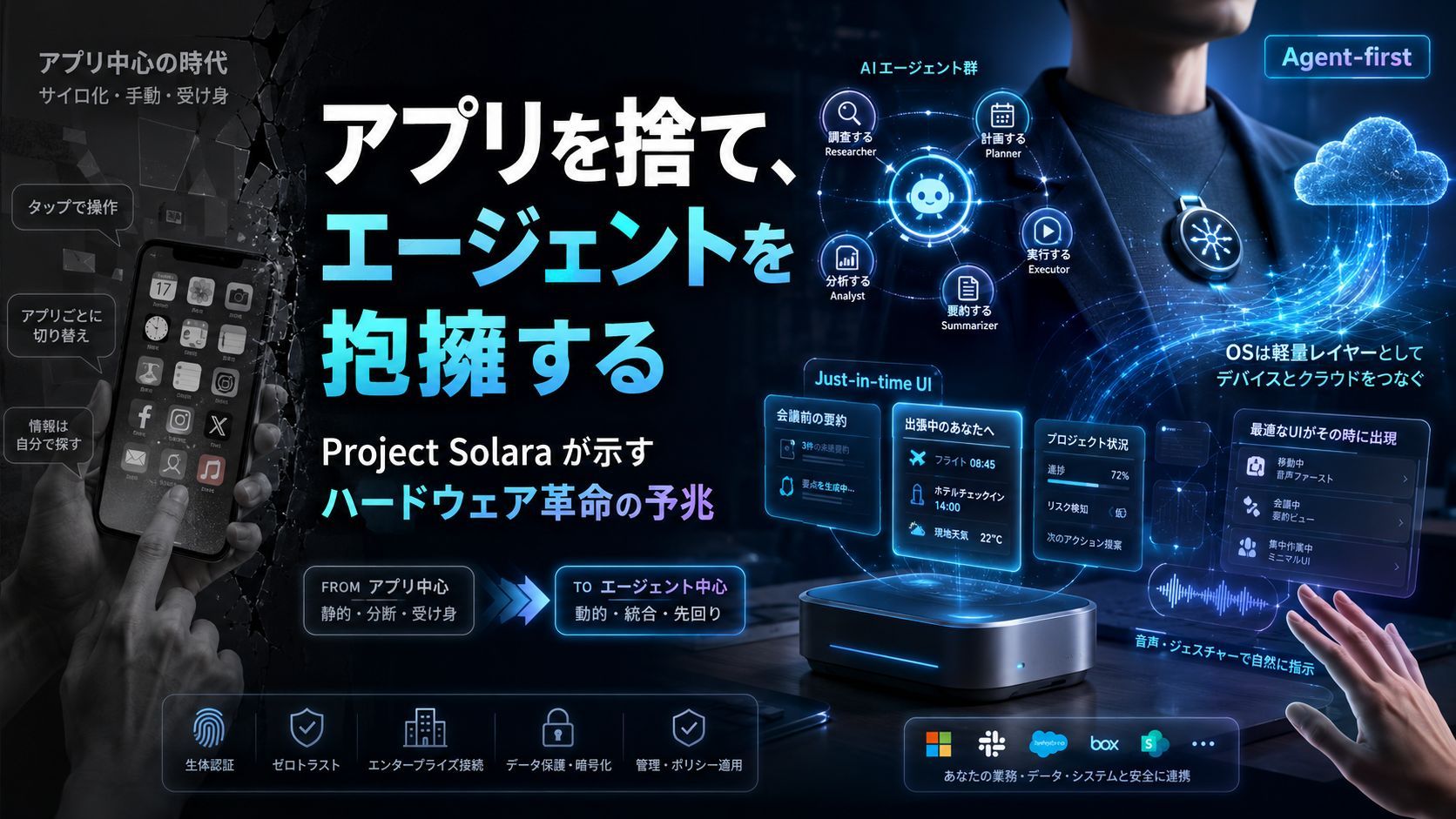
Microsoft's "Project Solara" marks a shift from app-centric computing to an "Agent-first" paradigm. This article analyzes how "Just-in-time UI" and enterprise infrastructure redefine hardware-software interaction, offering developers key insights into the evolution of future computing platforms and the architectural changes involved.

Ditching Apps, Embracing Agents: A Preview of the "Hardware Revolution" Brought by Project Solara
As developers, we are all accustomed to the concept of an "App": open the phone, tap the icon, enter the application, and complete the task. But if I told you that the era of "Apps" is gradually moving to the periphery, and a new era—"Agent-first"—is quietly beginning, would you believe it?
Recently, Steven Bathiche of the Microsoft Applied Sciences team shared the vision for Project Solara. This is not just a new project, but a profound reconstruction of how we define computing. As engineers, we are often dazzled by various new technologies, but this time, we need to stop and think: when "Agents" become the smallest unit of human-computer interaction, what kind of earthquake will occur in our hardware stack?
Why do we need new computer forms?
Looking back at the history of computing, every paradigm shift has been accompanied by the evolution of device forms. Mainframes did not die when personal computers appeared, and PCs did not disappear when mobile phones arrived. Each generation of devices survives because they are closer to the user's specific scenarios and tasks.
However, we are currently facing a cruel engineering reality: the development cost of dedicated devices is extremely high.
For a long time, if you wanted to invent a new form of computer, you had to build a complete technology stack from scratch: hardware, software, services, developer tools, UI patterns, security models... This is not only a huge investment in money but also a difficult technical chasm to cross. In the past, we were forced to cram all complex tasks into general-purpose devices (phones or laptops), even if they weren't the optimal solution.
Project Solara: Not just AI, but "infrastructure" for hardware
The core logic of Project Solara is: AI is eliminating this expensive necessity of "reinventing the wheel."
It is a platform from chip to cloud, aiming to build "Agent-first" devices. This may sound a bit abstract, but from another perspective: it tries to strip the "operating system" away from the device itself, making it like a "thin film" covering the device and the cloud.
"Project Solara's mission is to pioneeringly build an experience around you—your agent, your tasks, your environment, under your control."
As an engineer, I am particularly interested in two technical points mentioned:
- "Just-in-time UI": This is the core of solving the fragmentation problem. In the past, we had to write code for every resolution and every input method. Now, through agents, UI can be dynamically generated based on device, content, and context. This frees us from over-reliance on traditional application frameworks.
- Enterprise-grade foundation: Many AI prototypes cannot be implemented because they lack enterprise-grade management. Project Solara has not overlooked this; it integrates Intune management, Entra ID authentication, and Hello for Business biometric recognition at the underlying layer. This means this system is not a toy, but a tool prepared for enterprise productivity.
Engineer Perspective: When "Intent" Replaces "Buttons"
Project Solara shows us a future: computing devices are no longer containers for running Apps, but windows to the "Agent world."
In their conceptual demonstrations, whether it is the badge device worn on the chest or the desktop companion (Desk), the core is to free agents from the shackles of browsers and Apps, allowing them to collaborate across devices and environments.
We no longer need to navigate complex menus for a simple task; instead, we express "intent" directly to the agent via voice, vision, or gestures. This shift in interaction paradigm will fundamentally change the way we build software:
- No longer building a single large App: Instead, building agents that can collaborate with each other and load dynamically based on the scenario.
- No longer designing UI for screens: Instead, designing logic for tasks and letting the UI automatically adapt to the hardware.
Implications for Developers
The current experimental designs (such as badge and desktop concept machines) have already started internal pilots, including scenarios like GitHub Copilot and Dragon Copilot. Although these hardware devices are still some way from mass adoption, the direction is clear: agents will reshape software and will also reshape the hardware itself.
If you are currently developing applications using the Microsoft 365 Agents SDK or Copilot Studio, congratulations, you are already at the forefront of this wave. The future opportunity lies not in "making another App," but in how to bring your agents into specific scenarios where computing power could not reach before—such as hospitals, retail stores, or even your desk.
This is not just news about AI; this is a blueprint for the next generation of computing platform. If you are interested in the details of this technology, you can view it here: Project Solara Details.
As an engineer, are you ready to build your own agent?