
SoftBank World 2026: Masayoshi Son’s Roadmap to the 2040 ASI Era and a Cold Analysis of Real-world Obstacles
This article summarizes and analyzes Masayoshi Son's presentation at SoftBank World 2026. He projected with concrete figures that ASI will account for 20% of global GDP and 1 billion humanoids will be active by 2040. The post outlines the "objective facts and tech trends" within his ambitious vision while offering a calm analysis of "subjective speculations and challenges," such as capex viability and fusion commercialization.

Here is the English version of the summary and objective analysis of Masayoshi Son's presentation at SoftBank World 2026.
Just like the previous versions, it breaks down his key messages and analyzes what is a grounded reality versus what leans into his characteristically bold, visionary optimism.
1. Core Summary of Masayoshi Son’s Presentation
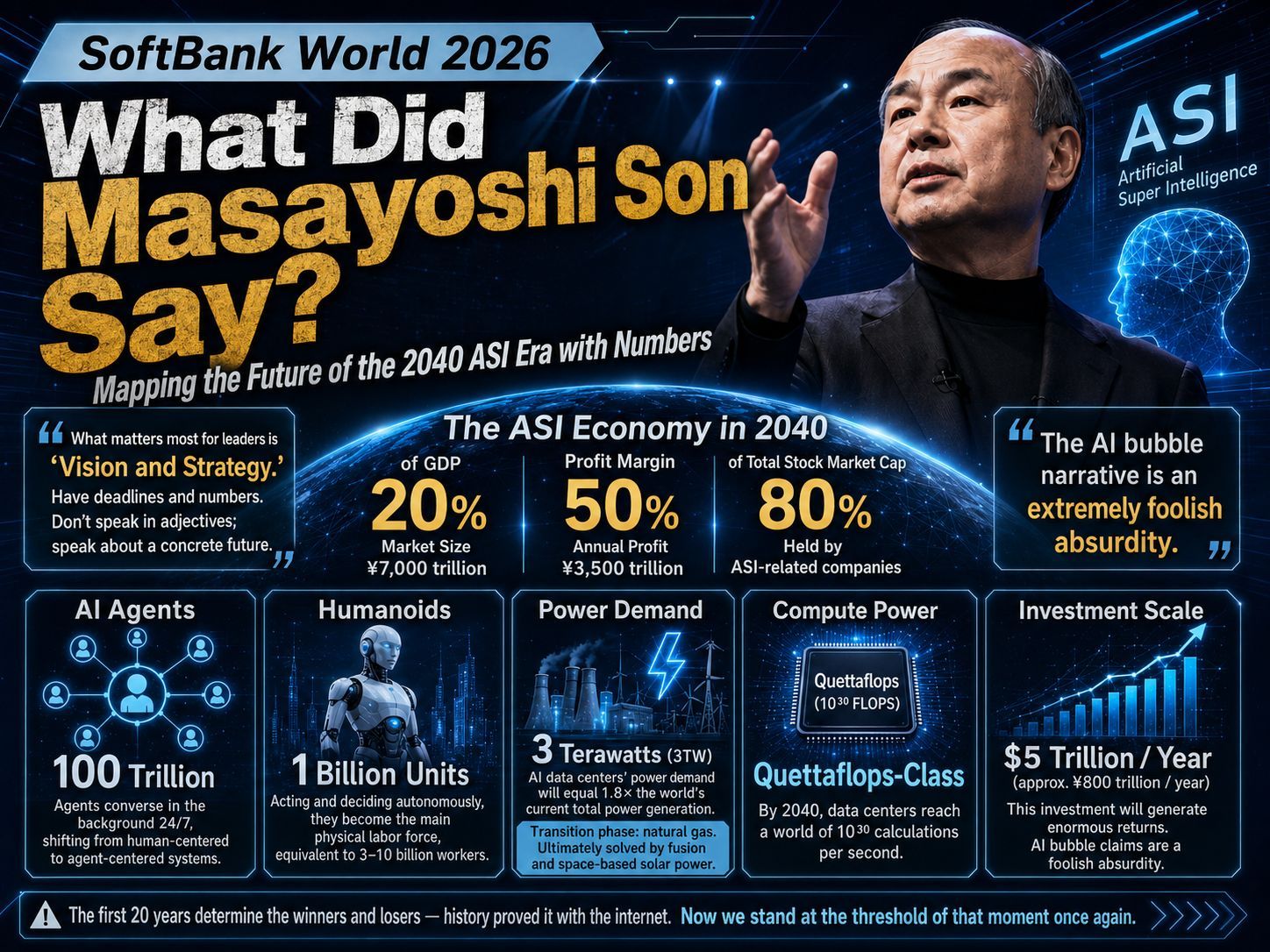
Masayoshi Son delivered a highly ambitious, numbers-driven roadmap for the arrival of the ASI (Artificial Super Intelligence) Era by 2040. He emphasized that for business leaders, having a bold vision and strategy defined by "clear timelines and numbers" is far more crucial than relying on vague, comfortable adjectives.
Here are the specific projections he laid out:
- The Scale of the ASI Economy:
- By 2040, the ASI ecosystem will account for 20% of global GDP, translating to roughly 7,000 trillion yen (approx. $45–50 trillion USD) in annual revenue.
- This industry will operate at an incredible profit margin of nearly 50%, yielding about 3,500 trillion yen in annual profits for top players.
- While making up 20% of GDP , these AI-driven companies will command 80% of the total global stock market capitalization due to their extreme growth multipliers.
- AI Agents and Humanoids (Embodied AI):
- The world will be populated by 100 trillion AI Agents interacting 24/7. The global infrastructure will shift from a "human-centric" to an "agent-centric" network.
- Around 1 billion humanoid robots (AI-powered) will be active globally, performing physical labor. Operating 24 hours a day, they will execute work equivalent to 3 billion to 10 billion human workers, making humanoids the primary physical labor force on Earth.
- Data Centers and Energy Demands:
- To power this intelligence, global AI data centers will require 3 Terawatts (3TW) of power by 2040—roughly 1.8 times the total electricity consumption of the entire planet today.
- While natural gas will serve as the primary bridge fuel , Son firmly believes nuclear fusion will mature within 15 years, providing safe, clean, and virtually limitless energy that will make carbon emissions and global warming a thing of the past.
- Computing Power and Investment Cost:
- By 2040, these 3TW data centers will operate at Quettaflops ($10^{30}$ FLOPS) of floating-point computing capacity.
- Building this infrastructure will require a staggering global investment of $5 trillion USD (approx. 800 trillion yen) annually. Son argues this is highly feasible and mathematically sound given the projected 7,000 trillion yen revenue, calling any talk of an "AI Bubble" complete foolishness.
2. Objective Analysis: Fact vs. Wishful Thinking
To analyze this speech with cold, objective realism, we must separate technological/historical facts from highly speculative, optimistic projections.
A. Grounded Facts & Industry Agreements The Reality
* The "First 20 Years" Rule: * Analysis: Son’s observation that the first 20 years of a tech revolution set the permanent leadership board is historically accurate. Looking back at the internet revolution (approx. 1995 to 2015) , the players who secured top-tier positions during those two decades (like Google, Apple, Amazon, and Microsoft) remain the dominant forces today.
- AI as an Accelerator for Science (Fusion):
* Analysis: This is a proven trend. Artificial intelligence is already playing a pivotal role in accelerating scientific research, notably in plasma control simulations for magnetic confinement fusion (tokamak reactors).
- Mathematical and Scale Metrics:
* Analysis: The progression of prefixes he discussed—Exa ($10^{18}$), Zetta ($10^{21}$), Yotta ($10^{24}$), Ronna ($10^{27}$), and Quetta ($10^{30}$)—aligns perfectly with official SI unit definitions. His warning about the massive power-hungriness of data centers is also a very real, pressing bottleneck currently keeping hyperscalers awake at night.
B. Masayoshi Son’s Speculations The Wishful Thinking
As one of the world's most famous tech evangelists and venture capitalists, Son’s timelines assume a "frictionless" world. The following points face immense real-world skepticism:
1. The 20% GDP and 80% Market Cap Monopolization
- Speculation Index: ⭐️⭐️⭐️⭐️
- Analysis: Even with the internet fully integrated into daily life, core internet industries do not account for 20% of global GDP. For AI to swallow 20% of the entire global economy in just 15 years requires overcoming massive geopolitical, regulatory, and labor union barriers. Furthermore, projecting that AI companies will capture 80% of global stock market value drastically undervalues the foundational, non-digitizable sectors of society (agriculture, physical infrastructure, healthcare, etc.).
2. Maintaining a 50% Profit Margin on $5 Trillion Annual Capex
- Speculation Index: ⭐️⭐️⭐️⭐️⭐️
* Analysis: Son’s business logic is simple: "Since we will make $45+ trillion, spending $5 trillion a year on infrastructure is a drop in the bucket".
- However, tech history shows that commodity forces and open-source models inevitably drive down margins. Once Quetta-scale compute becomes a reality, intelligence will likely behave like electricity or water—a low-margin, heavily regulated public utility. Expecting a massive, highly competitive global industry to sustain a 50% profit margin long-term goes against fundamental economic laws.
3. 1 Billion Humanoids & 100 Trillion Active Agents
- Speculation Index: ⭐️⭐️⭐️⭐️
* Analysis: * Hardware Limitations: Manufacturing, shipping, and maintaining 1 billion highly complex physical robots (which require rare-earth minerals, precision actuators, and advanced batteries) within 15 years is a physical supply-chain impossibility under current projections.
* Systemic Safety: Having 100 trillion autonomous software agents negotiating with one another 24/7 introduces unprecedented systemic risk. Without advanced coordination safety protocols (which do not yet exist), such high-frequency, complex interactions could lead to catastrophic digital "flash crashes" across global networks.
4. Commercial Fusion Power by 2040 to Solve Climate Change
- Speculation Index: ⭐️⭐️⭐️⭐️
* Analysis: There is a long-standing joke in physics: *"Nuclear fusion is always 30 years away."* While AI is speeding up the engineering process , transitioning from a scientific breakthrough to commercializing, building, and hooking up fusion reactors to the grid to support a 3TW data center load in just 15 years is incredibly hand-wavy.
3. Final Verdict
Masayoshi Son’s SoftBank World 2026 speech is a masterclass in corporate storytelling and vision-casting.
He is directionally correct. The world is undoubtedly moving toward a future defined by agentic AI, physical automation, and a massive restructuring of global energy grids.
However, his timeline ignores all real-world friction. He presents a hyper-optimistic scenario where supply chains never bottleneck, antitrust regulations never interfere, geopolitical tensions don't fragment the internet, and deep tech engineering occurs at the speed of software deployment. It is an incredibly inspiring blueprint for investors, but one that should be digested with a healthy dose of practical realism.