
From Chatbot to Agent: The Evolution of AI into a Practical Work Partner
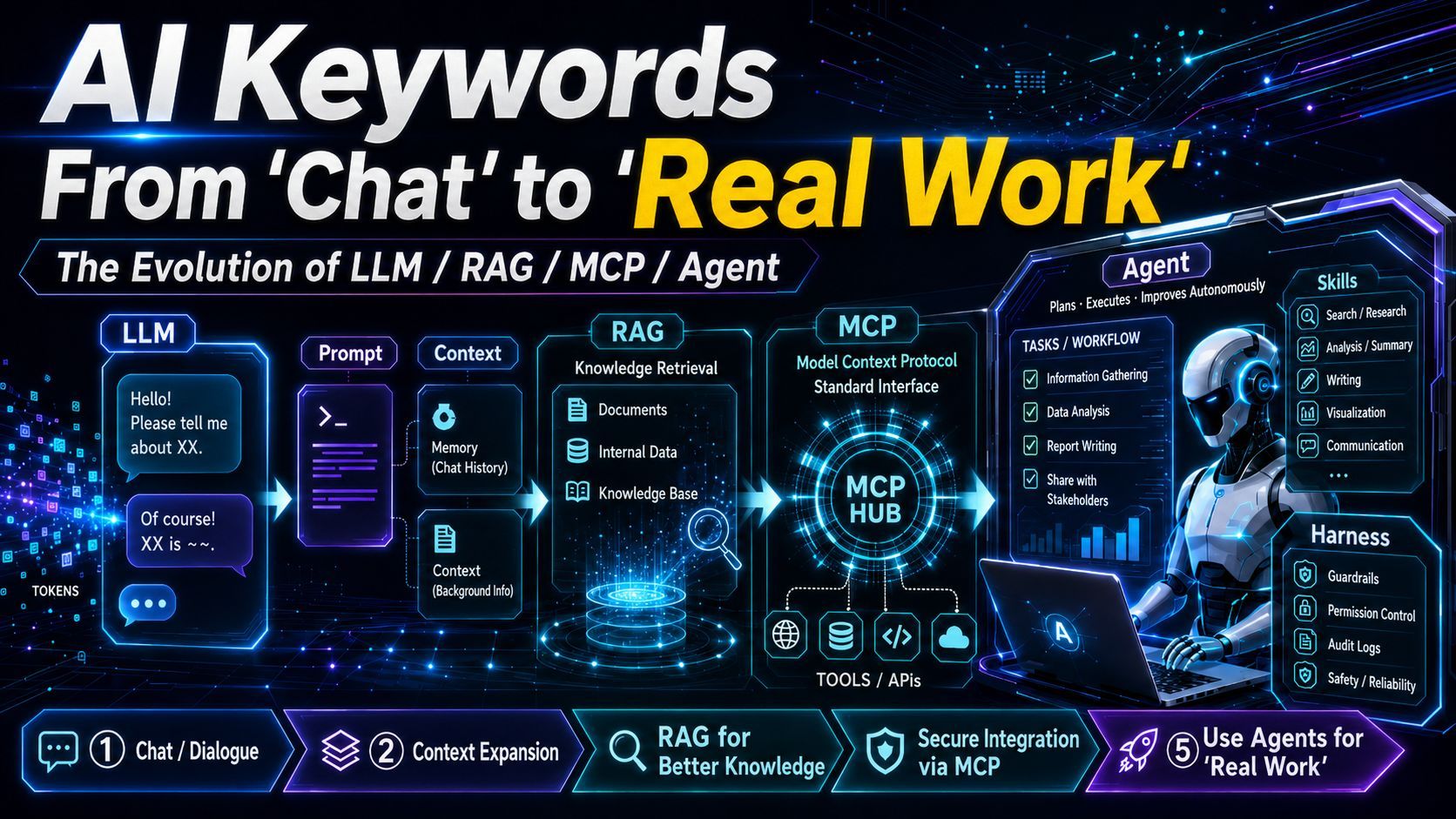
Over the past two years, AI has evolved rapidly. From basics like LLMs and prompts to knowledge retrieval via RAG, external tool integration with MCP, and autonomous execution via agents, AI has transformed from a simple chatbot into a partner capable of performing complex tasks. Using the analogy of a "Tokyo trip," this article demystifies complex AI terminology and maps the evolution of technology, explaining how AI has progressed from simple conversational tools to intelligent agents that truly get work done.

In the past two years, AI buzzwords have emerged one after another: LLM, Token, Prompt, RAG, MCP, Agent, Skill... just reading the list is overwhelming. How did these terms come about, and what pain points do they solve? Let's use the example of a "weekend trip to Tokyo" to connect these complex concepts and explain how AI has evolved from "just chatting" to "actually getting things done."
Phase 1: The Foundation of Dialogue — Models and Prompts
When you open a chat window and casually ask, "I want to visit Tokyo this weekend," the AI responds quickly.
LLM Large Language Model:
This is the core engine behind the scenes.
Token:
Large models do not "read" text directly; they break your input into Tokens. A Token is not a single character, nor is it exactly a word; it is the smallest unit the model understands, with each Token corresponding to a numerical ID. The model predicts the next Token based on calculation, piecing together a complete response.
Prompt:
These are the instructions you provide to the AI. A casual question often leads to a shallow answer. If you rephrase it—"With a budget of 2,000 RMB, please plan a day-by-day itinerary and skip tourist traps"—the quality of the answer improves immediately. This methodology of "being clear" is called Prompt Engineering.
Phase 2: Memory and Knowledge — Context and Retrieval-Augmented Generation
As a conversation deepens, you may want the AI to remember your preferences and associate them with private information. This requires the following technologies:
Context:
When you send a message, the system bundles the previous conversation and sends it to the LLM. This is "context." However, large models have a limited capacity for context, and as the conversation grows, the model may "forget" the earlier parts.
Memory:
To solve the forgetting problem, a common approach is to have the model compress and summarize previous dialogues, retaining only key information. This serves as the model's "memory."
RAG Retrieval-Augmented Generation:
If you ask the AI, "Take a look at the travel guides I saved earlier," the AI often fails because it doesn't know your private files. RAG solves this by slicing your data into small segments and storing them in a knowledge base. When you ask a question, the system retrieves the most relevant segments and provides them to the AI as background resources, making the answer more authentic and reliable.
Phase 3: Giving AI Hands and Feet — External Tools and Standardization
Although large models are intelligent, they were originally unable to operate external tools. For example, they could tell you "how to check for high-speed rail tickets," but could not book them for you directly.
Function Calling:
This is the key mechanism that allows models to connect to external tools. The system informs the model of available tools. When the model determines a tool is needed, it outputs a structured function instruction. The program receives this instruction, executes it (such as checking train schedules), and returns the result to the model.
MCP Model Context Protocol:
Previously, every time a new tool was connected, custom adapter code had to be written, which was difficult to reuse. MCP establishes a unified interface protocol for all third-party tools. Once an AI application is adapted to MCP, it can trigger any tool that follows the protocol, greatly reducing development costs.
Phase 4: From Command to Proxy — The Rise of Agents
Previously, you had to guide the AI step-by-step. Now, you only need to say, "Help me arrange my Tokyo trip," and leave the rest to an Agent.
Agent:
This is an advanced form of an LLM. Once an Agent receives a goal, it autonomously thinks, plans steps, calls external tools, and records the results of each step. It is a system capable of working independently, continuously learning and reasoning.
Forms of Variance:
Essentially, most AI products on the market are Agents, differing only in their degree of autonomy and form. Examples include CLI tools for programming or desktop AI assistants. These assistants can operate your local computer, execute scheduled tasks, and even communicate with you via social apps, acting as true assistants to help you get work done.
Phase 5: Efficiency and Security — Skills and Harnesses
With Agents, we need more efficient management:
Skill:
Prompts are like one-off "tricks" that must be rewritten every time; Skills are like a "book" of structured, reusable, and programmable capabilities. By embedding preferences and rules into a Skill, the Agent can activate, read, and use it as needed during operation, significantly saving on context overhead.
Harness:
When an Agent gains the ability to work independently, it may engage in uncontrolled behaviors—such as making unauthorized purchases or formatting a hard drive—if left unchecked. A Harness acts like a literal harness, putting constraints on the runaway Agent: it provides comprehensive and stable context, establishes red lines (boundaries), and automatically validates task outcomes to ensure the AI explodes with productivity within a controllable range.
Conclusion
These concepts were not conjured out of thin air; each was born to solve the practical pain points encountered in the previous stage. From simple chatting to the Agents of today, AI is undergoing an evolution from "just talking" to "truly capable of doing."