
Insights from Guiguzi’s 'Chuai Pian': Mastering Psychological Insight and Persuasion
This article explores the teachings of Guiguzi’s "Chuai Pian" on navigating complex human interactions. Rather than relying on logic to persuade others, which often fails, the text emphasizes two core concepts: "Liangquan," which involves assessing situations objectively, and "Chuaiqing," which requires understanding the underlying anxieties and desires that drive human decisions. By mastering these techniques and introspecting on one's own attachments, one can move beyond emotional conflicts, communicate effectively, and achieve results without unnecessary confrontation.

Guiguzi, in his work Chuaipian The Chapter on Estimating, once explored a profound proposition: How can one go through life without getting angry?
Many people feel anger in daily life or find those around them unreasonable, ultimately because we operate under a preset assumption: that people are rational. We try to use data to persuade a boss, only for them to fly into a rage; we try to communicate calmly with a partner, only for them to deny the facts entirely.
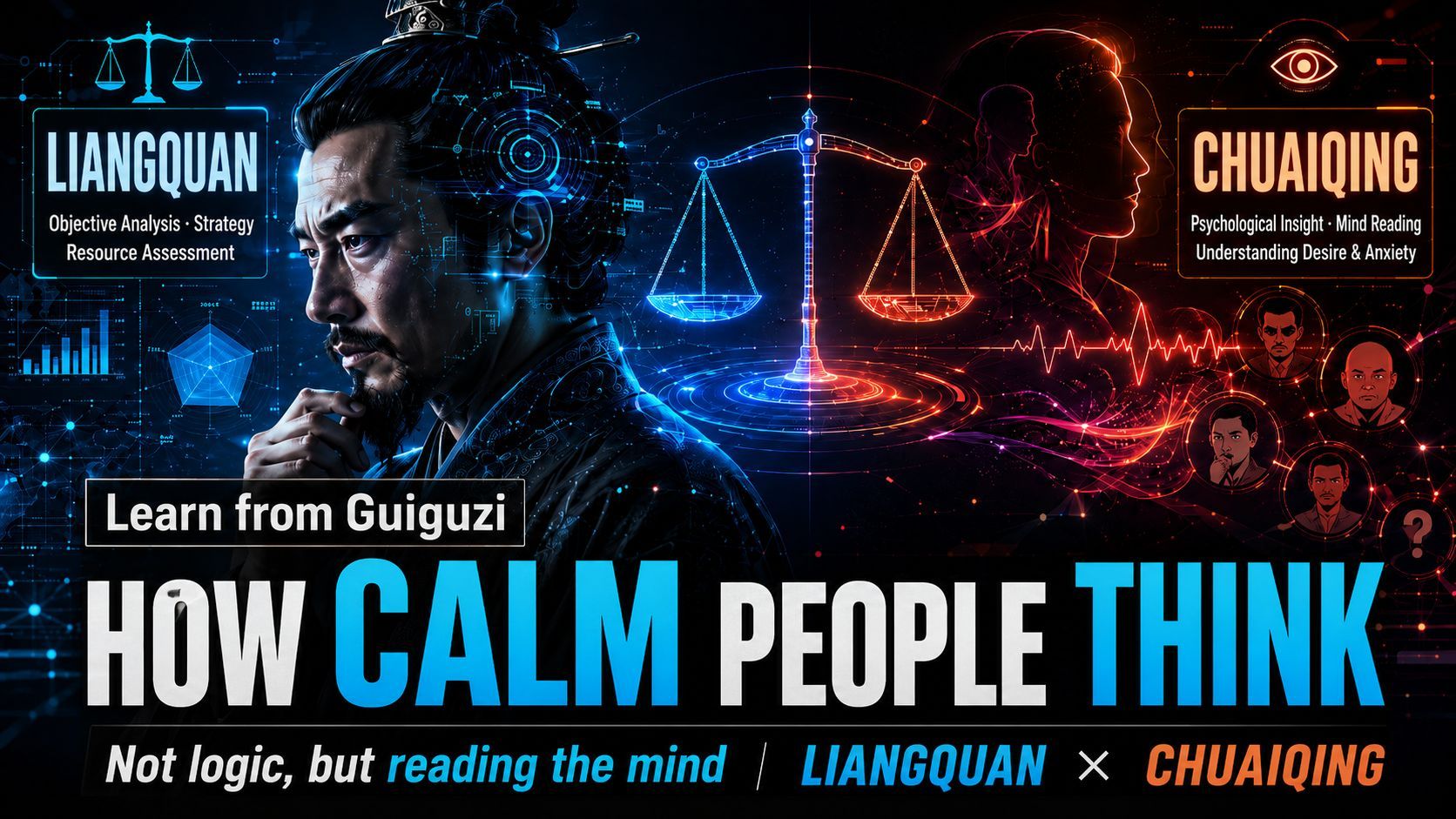
In reality, we are never dealing with "logic," but with the deep-seated insecurities and desires that others desperately seek to satisfy. These underlying factors are often entirely irrational. Those who truly achieve things usually possess two core faculties: one is "Liangquan" (weighing circumstances), used to handle objective matters; the other is "Chuaiqing" (assessing sentiment), used to fathom the human heart.
I. Liangquan: Detaching emotions from the "matter" dimension
The education we receive from a young age often dictates: if you put in the effort, there should be results; if you persist, there should be a response. Therefore, when facing trouble, our first reaction is often to "invest emotions," attempting to force a turnaround through endurance and suffering.
Guiguzi refuted this logic at the beginning of the *Chuaipian*, proposing "Liangquan" (weighing power) when facing matters. The original text points out: "Measure the size, plan for the importance and number, compare talents and resources, estimate the quantity of talent and fame, distinguish the dangers of the terrain, evaluate who has the power and who has the harm, and whose strategies are long or short."
This means that a matter is only about laws and logic, not emotions. We need to evaluate things calmly: Is there enough manpower? Are resources sufficient? What is the environment? Who is the doer, and who is slacking off? The trajectory of a matter often has no direct connection to how much emotion you invest or how hard you struggle. Seeing through this is the first threshold toward maturity.
II. Chuaiqing: Seeing through the driving forces behind the human heart
After crossing the hurdle of examining the "matter," many people fall into the dead end of "reasoning with people." In reality, human rationality is not used for decision-making, but for finding "explanations" for conclusions already set by our psychology. Therefore, no matter how perfect your logic is, if the other party already has a preconceived notion, their behavior will not change.
The "Chuaiqing" (assessing sentiment) that Guiguzi speaks of is very practical:
- Observe the peaks: "When estimating, one must do so during times of great joy, pushing towards the extreme of their desires." When the other party is happiest and most relaxed, go along with their momentum, and what they desire most will naturally emerge.
- Observe the valleys: "One must do so during times of great fear, pushing towards the extreme of their aversions." When they are most panicked and insecure, touch upon the bottom lines they dare not cross; for the sake of self-preservation, they will expose their truest motives.
This also explains why those around you get angry at you: this is likely not about the matter itself, but because their internal insecurity and sense of loss of control have found an outlet. Guiguzi said: "Those who do not manage their internal state will behave basely externally." When a person has suppressed emotions in their heart, their words and actions will sooner or later reveal the truth. Those who truly understand people need only observe the other person's gaze or tone to understand immediately, and thus will not be easily swayed by emotions.
III. The cost of clarity and the way to respond
The clearer you see human nature, the less you feel the need to maintain "emotion without impurities" in your heart. Just as Su Qin lobbied the six states, seeing through the mind of every monarch, in the end, he did not have a single friend he could speak to sincerely. Seeing people too accurately often leads to loneliness. Guiguzi eventually retired to the mountains, partly because such "transparency" is a huge drain on the spirit.
If you encounter someone who is extremely steady and watertight, a head-on confrontation is the worst strategy. Guiguzi suggested: "If they are moved but you do not know the change, then introduce their affairs into the conversation, and instead ask about what they consider light, to know what makes them feel at ease." Since you cannot break through from the front, do not lock horns; go around, and understand their preferences and concerns through people they trust. Handle matters flexibly; do not let yourself be trapped by a single path.
IV. Ultimate cultivation: Looking inward
The core of Guiguzi's scholarship is not just to see through others, but to see oneself clearly.
We speak logic not to solve problems, but to prove "I am right," and to make the other party admit "I am better than you." This obsession with winning or losing is actually no different from the person who is yelling at you and refusing to communicate—we are equally being dragged along by emotions.
People follow you not because you "are right," but because you "spoke to their hearts." When you truly see what you are afraid of and what you are obsessed with, you will no longer be in a hurry to win; and by not being in a hurry to win, you truly possess the ability to persuade others and accomplish great things.
Seeing oneself clearly is the deepest layer of "estimating the heart."