
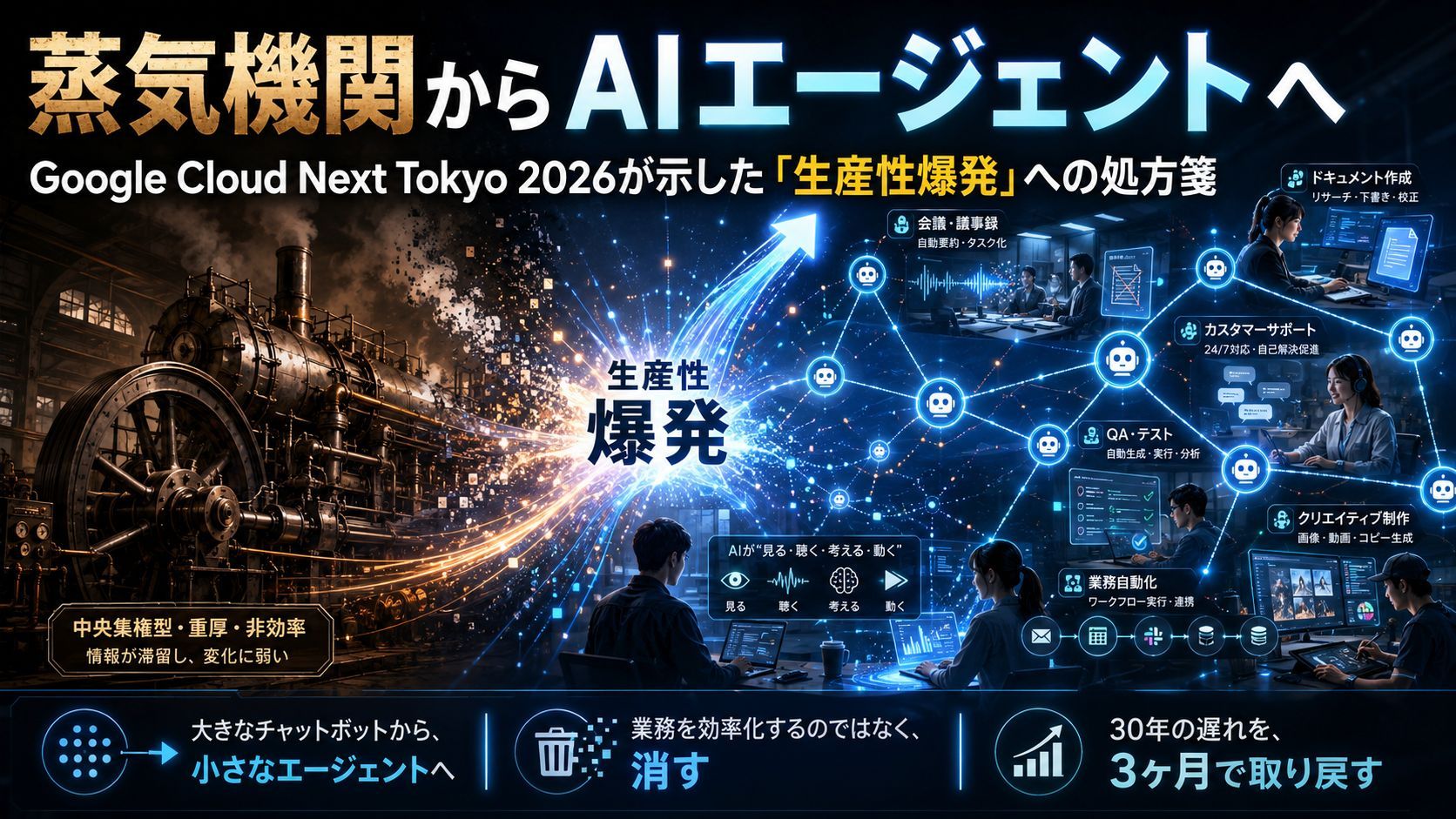
From Steam Engines to AI Agents: Prescriptions for a "Productivity Explosion" at Google Cloud Next Tokyo 2026
Based on Google Cloud Next Tokyo 2026, this article explores strategies for achieving a "productivity explosion" with AI. It highlights shifting from centralized chatbots to localized AI agents, legitimizing shadow AI into corporate assets, real-world case studies from Sompo Japan and Square Enix, and eliminating redundant workflows to augment human capability through multimodal AI.

Introduction: Why Do We Remain "Busy" Even with the Latest Technology?
Historically, there is a massive time lag between the introduction of a breakthrough technology and the moment it truly delivers a "productivity explosion." During the Industrial Revolution, it took 30 years from the invention and factory adoption of electricity before productivity skyrocketed.
Today’s AI implementation faces the exact same situation. Even after adopting cutting-edge tools, frontline teams remain strangely busy, feeling no dramatic shift. The reason? We have satisfied ourselves with simply "replacing tools" without changing the way we actually work.
What Google Cloud Next Tokyo 2026 presented was a prescription to break through this stagnation and trigger a "productivity explosion." Moving beyond mere efficiency, this article dives into the core of how Japanese companies can reclaim 30 years of delay in just 3 months.
Takeaway 1: Abandon the Central "Big Motor" — Shifting from Chatbots to AI Agents
In early Industrial Revolution factories, managers simply replaced large central steam engines with "big electric motors." Because they left the old infrastructure intact—such as ceiling shafts and belts—productivity did not increase for 30 years.
True innovation occurred only when "small motors" were placed directly on individual machines, and workflows were redesigned around the unique characteristics of electricity. Applying this to AI reveals that placing a generic "big chatbot" at the center of an organization is simply not enough.
*"Embedding small motors—AI agents—directly into each frontline task and redesigning work processes might be the very trigger that unleashes explosive innovation."*
While conventional chatbots are "passive Q&A tools," AI agents are "active workforce members" that think, judge, and execute processes autonomously. The key to success lies in shifting away from centralized tools to decentralized "small agents" embedded deep within frontline operations.
Takeaway 2: Japan's "Shadow AI" Is an Expression of Frontline Improvement Desire
Surveys in the Japanese market reveal a striking contrast: while 70% of companies have yet to utilize AI agents, nearly half of active users rely on unauthorized "Shadow AI."
It would be premature to dismiss this purely as a security risk. In frontline operations facing severe labor shortages, this phenomenon reflects a fierce desire among employees to "make current tasks even slightly better"—a sheer survival strategy.
Instead of framing this frontline energy negatively, companies must unlock it on legitimate platforms as "authorized agents." This is the fastest path to transforming tacit knowledge into corporate value.
Takeaway 3: The Day "Minutes Taking" Disappears — Sompo Japan's Challenge
Sompo Japan’s case study demonstrates that the true essence of AI adoption is not "automating existing tasks," but "eliminating the tasks altogether."
While many organizations are figuring out how to make AI write meeting minutes, Sompo Japan utilized a voice memo app that automatically transcribes, stores, and shares content directly into "Gemini Notebook." As a result, the task of "having someone summarize meetings later" was completely erased.
*"Our goal was not to make AI create meeting minutes. We are driving top-down meeting reform under the fundamental premise that meeting minutes don't need to be created in the first place."*
When a culture of "asking AI (Gemini Notebook) before asking colleagues" takes root, vast reserves of tacit knowledge—such as lengthy manuals and policy documents—instantly transform into actionable corporate assets.
Takeaway 4: "See, Hear, and Act" — Multimodal AI Transforms Creative Frontlines
AI has now advanced beyond processing text data into the realm of "multimodal AI," capable of perceiving the chaos of the real world—such as images and audio—as it is.
In Square Enix’s case study, cutting-edge agents "see" game screens, "hear" sound effects, and autonomously operate controllers like human players to identify bugs, automating Quality Assurance (QA) tasks. Furthermore, initiatives like the "Talking Slime" in *Dragon Quest X Online* demonstrate AI buddies that monitor screen situations and initiate conversations on their own.
Agents that can "see, hear, and act" create an environment where humans can focus entirely on creative endeavors that only humans can accomplish—delivering new gameplay experiences and emotional resonance.
Takeaway 5: The Battle in the AI Era Lies in "Outliers" Beyond Efficiency
When anyone can produce a baseline level of output using AI, an organization's "average performance" becomes a low-cost commodity. At that stage, competitive differentiation no longer comes from raising the average, but from creating "outliers"—extraordinary value that sits far beyond it.
As Sompo Japan’s philosophy illustrates, winning the competition comes down to two key factors:
- Whether valuable internal data has been rendered "AI-Ready" for immediate utilization.
- How far humans can expand their "experience, intuition, and framing power" alongside AI as a partner.
By treating AI not as a mere efficiency tool but as a leverage point for human augmentation, companies can strike "outliers" through uniquely human perspectives. This "human capability expansion" represents the true competitive advantage.
Conclusion: Reclaiming 30 Years of Delay in 3 Months
In the era of electricity, productivity transformation took 30 years. Today, generative AI is accelerating dramatically in cycles of 3 to 6 months. There is no time left to wait for a 3-year roadmap.
The "lifehack" we should practice starting today is extremely simple. Before asking *"How can we get AI to do this task?"*, ask yourself first: "Can this task be eliminated altogether?"
Ditch the central "big motor" (old habits and massive tools) and distribute "small agents" (optimized automated processes) across frontline operations. Start redesigning your daily meetings and routine workflows today. The technology is already ready—now it is your turn to shape the future with the right questions.