
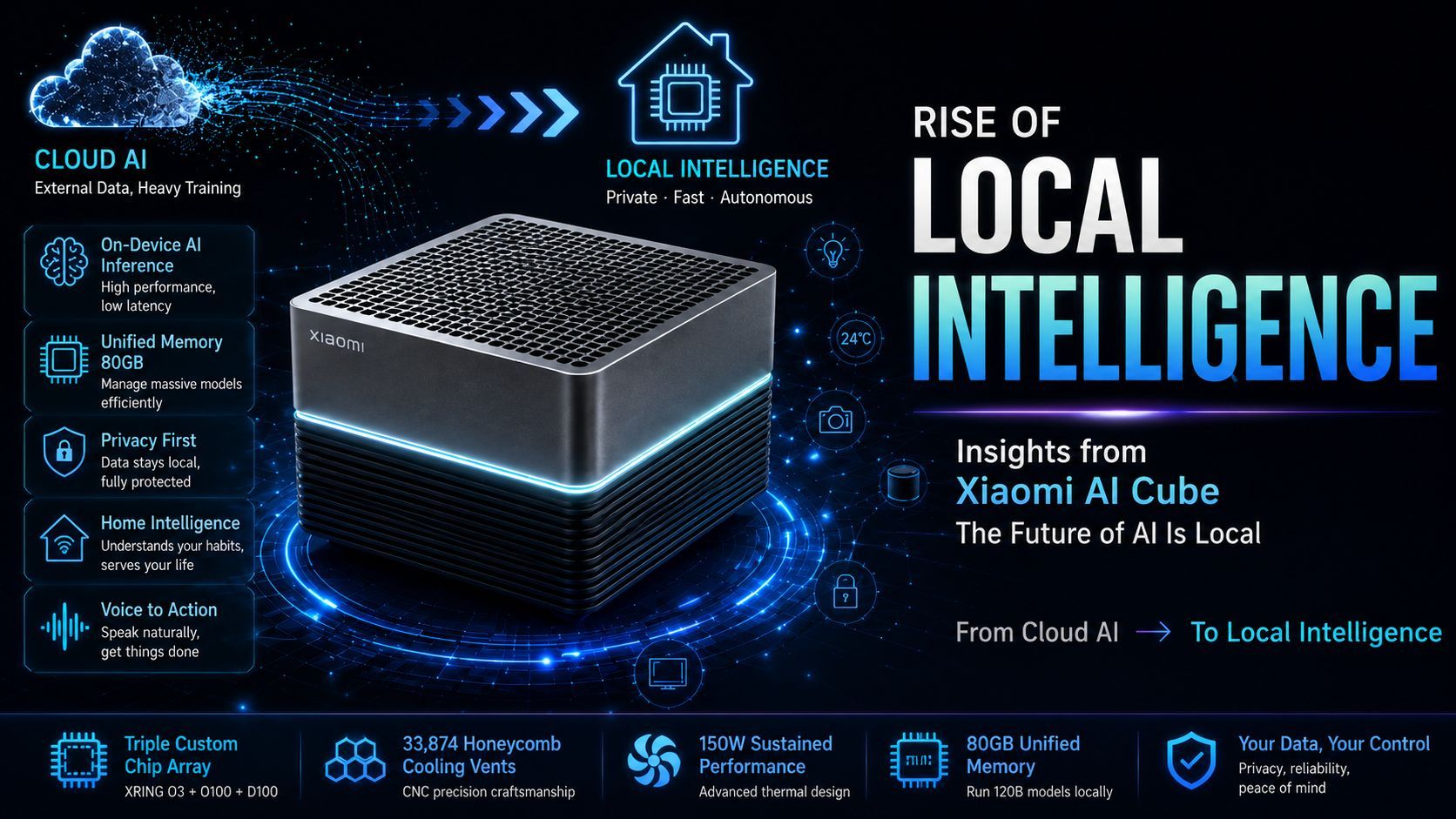
The Rise of "Local Intelligence": Insights from Xiaomi's AI Cube
This article examines the future of AI through the Xiaomi AI Cube, an "AI computing base station," exploring the shift from simple LLM chatbots to "local intelligence" as a foundation for daily life. From an engineering perspective, it analyzes the device's high-performance hardware, local processing for privacy, and the potential for true "Voice to Action." The piece discusses the transition from cloud-dependent AI to a user-centric, locally-integrated AI experience.

Refusing "Pseudo-Intelligence": The Rise of "Local Intelligence" from the Xiaomi AI Cube
What comes to mind when you hear "AI"? A web window that just chats with you, or that loading bar that always says "requesting cloud processing"?
As an engineer, I have seen countless products slapping an AI label on themselves, and I have developed aesthetic fatigue. However, when I saw the hardcore parameters and design philosophy in the technical document at this link, I have to admit, I was moved. This is not just a product; it is a powerful response to the ultimate question: "How exactly should AI serve humanity?"
The Art of "Over-Specing": More Than Just a Chip Party
First, let's examine this "AI Computing Base Station" from an engineer's perspective. Xiaomi clearly isn't playing around this time; they have unleashed heavy firepower:
- Proprietary chip array: The Xuanjie O3 (general computing), Xuanjie O100 (AI acceleration), and Xuanjie D100 (high-performance driving intelligence) work in synergy—a computing array custom-built for local AI.
- Cooling aesthetics: The body is CNC-milled with 33,874 honeycomb cooling holes. This is not just for looks; it is the confidence required to continuously output 150 watts of performance under such high loads.
- Memory specs: The unit comes with 80GB of huge unified memory. What does this mean? It means large models (120B parameters) can reside locally without needing to frequently "handshake" with the cloud.
For those of us who stare at latency every day, local inference is the truth. No longer restricted by network status or smart connectivity dropping in tunnels or parking garages, this is the first step for AI to truly land in the home from the cloud.
The True Revolution: From "Local LLM" to "Local Intelligence"
The market is flooded with various Local LLM demos, but many products just stuff a chatbot into hardware. You ask it "How is the weather today?", it answers, and that's the end of the story.
But this isn't a revolution.
The real pain point is: How does the device understand "what happened" and get things done? This is known as "Voice to Action."
The direction Xiaomi AI Cube provides is clear:
"The true change isn't called 'Local LLM,' it's called 'Local Intelligence.' AI no longer lives in an App; it becomes the foundation of life."
Imagine a scene: You wake up without giving orders, your watch senses you're awake, the curtains open automatically, and your headphones organize the key points of your meetings. AI is not an app you need to "open"; it is the butler watching over you silently. It knows your habits, knows who you are, and knows when to exercise restraint in certain environments, rather than constantly intruding on your attention.
A Thought for Engineers: Why Now?
We often say that "technology working" and "consumers being willing to pay" are two different things. The AI application layer is indeed facing a reshuffle right now. If we just simply stuff large models into phones, users won't buy it.
But, when AI starts becoming the butler of home data—analyzing medical reports for us, searching through hundreds of thousands of photos, and even processing highly private household financial ledgers—the value of the product changes.
- The boundary of privacy: All data is stored locally, meaning conversations and living habits do not need to leave the house. For privacy-conscious users, this is a solid barrier.
- The return of the human: The logic of the future shouldn't be "the device is the center," but rather "the human is the center." Small tasks stay by your side, difficult problems are handed to the cloud, and computing is positioned exactly where it should be—this is the most reasonable system architecture.
Conclusion
The current AI Cube is still an engineering prototype; it hasn't even been decided if it will be sold to the public. But it shows us a possibility: when computing power is powerful enough and deployed locally, AI can transcend mere "chatting" and become a life foundation that truly understands you.
The transition from flip phones to smartphones didn't happen overnight. Perhaps we are witnessing the eve of the leap from "Cloud AI" to "Local Intelligence." As developers, perhaps we should focus more on: How to utilize this local computing power so AI can truly save users from hundreds of repetitive operations every day, rather than just keeping them company.