
AI Can Already Answer. So Why Isn’t the Work Done?
AI can now write, answer, and draft proposals, but generating something is not the same as doing the work correctly. As agents move from conversation to execution, people still define the problem, design the process, judge the result, and own the consequences. Drawing on project experience, this article looks at PM/FD roles, requirements and acceptance, reusable skills and knowledge, and turning deliverables into templates. The technology will keep changing; getting the method right matters more.

AI Can Already Answer. So Why Isn’t the Work Done?
Recently I talked with several experienced friends, and they described a similar frustration. AI can write, answer questions, and draft proposals. But when you put its output into real work, you often have to rewrite it from the beginning. The problem isn’t that it generates too little. It’s that it doesn’t generate the right thing.
That also explains something I’ve noticed: the more hands-on experience people have, the less likely they are to treat AI as a tool where “type one sentence, receive a deliverable.” They care about the conditions under which it can be trusted, how far it should go, and who signs off. AI has become a required skill, but the core of that skill isn’t prompt writing. It’s knowing what “right” means.
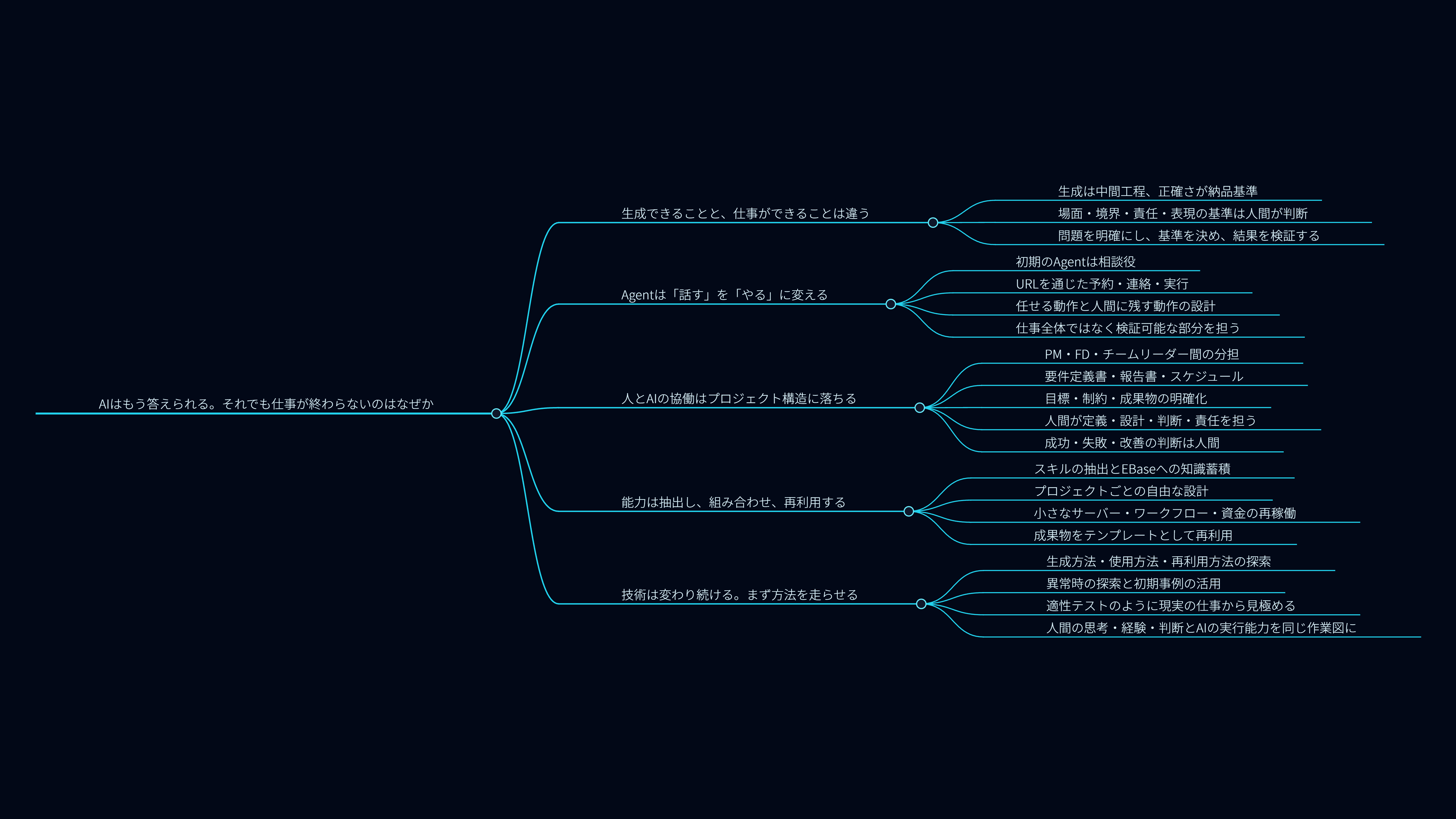
Generating something is not the same as doing the work
One line from the conversation stayed with me: the goal isn’t just to generate, but to generate correctly. Generation is an intermediate step; correctness is the delivery standard. Context, boundaries, responsibility, terminology—those judgments still sit with people. The more experience you have, the faster you spot what’s off and the better you can pull AI’s output back into a usable range.
So it’s not enough to ask whether AI can generate something. A report, a proposal, a piece of code—generation is only the start. Does it fit the constraints of this project? Will colleagues and clients accept it? Who is accountable if something goes wrong? A stronger model does not answer those questions automatically. What we actually need to train is the ability to frame the problem, set the standard, and verify the result.
Agents turn “talking” into “doing”
I’ve built AI agents myself. Early agents mostly discussed unfamiliar topics in a web page or chat window and then replied. They were like an adviser sitting nearby: useful for information, but someone still had to do the work.
What has changed is that agents are starting to connect to concrete actions. Through a URL, an agent can contact a service, complete a booking, and take over a flow that used to require a person to open a page, fill in details, and confirm a time. Anything that can be booked can, in principle, be wired into that flow.
The significance isn’t that agents are better at conversation. It’s that they are beginning to occupy the layer of execution. Which actions can be handed over, and which must stay with people, becomes a new design question. The boundary matters too: some work is already finished, and some has not moved over. An agent doesn’t swallow the whole job; it takes the parts that can be described and verified.
Human-AI collaboration has to land in the project structure
In large-scale development and team work, the issue becomes more visible. A project needs a PM, and it also needs roles like FD. Team leaders need clear divisions of work, and project groups need interfaces. In the past, each domain offered different projects, handled by S.E.s or research engineers. When needed, the right people were moved into more specialized positions.
When working with project groups, requirements documents, reports, and timelines still follow the old approach. AI hasn’t made project governance disappear; it has made it more important. Only when goals, constraints, and deliverables are written clearly can an agent take something on. And once a project is running, the team still has to keep asking how to improve it, how to add complexity, and how to turn deliverables into reusable templates along the way.
So human-AI collaboration isn’t a slogan. It’s a division-of-labor chart. People define the problem, design the process, judge the result, and own the consequences. AI executes the parts that can be separated cleanly. There need to be interfaces between the two, and there needs to be acceptance testing. Without that, stronger AI can mean more rework.
Success, failure, improvement—those three words come up again and again in projects. AI can shorten the middle of the process, but it cannot define success on a person’s behalf, and it cannot bear the cost of failure for them. Where it’s worth continuing to invest, and where to stop and rebuild, remains a human judgment.
Capabilities need to be extracted, combined, and reused
The conversation offered another judgment: skills can be extracted from a wider range, and knowledge can accumulate in EBase. For each individual project, those pieces can be combined and controlled according to the process, and the design can be free.
The underlying change is that organizational capability no longer lives only in one person’s head. It can be broken into skills, knowledge, and processes, then reassembled project by project. Small servers, workflows, and funding can be set in motion again. The conversation mentioned that the company’s performance had been good for a while, that spending fell, and that the second half improved further. No verifiable data was given, so I treat that as a direction rather than a proven conclusion.
What actually accumulates is a deliverable being reused as a template. The next project doesn’t start from zero; it starts from the structure of the previous one. Improvement stops being a slogan only when it is reused.
The technology will keep changing. Get the method running first
Where does a new way of generating make sense? What method should be used? How do we use it, reuse it, and eventually use it directly? There are no standard answers yet. What is clear is that the technology will keep improving, and no one can write the future in advance.
What we can do is keep exploring. When something unusual happens, go and look at it. A good example from the earliest stage may lead to a much bigger change. Colleagues used to offer similar aptitude tests: first look at what a person actually does and what suits them, then make a plan. The same applies to AI. First see where it can genuinely deliver, then decide how much to put in.
In the end, AI and human intelligence belong on the same work map. That doesn’t mean handing over all the work, and it doesn’t mean keeping AI outside the door. It means putting human thinking, experience, and judgment in the right place alongside AI’s capacity to execute. AI can already answer. The next question is how we redesign the work.