
Making Money Without Making Anything: The Logic and Limits of the Distribution and Retail Model
This post breaks down the distribution and retail model: companies make nothing, buy from producers, sell to customers, and earn the spread. It explains the two axes—matching power and the value chain—through Treasure Factory, which cleans and repairs secondhand goods for a 55.9% gross margin. It then examines the model's two weaknesses, easy imitation and thin profitability, and why general supermarkets and trading houses are moving toward combined models.

Making Money Without Making Anything: The Logic and Limits of the Distribution and Retail Model
Most of the time, the company that sells a product is not the company that made it. Department stores, supermarkets, wholesalers, and specialized trading companies take goods from manufacturers and pass them on to the next buyer. They make nothing themselves; their revenue comes from the gap between the purchase price and the selling price. This is the distribution and retail model—a business model that looks almost devoid of technical skill, yet sustains companies such as Mitsukoshi Isetan, Takashimaya, Itochu, Mitsubishi Corporation, Mitsui & Co., Sumitomo Corporation, Marubeni, Toyota Tsusho, ASKUL, and MonotaRO.
The barrier to entry looks low: anyone can buy inventory, and anyone can open a store. But the companies that have grown large and lasted for generations have not done so by relying on the phrase "buy low, sell high." Understanding where they create value also explains why this model can produce a 300-year-old business while keeping an entire industry trapped in thin margins.
1. Making Nothing, and Owning Only the Job of Getting Things to the People Who Need Them
The definition is simple: the company does not manufacture products. It purchases from producers, sells to customers, and earns the difference. Retail, wholesale, and specialized trading companies are the three most typical forms.
Broadly interpreted, investment funds also fit the framework. A fund pools capital from investors and allocates it to companies that need money; an advertising agency organizes information about a business and delivers it to consumers through the media. Neither produces physical goods, but both perform a connecting function between producers and consumers—or between sources of capital and recipients. That is why an investment firm such as Integral and an advertising group such as Dentsu can also be included in this model.
The industry also contains a quieter group of long-lived companies. The department stores under Mitsukoshi Isetan Holdings, Takashimaya, J.Front Retailing, and general trading houses such as Itochu, Mitsubishi Corporation, Mitsui & Co., Sumitomo Corporation, Marubeni, and Toyota Tsusho are all established names in their fields. Some specialized trading companies were founded in the 17th century and have histories spanning more than 300 years. They do not stand in the spotlight the way technology companies do, but they run steady businesses rooted in their regions—options worth serious consideration for anyone thinking about working at or investing in this kind of company.
2. Two Axes: Matching Power on One Side, the Value Chain on the Other
The distribution and retail model can be broken down along two axes.
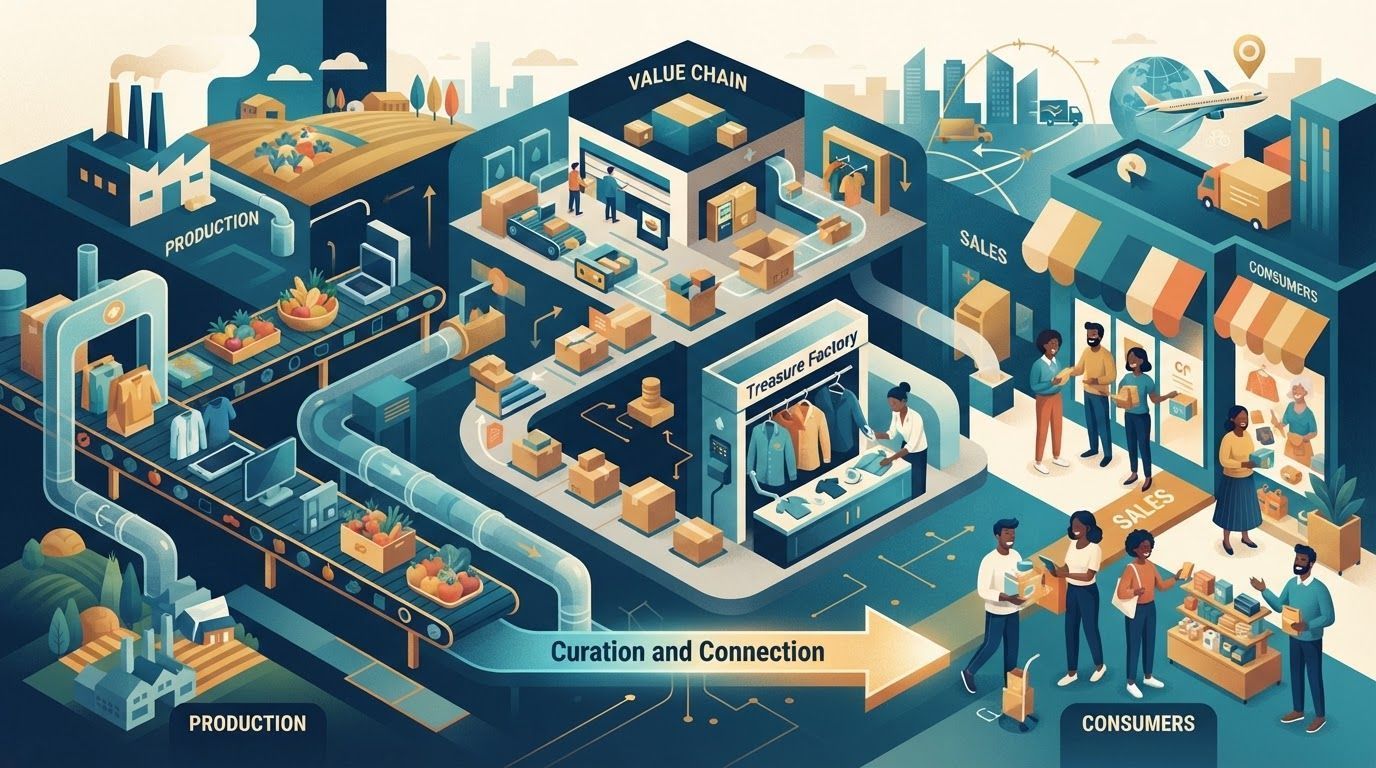
The horizontal axis is the source of value: what we might call "matching power." It connects producers and consumers who would otherwise struggle to find each other, through company-owned stores, distribution channels, media, or capital. A department store gathers scattered brands into a single space; a trading company links overseas supply with domestic demand. The first layer of value they sell is a lower cost of finding the other side.
The vertical axis is how the company makes money: the value chain. From procurement, processing, and logistics to display and sale, the company looks for points along the entire chain where it can add a markup.
There is an often-overlooked premise here. If you simply buy the same product and resell it unchanged, it is actually hard to create value. The product functions the same no matter where it is bought, so customers have no reason to pay extra for the fact that it passed through your hands. What determines profit is whether you can add a step along that chain that others have not. Buying in bulk to lower the purchase price, choosing a better store location, changing the product mix, or offering added services such as cleaning and repair—these are the moves that create the spread.
In other words, the core of the distribution and retail model is not the act of buying and selling. It is what you add between the buying and the selling.
3. Treasure Factory: Turning Cleaning and Repair into Margin
Treasure Factory, a secondhand clothing chain, is a clear example. It operates reuse shops mainly in the Kanto and Kansai regions, handling used clothing, bags, wallets, and similar goods. The business model is to buy unwanted items from individual customers, organize them, and sell them in its stores.
The key is that it does not simply "take items in as they are and sell them as they are." Purchased goods are cleaned, repaired where necessary, and only then put on the sales floor. Cleaning, repair, sorting, and display are all steps added along the value chain from purchase to sale. Customers are willing to pay more for a secondhand item that has already been cared for and is ready to use. That is where the margin comes from.
The numbers make the point. Treasure Factory's total purchases were about 14.8 billion yen, while sales were about 33.6 billion yen—2.3 times the purchase figure. On a per-item basis, that is roughly a 3,000-yen purchase sold for 6,800 yen. The gross margin reaches 55.9%, a notably high level for retail.
That 55.9% is not evidence that "the secondhand business is naturally a gold mine." It is a number produced by cleaning, repair, product selection, and store operations working together. Pile up the clothes you bought and resell them at cost, and the number does not hold.
4. Two Weaknesses: Easy to Copy, Hard to Make Money
The first problem with the distribution and retail model is that it is easy to imitate.
In the secondhand business, for example, opening a store requires a secondhand goods dealer's license, and appraising branded goods requires specialized knowledge. But those conditions are not enough to create a lasting barrier. The industry includes large chains such as GEO Holdings and BOOKOFF GROUP HOLDINGS, as well as online flea-market platforms such as Mercari. Physical stores must compete with peers on price and location, and they must also compete with online services that are not constrained by storefronts. The model itself has no patent; anyone can learn it.
The second problem is low profitability.
Competition to buy secondhand goods is intense, and the average operating margin of listed major secondhand retailers is only a little above 2%. Specialized trading companies earn most of their revenue from fees for connecting suppliers and customers, and their operating margin is only around 2%. Department stores and bookstores are hardly high-margin industries either.
The reason is not complicated. Products are hard to differentiate, so competition tends to slide toward "who can operate at a lower cost and sell more cheaply"—or customers are pulled away by e-commerce sites and commercial facilities that are cheaper and more convenient. Low profitability is not the result of poor management at one company. It is a structural outcome of the model.
5. When the Spread Is Too Thin, Where Do Companies Go?
Precisely because profits are thin, many companies do not stay in "pure distribution and retail." They extend from this model into other forms of business.
General supermarkets are a representative case. Rather than relying only on the simple spread between purchase and sale, they moved toward selling combinations of goods and services and managing the business on overall returns. General trading houses have followed a similar path. They traditionally handled distribution and trade, but they have layered business investment on top, building a "trade plus investment" combination.
These changes do not mean the distribution and retail model has stopped working. On the contrary, they show that the model's foundation—matching power and the value chain—remains valid; it is simply that the single layer of "buy and sell" can no longer support higher returns. What companies need to do is keep adding steps to the value chain, or connect their distribution capabilities to other sources of revenue.
Back to the opening question: if you make nothing, how do you make money? The answer is that these companies are not earning from the product itself. They earn from connecting and from processing. Connecting lowers the matching cost between producers and consumers; processing makes the same product more valuable at the end of the chain. The better they do both, the wider the spread. When neither can create real distance from competitors, low profitability becomes the industry's normal state—and reinvention becomes a required course.