

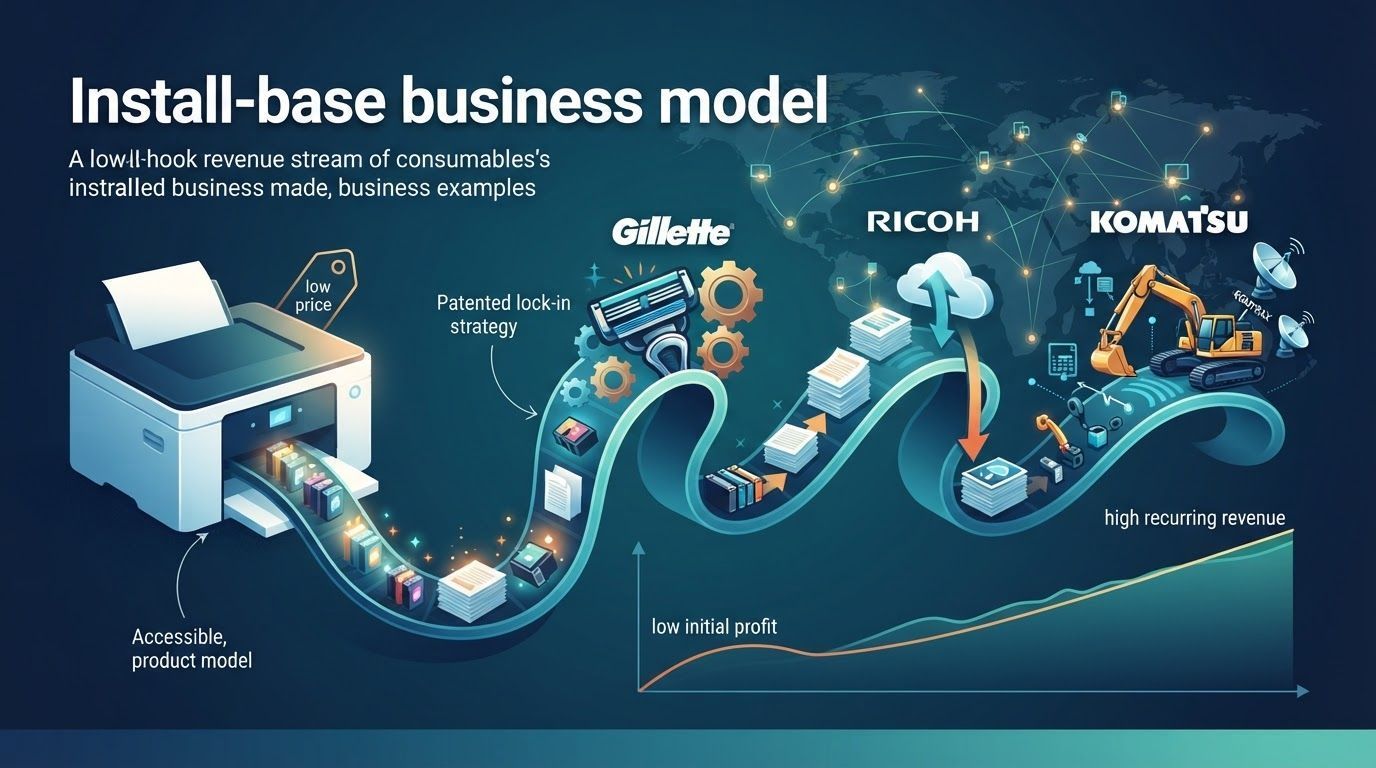
Sell the Machine Cheap, Earn on Consumables: The Power and Limits of the Installed-Base Model
When a copier is sold, the real profit often comes not from the machine itself but from the toner, consumables, service contracts, and replacement parts sold over the following years. This seemingly simple arrangement is the "installed-base model," also known as the "razor-and-blades model." The point is not cheapness per se, but using an inexpensive hook product to open the door and then recovering value through ongoing consumption and service.
But why does this logic work in some industries and fail in others? Gillette, Ricoh, and Komatsu show both its conditions and its limits.
1. Cheap Is the Entrance; the Money Is in the Combination
The structure of the installed-base model can be broken down along two axes.
On the horizontal axis, the source of value is the "power of combination": a company first offers its base product at a relatively low price—sometimes close to cost—so that as many customers as possible start using it. It then supplies higher-margin maintenance services and consumables. The base product builds the installed base; consumables and services recover the profit.
On the vertical axis, the way profit is captured is "recurring": the sale is not the end of the transaction. After the sale, the company keeps supplying consumables, parts, and services over the long term, earning revenue again and again. The crucial point is that if consumables, too, are sold as a one-off, the model degenerates into ordinary "bundling" and is no longer an installed-base model.
So there are at least two preconditions. First, the base product must be durable enough and used often enough that customers stay within your installed base for a long time. Second, the consumable or service must remain "connected" to the base product—through a physical interface, a patent, certification, a service network, or any mechanism that keeps customers from casually switching to another vendor. Without that connection, a cheap machine is just a one-time concession.
2. What Gillette Really Invented Was the Connection Between Blade and Handle
In the early twentieth century, a razor was still a high-end durable good that had to be honed again and again. King C. Gillette wanted to turn the blade into a disposable item: the handle could be used for years, and the blade would be replaced once it dulled. To achieve that, he put enormous effort into thin steel sheet manufacturing, eventually making a disposable blade that could be mass-produced.
The Gillette company soon became America's largest razor manufacturer. But imitators appeared quickly. Gillette's response was not to make the handle even cheaper. It was to patent the way the blade connected to the handle: the handle was built with a special structure that accepted only genuine Gillette blades. Competitors could sell blades, but not blades that would fit. To make a compatible blade, they would have to get around the patent on the connection.
That is the heart of the razor-and-blades model. The cheap handle exists to give the blade somewhere to go; the patent exists to keep the blade coming from Gillette. The first is the entrance, the second is the lock. Without the lock, the entrance is just loss-leading.
The model also has a shelf life. Gillette was the world's largest razor maker for a long time, and in 2005 P&G acquired it for $57 billion. Since then, however, its market share has reportedly been declining as competitors have risen. However good the model, it does not guarantee a permanent win.
3. Wear Turns "Service" into a Necessity
The same logic is even clearer in office equipment and industrial machinery.
A copier or printer consists of the main unit, paper, toner, ink, and maintenance service. The main unit can be sold relatively cheaply, but any machine wears out as it runs: friction, heat, and reciprocating motion mean parts need lubrication, cleaning, and replacement. Unlike digital content, a physical machine consumes itself simply by being used. Consumables and maintenance are therefore not optional; they are the condition for keeping the machine running. Many manufacturers also keep this recurring revenue in-house through the "genuine consumables" arrangement.
Ricoh is a long-established name in copiers and printers. It is struggling to grow amid the shift to paperless work. The example reminds us that the installed-base model can lock in "consumables" but not "purpose." When customers no longer need to print or copy in volume, the installed base itself shrinks, and no clever consumables mechanism can make up for it.
IT services have a similar variant. OBIC, for example, handles system implementation and operation as one integrated business and earns a profit margin above 60% through long-term operation and service. What it sells is less a one-off development project than the continued running of the system. The base product changes from a machine to a system, but the structure—establish a relationship first, then profit from continued use—remains the same.
4. Komatsu's KOMTRAX: From Selling Parts to Selling Uptime
Construction machinery takes the installed-base model further. Excavators and mining machines are essential on-site equipment; if one breaks down, the whole operation stops. These sites are often far from cities, and rushing a part in can take days. While the machine sits idle, rental fees for other equipment and workers' wages keep accruing. For the customer, the real pain is not the price of the part but the downtime.
Komatsu began research in 1996, building GPS and communication systems into its vehicles so that operating status and location could be monitored remotely. The system is KOMTRAX. In 2001, Komatsu made KOMTRAX standard equipment on some hydraulic excavators sold in Japan; in 2004 it extended the system to China, and in 2006 to models sold in the United States and Europe.
What is more interesting is how the data is used. Information collected by KOMTRAX is fed back to sales dealers, who use it to judge how hard a machine is actually working, prompt oil changes at the right time, and replace parts before a failure occurs. Service thus shifts from "repair after breakdown" to "condition-based preventive maintenance," so the customer's machine runs more reliably, downtime risk falls, and work becomes more efficient.
Here the center of gravity of the installed-base model has moved from "selling genuine parts" to "selling availability." The machine is the entrance, data and service are the recurring revenue, and the dealer network is the connection. It is still combination plus recurrence—only now the combination includes a layer of information.
5. When the Model Works
Putting the cases together, the installed-base model rests on roughly three conditions.
First, the base product must build a sufficiently large installed base and be used by customers for a long time. A one-off purchase or a low-frequency product cannot support recurring revenue afterward.
Second, the consumable or service must be a genuine necessity and must be stably connected to the base product. Gillette relies on patents, printers on genuine consumables and machine design, Komatsu on proprietary terminals, dealers, and on-site service. The stronger the connection, the steadier the recurring revenue.
Third, the purpose of the base product must not be replaced. Ricoh's pressure comes from paperless work, not from poor consumables sales; Gillette's pressure comes from competition, not from blades no longer wearing out. The installed-base model is good at managing "equipment already installed," but poor at fighting "customers no longer needing that equipment."
This is also where it is most often misread. Seeing "sell machines cheap and earn on consumables for years," many assume low price is the core. In fact, low price is only a means of expanding the installed base. What decides success is whether the recurring-revenue pipeline after installation is solid, and whether the use it depends on still exists.
In one sentence: the combination of a hook product with repair and consumables, multiplied by the time of continued use. The part before the multiplication sign determines whether customers come in; the part after determines how long the business can last.