
The Sale Is Only the Beginning: How the Installed-Base Model Produces High Margins and Stability
Sell a machine, and the transaction looks finished. For another kind of company, that is exactly when the real business starts.
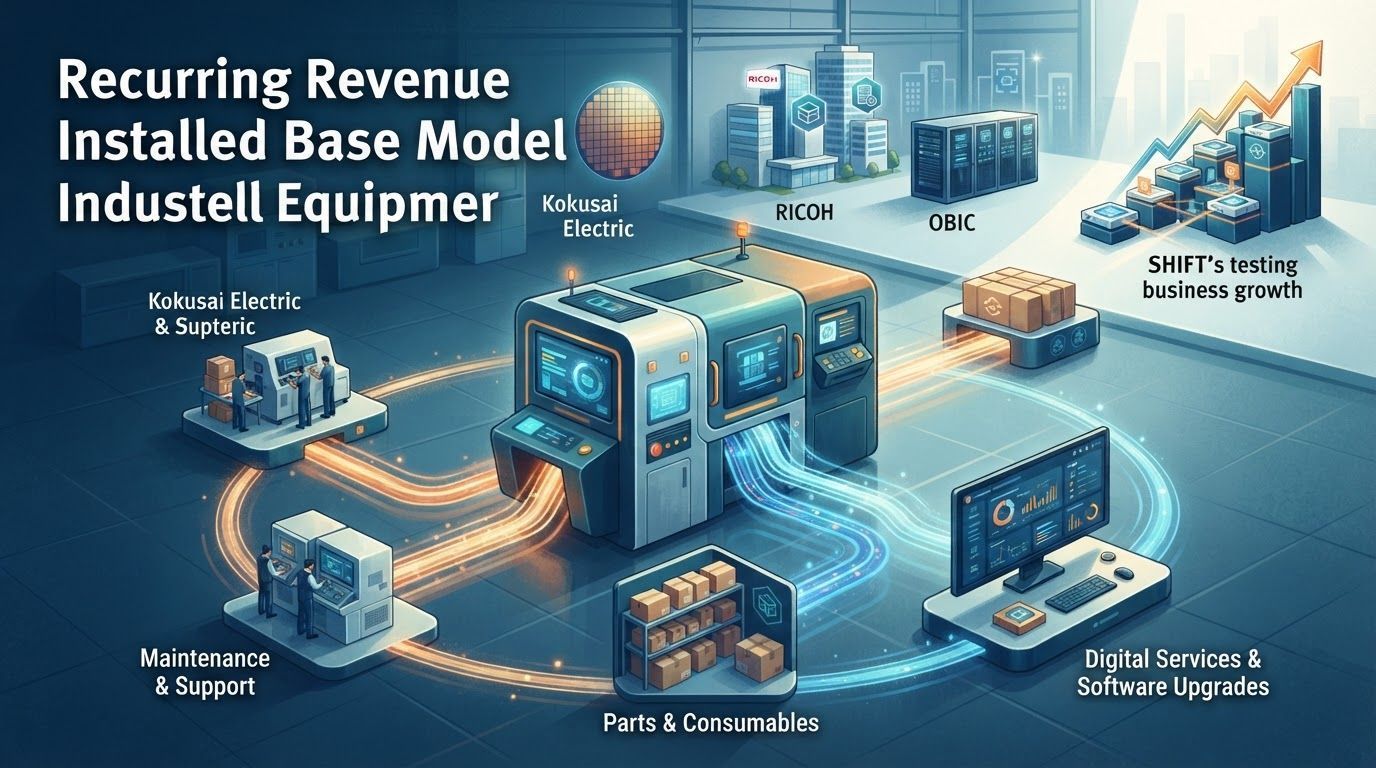
In Japanese, the term is *setchi base model* — literally the "installed-base model." The point is not to charge more for the equipment but to keep it installed at the customer site and build a continuing stream of consumables, parts, repairs, upgrades, and services around it. Equipment sales are one-off; the installed base endures. Revenue shifts from a one-time transaction to cash flow billed by the year, the month, or even the page.
The model is often reduced to "razor and blades": sell the handle cheaply, make money on the blades. But the interesting part is not the pricing trick. It is the structure it creates: switching costs rise, revenue becomes more predictable, and service capability becomes a platform for entering adjacent businesses. The three companies below apply this logic to semiconductor equipment, office machines, and IT systems. At the end, I will add a company that takes a different route.
1. Kokusai Electric: Service Is Only 20-30% of Sales, but It Earns More Than Equipment
Kokusai Electric makes semiconductor manufacturing equipment — the machines used to produce the chips inside electronic devices. Circuit patterns have reached 7 nanometers, or seven billionths of a meter, and equipment capable of that precision carries high added value. The company's operating margin reaches 20-30%.
The industry has another feature: in the equipment market for each step of the semiconductor manufacturing process, a handful of major suppliers hold large market shares. The industry is highly concentrated, which makes it easier for leaders to sustain high profitability.
The real lesson at Kokusai Electric, though, is service. Semiconductor manufacturing involves repeated cleaning and heat treatment; some parts wear out quickly, creating constant demand for consumables. Factories also frequently rearrange equipment to improve efficiency. Once a tool is installed, maintenance and technical support become unavoidable recurring expenses. Service accounts for 20-30% of the company's sales. It does not disclose segment profit, but on the economics of the business, service is more profitable than equipment sales.
That is why the company designs for service from the development stage: parts that matter in maintenance are made easier to handle, anti-counterfeiting features prevent third parties from copying components, and service contracts are secured early, around product launch. The more tools it sells, the larger the installed base it can serve; the more parts and maintenance revenue it earns per tool, the thicker the service business becomes. It is a revenue curve that runs from "sell one machine" to "service it for years."
The semiconductor industry cycles through booms and downturns roughly every two to three years. In good times customers expand capacity and orders pour in; in bad times they cut capital spending first, and equipment sales fall sharply. That is when service revenue proves its worth. It cannot abolish the cycle, but it can hold up the company's overall results and keep R&D and next-generation product work from being interrupted.
2. Ricoh: The Money Starts After the Machine Lands in the Office
Office equipment is the textbook case of the installed-base model. Copiers and printers are installed in offices and schools, and the continuing revenue comes from toner, parts, and maintenance. The machine itself is a one-time sale; consumables and service last for years. As long as the machine is in use, revenue keeps coming.
Barriers to entry are high. Canon, Ricoh, and other Japanese manufacturers hold most of the market. An office machine looks like "just a printer," but behind it are chemical engineering, mechanical engineering, and other disciplines that must be integrated with great complexity and precision. A latecomer cannot simply copy the formula.
The business model has also evolved. Companies used to sell machines; today leasing or charging by print volume is more common — for example, two yen per monochrome page. Customers no longer pay to own the equipment; they pay to use it. For the manufacturer, this reinforces the importance of the installed base: the more machines are installed and used, the steadier the stream of consumables and service revenue.
But the office equipment industry faces a structural headwind: paperless work. Digitalization is reducing print volumes, and remote work has further cut demand for office printing. One forecast sees office print volumes continuing to fall by about 5% a year. The machines remain, but usage is declining — a direct erosion of a model built on per-page charges.
Ricoh's response has been to turn the customer relationships created by its installed base into a gateway to new business. It uses the customer touchpoints and trust built in office equipment to expand from "office machines" to "digital services": selling business-process improvement software to existing customers and helping them digitalize. That cannot be done by the existing sales force alone. Ricoh trained the staff responsible for equipment warranties and inspections so they could understand customers' specific digitalization problems and propose solutions. To keep customers buying services, talent development and more compelling product development are both essential.
Facing the same shrinking market, Canon chose a different path: acquisitions to raise the share of revenue from outside office equipment. Commercial printing, surveillance cameras, and medical equipment are the main fields it entered through M&A, with acquisitions in these areas totaling more than one trillion yen. Canon looks for areas where its optics and mechanical engineering can be applied and uses acquisitions to prepare for a paperless world. Those large investments were possible precisely because the office equipment business generated stable earnings.
Ricoh and Canon chose different routes, but the underlying logic is the same: the installed base provides not only profit but customer relationships, cash flow, and the time needed to transform. The machine is the entry point; the customer relationship is the asset.
3. OBIC: The Real Long-Term Revenue Starts After the System Goes Live
IT systems are another "once installed, hard to remove" business. Factory production lines, retail sales and inventory management, corporate accounting and HR all depend on systems to process large amounts of information. System developers typically combine two businesses: building systems to customer requirements, and maintaining and operating them afterward. That is the classic installed-base model — going live is not the finish line but the starting point of a long service relationship.
OBIC has taken this model unusually far. It targets mid-sized companies with revenue of 50-100 billion yen, handles indirect functions such as accounting, HR, and sales end to end, and develops and sells mission-critical information systems. Through March 2024, it had posted 30 consecutive fiscal years of operating profit growth, with an operating margin of 63.5%.
Behind that number is an organizational model that runs against industry convention. System developers usually operate a prime contractor/subcontractor structure: a large firm takes the prime contract and manages the overall project, while development and operations are outsourced to subcontractors. This saves internal resources and allows the prime to take more orders. OBIC keeps almost every process in-house. By not relying on outsourcing, it can respond quickly to system changes and accumulate development and operations know-how internally.
It also uses standardization to hold down the cost of customization. For the mid-sized clients it knows well, OBIC standardizes development requirements by industry and business type, eliminates ambiguity during requirements definition, and minimizes rework and problems later. After go-live, most customer systems run on OBIC's dedicated cloud, operated by the company itself.
The results show up in margins: the systems integration business earns 59%, while maintenance and operations — where little development spending is required — reach 70% in the system support business. Maintenance and operations now account for a larger share of the business than development and have become the pillar of stable earnings.
4. SHIFT: Turning Unpopular Testing Work into a Scalable Service
From an investor's perspective, one more company is worth setting beside these three: SHIFT. It does not fit the installed-base model, but the contrast reveals another source of recurring revenue.
SHIFT's core business is software testing and quality assurance: someone has to verify that the programs customers build actually work. In the IT industry, testing has long been seen as dull, unpopular work that few people want to do. SHIFT chose to train its own test engineers. It developed a distinctive training method that turns people from other industries — including former members of the Self-Defense Forces — into test engineers, and it has kept hiring at scale. Since its 2014 IPO, annual revenue growth has averaged more than 40%.
That path differs from the installed-base model. The installed-base model depends on an existing customer base and recurring service needs; SHIFT standardizes and scales labor-intensive, low-status work, then meets demand with a steady supply of trained people. What they share is that neither makes money from a one-off sale. Both occupy a step the customer needs repeatedly and is willing to pay for over time.
Conclusion: The Installed Base Is a Starting Point, Not an Answer
The first three companies show three forms of the installed-base model: semiconductor equipment smooths the cycle with service and consumables; office equipment migrates customer relationships into digital services; IT systems turn one-off development into long-term revenue through maintenance and standardization. What they share is not "selling machines" but occupying a place where customers keep spending.
The model has limits. First, the installed base must retain its usefulness. If print volumes keep falling, the ceiling on per-page charges keeps dropping, and the company must find new services. Second, recurring revenue is not automatic revenue. It requires people to deliver the service, products to support it, and customer trust — backed by long-term R&D, training, and process building. Third, the installed-base model is good at stability, not explosive growth; it is closer to a compounding machine than a rocket.
For investors, the "share of service revenue" is not enough. The more important questions are whether the installed base is still growing, how high switching costs are, whether service really is more profitable than equipment, and whether the company has turned service capability into a foundation for the next business. The installed base is a starting point, not an answer.