
No Fab, No Standard Chips: How Socionext Turned Custom SoC Design into a Business
The short answer: it sells design judgment, not chips
In semiconductors, most companies either keep design and manufacturing under one roof or take one stage of a divided chain. Socionext belongs to the second group, but it chose a narrower stage: no wafer fab, no standard catalogue, and fully custom design for each customer. It takes a customer's request and designs a fully custom SoC (system on chip, which integrates processors, memory interfaces, dedicated logic and other functions on one die), starting from the specification. In the fiscal year ended March 2024, revenue had roughly doubled over three years to ¥221.2 billion. That growth is often filed under “fabless means asset-light.” The more specific reason is that Socionext takes on the design work its customers cannot do themselves. 10
Three arrangements: who carries which stage
| Model | Who does what | Where the money goes | Typical examples |
|---|---|---|---|
| Vertical integration (IDM) | Design, manufacturing and sales under one roof | Fabs and production equipment | Intel, Samsung Electronics; NEC and Hitachi (historically) |
| Fabless | Design and development only; manufacturing outsourced | Design talent, IP, development tools | Socionext and others |
| Foundry | Manufacturing only, for multiple design companies | Fabs, process technology, capacity | TSMC |
These are not stages on a progress ladder. They are different answers to who carries which capital burden. From the 1990s, leading-edge fabs became more expensive and design more complex; few companies could optimize both. Design houses handed manufacturing to foundries, and foundries spread the cost of a fab across many customers. On the foundry side, TSMC is the dominant player. The gain from horizontal division is focus: each stage can put its capital where it has the deepest advantage.
The exception inside horizontal division: going all-in on custom
Socionext began operations in 2015, combining the system LSI businesses of Fujitsu and Panasonic, with investment from the Development Bank of Japan. What it inherited was decades of ASIC (application-specific integrated circuit) and ASSP (application-specific standard product) development experience, not a line of general-purpose chips. From the start, it was built to make chips defined by customers rather than products defined by itself. 3
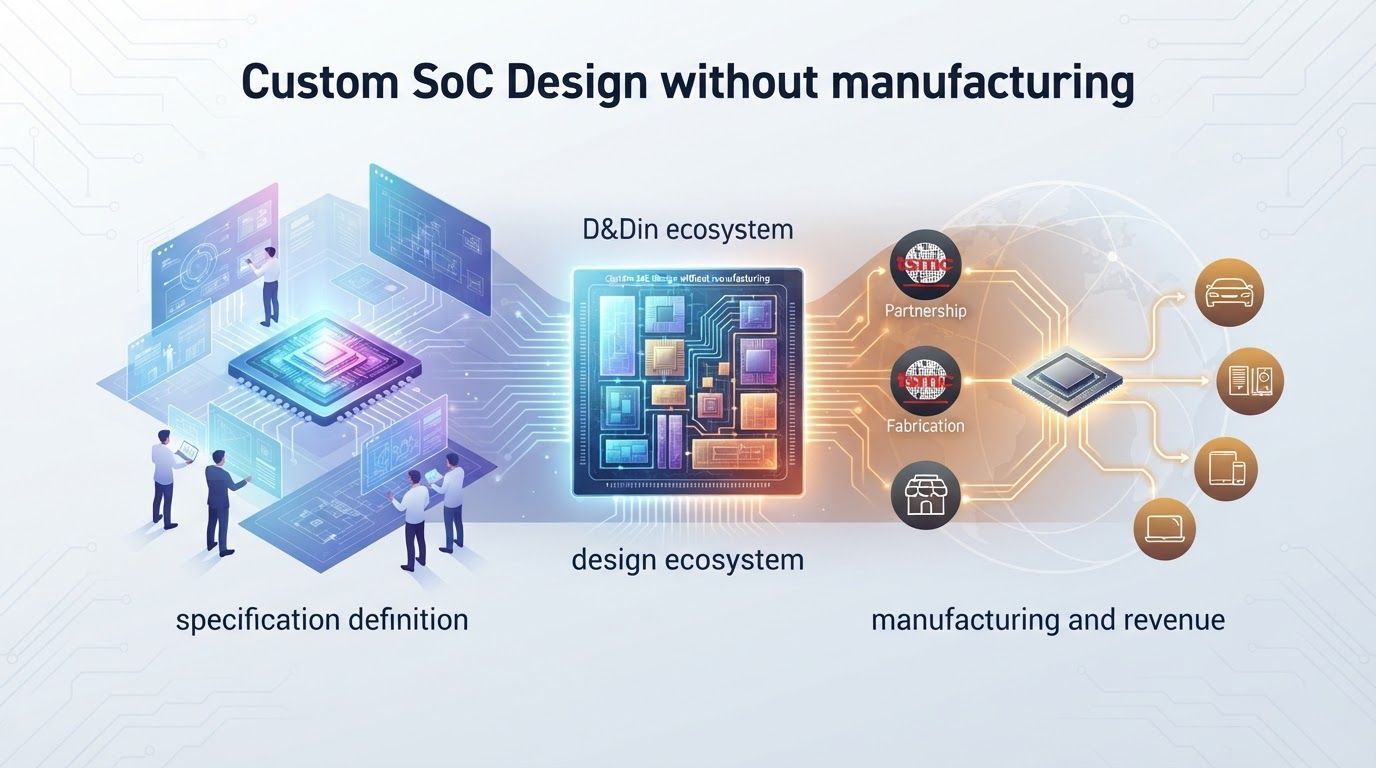
The company calls the model “Solution SoC.” It targets customers that cannot carry a U.S. giant's scale of in-house development but still want distinctive features in their own products. Customers want features that differentiate their products, but they do not necessarily know how to translate a system requirement into a chip specification, or how to choose among process nodes, IP, packaging and test options in a sprawling semiconductor ecosystem. Socionext enters at the concept stage, defines the specification and system architecture, does front-end and back-end design, outsources manufacturing to foundries, and stays responsible through volume ramp and quality control. For the customer, it is closer to renting a virtual SoC division than buying a part. 1 2
- System design that turns a product's differentiator into a chip specification
- Experience choosing and integrating process technology, IP, packaging and test
- An in-house design team large enough to sustain a multi-year development and ramp 2
From order to volume: revenue does not arrive all at once
Socionext's custom SoC flow 2
The customer brings a requirement. The two sides agree on a specification and sign a development contract. During development Socionext earns NRE (non-recurring engineering); only after design and prototypes are validated does volume manufacturing and product sales begin. Revenue is split into two phases, and the second arrives years later.
flowchart LR
    ask["Customer requirement"] --> spec["Specification and system design"]
    spec --> nre["Development contract (NRE)"]
    nre --> design["Multi-year design and prototyping"]
    design --> volume["Volume manufacturing and product sales"]
    volume --> ship["Shipping and quality assurance"]
That flow shapes the revenue model. In development, the customer pays NRE (non-recurring engineering), the fee for design work that can run for years. Once the chip is validated and enters volume, revenue turns into product sales per unit. The first shows a customer's willingness to pay for customization. The second determines how large the business can become. And because development takes years, an order booked today does not become revenue today. 4 1
Why doesn't it take every customer? 8 Fully custom development is expensive and slow. It only makes sense when the customer's expected volume, or the value of the differentiation, can cover that investment. If a standard part does the job, buying it is cheaper. If volume is too small, NRE and a multi-year schedule are hard to recover. Socionext's public materials concentrate on automotive, data center and networking, smart devices, and industrial equipment—areas with relatively long product lives and a clearer case for differentiation.
Same industry, opposite spending patterns
Put the two companies' spending side by side and the model difference becomes concrete. In the fiscal year ended March 2024, Socionext spent ¥53.279 billion on R&D, about 24% of revenue, and ¥24.438 billion on capital investment including intangibles, about 11%. In 2023, TSMC spent $30.45 billion on capital investment, about 44% of revenue, and roughly 8% on R&D. One puts the most money into people and design infrastructure; the other puts the most into fabs and process technology. Fabless does not mean cheap. It moves the heavy asset from buildings to people, IP and design infrastructure. 5 6 9
Where the money goes (2023) 5 6 9
| Company | Main spending | Share of revenue | What it buys |
|---|---|---|---|
| Socionext | R&D | About 24% | Design talent, IP, development and verification tools |
| Socionext | Capital investment (incl. intangibles) | About 11% | Prototyping, test, design infrastructure; no wafer fab |
| TSMC | Capital investment | About 44% | Leading-edge fabs and production equipment |
| TSMC | R&D | About 8% | Next-generation process and packaging technology |
How should we read the 5% and 24% figures? 5 6 9 The original talk put Socionext's capital investment at 5%. Its securities report for the fiscal year ended March 2024 shows ¥24.438 billion including intangible assets, or about 11% of revenue. The 5% figure probably counts tangible fixed assets only, or uses a different definition. The 24% R&D figure matches the report's ¥53.279 billion. TSMC's 44% and 8% are also approximations, and the two companies' fiscal periods and investment definitions are not identical. Treat the comparison as an order-of-magnitude contrast, not a precise like-for-like ratio.
The model has costs
A custom model looks stable because the customer is locked in from the start. But lock-in cuts both ways. Socionext's risk disclosure notes that its manufacturing partners are limited and that it has no long-term manufacturing contracts with them. If a foundry's capacity, pricing or technology roadmap shifts, Socionext cannot pass all of that through. The customer side is symmetric: a delay, cancellation or product-roadmap change can strand years of development investment and the volume plan that was meant to follow. 7
More plainly, this is still a semiconductor business. The fiscal year ended March 2024 was a cyclical high: ¥221.2 billion in revenue and a 16.1% operating margin. Revenue fell to ¥188.5 billion in the next year; it recovered to ¥200.8 billion in the year ended March 2026, but the operating margin was only 6.2%. The “doubled in three years” story includes an industry upswing and a concentration of large projects. It is not a rate that can be extrapolated every year. 10 8
So what survives the cycle? Design capability, customer relationships and integration experience. As leading-edge options multiply, customers find it harder to judge which combination fits. A team that can make that judgment and stand behind the result becomes scarcer, not more common. The barrier is not a visible asset like a fab, but it takes years of project work to build. It is not something a competitor can copy by buying equipment. 2
What travels: pick the hard-to-replace link in a divided chain
The same logic applies outside semiconductors. Horizontal division is not finished once the stages are separated; every company still has to answer which stage it carries for the customer. Socionext's choice is not simply “we don't manufacture.” It made “think through the chip for the customer and stay accountable through volume” its position. Capacity can be outsourced and fabs can be financed. Design judgment and project accountability are much harder to outsource. The company's real product is the confidence that lets a customer bet its differentiation on one custom chip.
- Is the customer's need specific enough that a standard product cannot solve it?
- Is the capability scarce enough that building an in-house team is a poor trade?
- Is the value of one project large enough to recover years of development investment?
If all three answers are yes, the business is not asset-light; it is judgment-heavy. If one is missing, you have merely swapped heavy assets for heavy payroll.
Sources
- Socionext · Business Model: Solution SoC
- Socionext · Why you need Solution SoC
- Socionext · Socionext Inc. Starts Operations (2015)
- ソシオネクスト 有価証券報告書 第10期(2023年度)・提出会社の経営指標
- ソシオネクスト 有価証券報告書 第10期・研究開発活動
- ソシオネクスト 有価証券報告書 第10期・設備の状況
- ソシオネクスト 有価証券報告書 第10期・事業等のリスク
- Socionext · About Socionext(FY26/3 実績)
- TSMC · 2023 Annual Report (Form 20-F)
- 株探 · ソシオネクスト 決算・修正履歴