

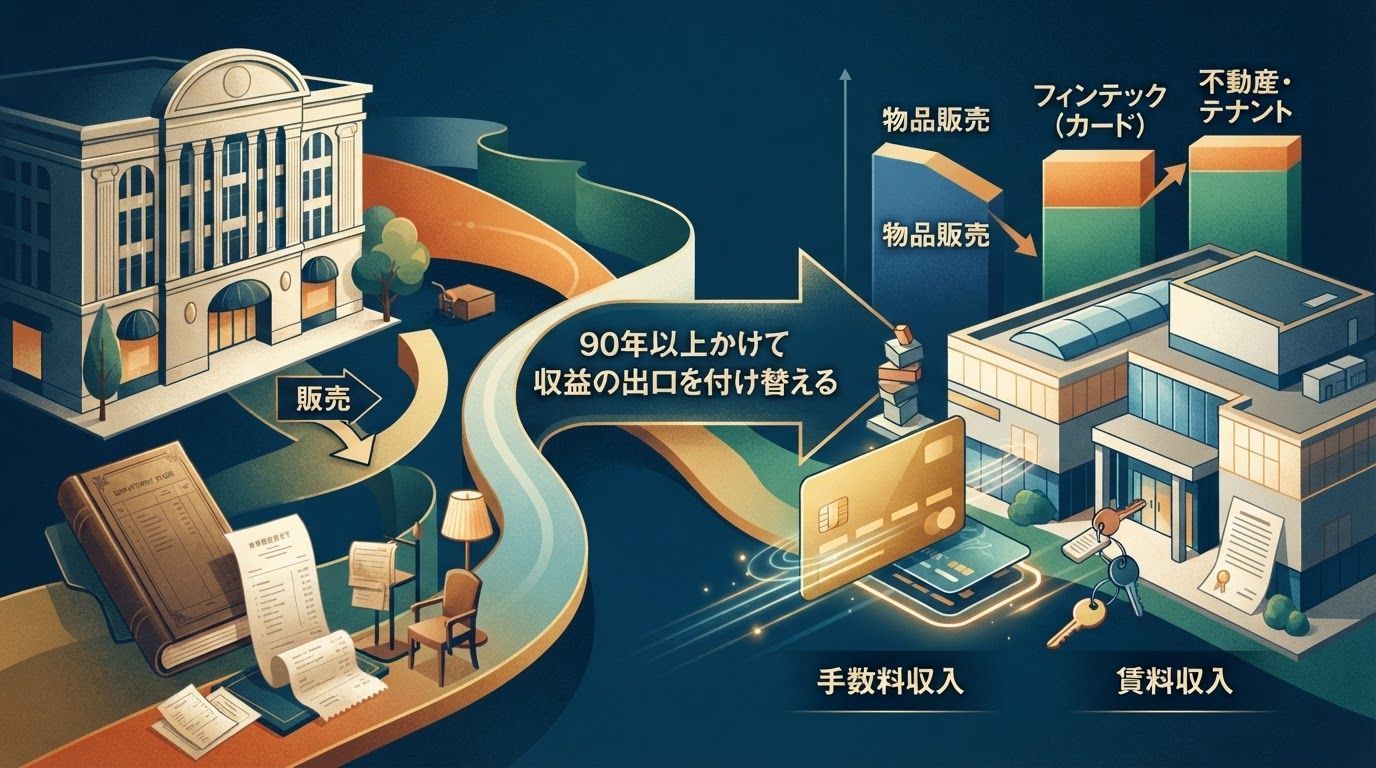
Marui Group no longer relies on selling goods alone. It also earns from fees and rent.
The short version: one credit relationship, two kinds of buyer
Marui Group is often described as a department store, but selling products is no longer where its profit comes from. It issues EPOS cards and earns fees from merchants and cardholders, while leasing space in its stores to tenants for fixed monthly rent. Finance and real estate look like separate businesses, yet both rest on the same asset: decades of credit data and a reason for customers to come back.
The group has two engines: a fintech business built around credit cards, and a retail business that operates commercial facilities such as Marui and Modi. Finance supplies the depth of profit; retail creates the points of contact with customers. Seeing how the two feed each other is the key to understanding the company.
The finance engine: earning from payment fees
EPOS is a classic two-sided card. Marui issues it to consumers, who use it at partner merchants; Marui collects a fee from those merchants, and when cardholders choose installment or revolving repayment, it also earns interest and fees from the credit itself. It does not need to make the products. It needs more people to sign up and to treat the card as their main one. 2
Is the ¥4 trillion card volume the same as revenue? 2 No. Card volume is the amount charged to cards, not Marui's own revenue. Marui earns merchant fees and interest or fees on installment and revolving balances. Treating card volume as sales would badly overstate the size of the retail business.
The talk put annual card volume above ¥4 trillion. Marui Group reported more than 8 million EPOS members as of July 2025. At that scale, even a thin fee rate can produce revenue in the hundreds of billions of yen. Card businesses carry heavy fixed costs and light marginal costs, so scale matters. 2
The member base skews young, with a high share of people in their teens and twenties. Young consumers spend readily, but their incomes are less stable, which normally means higher default risk. Marui uses its accumulated usage and repayment data to raise credit limits in steps as customers repay on time. Reliable payers earn more room; riskier ones stay on smaller limits. That is how it keeps defaults low while serving a young base. 2
The retail engine: from selling to leasing
Marui once ran its stores like a department store, on consignment. It settled with suppliers only after goods sold, leaving most inventory risk with them while Marui earned a margin on store operations and sales. That model depends heavily on foot traffic and weather. Low birthrates, an aging population and the rise of e-commerce made growth by opening ever-larger stores increasingly difficult.
Around 2014, Marui began changing tenant contracts from consignment to fixed-term leases, moving revenue from 'what sells' to 'rent due every month.' Its results briefing for the first half of fiscal 2015 showed a conversion rate of about 10%, with a plan to convert all eligible space by fiscal 2018. The appeal of rent is predictable cash: even in a weak sales month, the rent arrives. 4
Changing the contract is only half the job. The harder question is whom to put in the space. In recent years Marui has recruited restaurants, event spaces and service tenants rather than merchandise sellers, reducing its dependence on apparel. It now operates 21 Marui and Modi facilities, mainly in greater Tokyo and other large cities. Tenants get a location, foot traffic and card members; Marui gets fixed rent and another reason for people to visit. 3
If fixed rent is safer, where did the risk go? It did not disappear. It moved from inventory and weather to leasing and vacancy. If the facility cannot attract good tenants, the rent does not arrive. If a fixed-term lease ends without a replacement, the empty months eat into returns. The real skill in a rent model is not collecting rent but keeping space filled and convincing tenants that the rent is worth paying.
More than 90 years, several new places to send the bill
When Marui was founded in 1931, it sold furniture on installment. It extended credit for goods that were expensive at the time and collected the price in monthly payments. That was retail and consumer finance combined in prototype. In 1960 the company renamed installment sales 'credit' and issued Japan's first credit card. 1
In the 1970s, as incomes rose during Japan's high-growth era, credit demand for durable goods such as furniture and appliances began to plateau. Marui moved into fashion, which was growing, and narrowed its target to young people, becoming known as 'Marui for the young.' The shift showed that what it sold was not a product category but a generation's way of spending. 1
In 2006 Marui turned its house card, usable only in its own stores, into the VISA-branded EPOS card. The card could now be used worldwide, and 'a Marui member' became a payment tool that could travel. That step prepared the ground for finance to become the growth engine. 1
How the revenue outlet kept moving
The turning points line up as changes in products, contracts and customer touchpoints. What stayed constant was the credit relationship underneath.
flowchart LR
    a["1931 Furniture on installment"] --> b["1960 Japan's first credit card"]
    b --> c["1970s Pivot to youth fashion"]
    c --> d["2006 EPOS with VISA"]
    d --> e["2010s Fixed-term leases and rent"]
    e --> f["Finance and retail as two engines"]
What stayed the same: turning trust into a billable asset
The turns look like changes of industry, but they do the same thing: turn trust into an asset that can be billed. In the installment era, trust was the contract that let a customer buy furniture. In the card era, trust became a fee inside a payment network. In the rent era, trust is a tenant's belief that this place will bring customers. Marui calls this 'co-creating credit' and makes it the base of the company. 1 2
Three revenue models
| Model | Source of revenue | Who carries the risk | What caps growth |
|---|---|---|---|
| Installment sales (1931–1960s) | Interest on installments and sales margin | Marui (customer default) | How fast durable goods spread |
| Consignment (department-store model) | Share of sales and store operations | Suppliers (inventory), Marui (traffic) | Foot traffic and weather |
| Fixed-term leases + finance (today) | Fixed rent, payment fees, revolving and installment interest | Marui (leasing and credit) | Member base and tenant quality |
The model has costs. First, the more stable the rent, the more leasing skill matters; a facility that loses appeal turns fixed rent into vacancy cost. Second, the card business feeds on younger customers, whose incomes fluctuate; in a downturn defaults rise. Third, fees and interest both depend on spending. If Japanese consumption stays weak for years, finance growth slows too. Marui can price risk more finely with data; it cannot remove the risk.
For people who build products: find the trust, then the bill
- Ask what you actually own before asking who else could buy it. Marui owned credit data and customer relationships, not furniture or clothes.
- Change the revenue model when the environment changes. It changed product categories when durable-goods credit faded, and changed contract forms when the department-store model stopped working.
- Stable revenue is not the same as low risk. Fixed rent moves volatility from revenue to leasing, and raises the operating bar.
- Young customers are not doomed to be a high-risk business. Moving credit limits with repayment data turns 'high risk' into 'priced risk.'
From furniture installments to the EPOS card to rent-paying commercial space, Marui Group's turns over more than 90 years look like changes of industry but repeat one business: build trust, then find an outlet that can bill for it every month. That may be more useful than the word 'diversification.'