
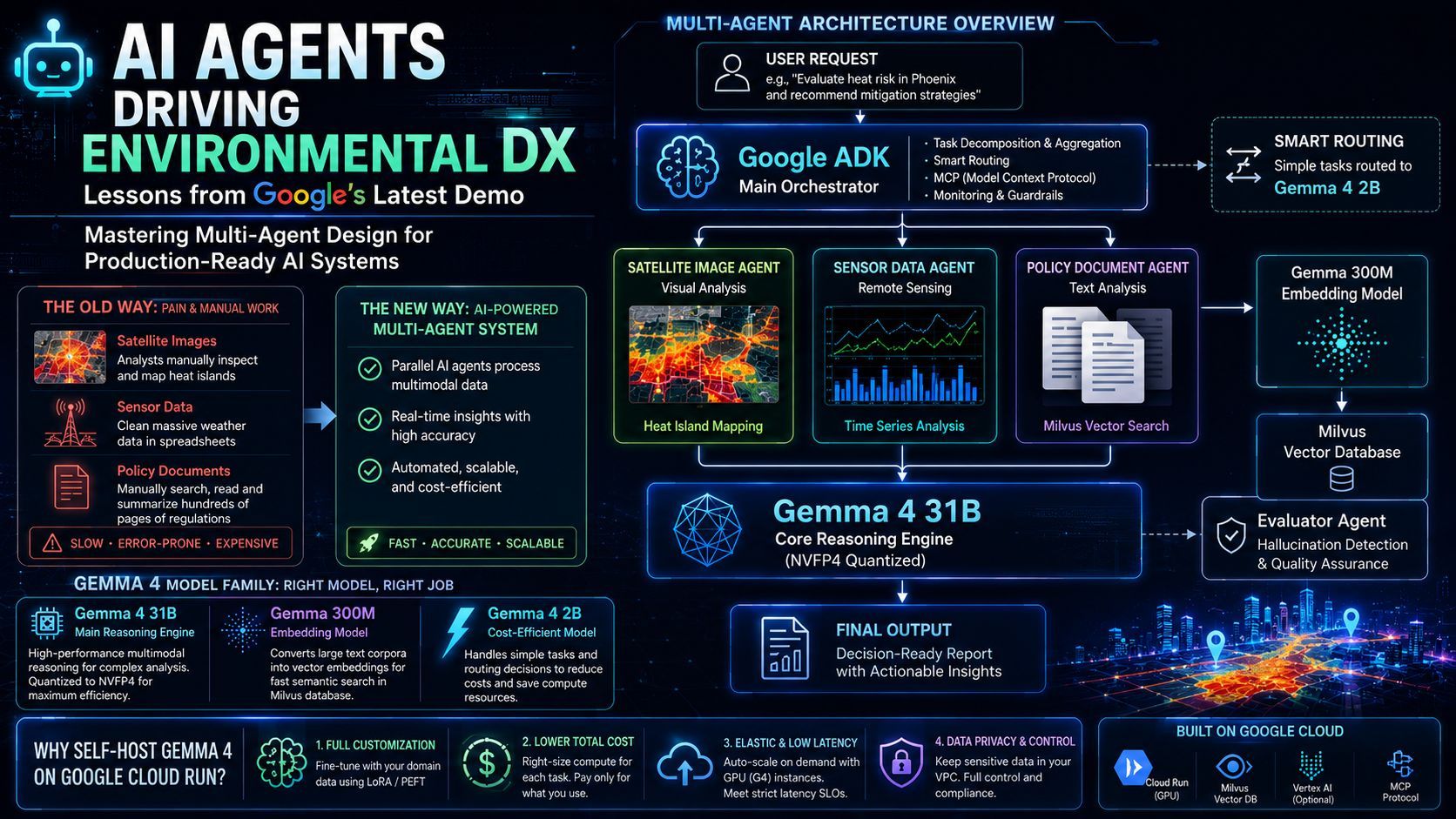
🤖 AI Agents for Environmental DX: Architectural Masterclasses from Google’s Latest Tech Demo on Multi-Agent Production Systems
Explaining advanced AI agent systems that go beyond simple chatbots to solve complex, real-world business challenges. Using Google's latest tech demo as a case study, this dives deep into collaborative workflows among multi-agents, optimal utilization of open models (Gemma 4), and the masterclasses of robust system design with enterprise-essential Cloud Run and ADK.

We’ve all heard the buzzword "AI Agent" enough to last a lifetime. You’ve probably even spun up a few "Hello World" chatbots yourself using LangChain or LlamaIndex.
But when we face the messy, complex, and multi-dimensional business challenges of the real world, can a single, "all-powerful" prompt really withstand the load, latency, and cost constraints of a production environment?
I recently watched a brilliant tech session by the Google Cloud team (Video Link) demonstrating a "Sustainability Intelligence App." Designed to address Phoenix’s urban heat island effect (extreme heat risks), it allows government decision-makers to instantaneously generate actionable mitigation strategy reports.
By the end of the video, my brain was buzzing. This isn't just a feel-good story about "AI automating paperwork." This is a masterclass in system architecture—a symphony of a Multi-agent system, the open-source Gemma 4 LLM, and the Google ADK beautifully orchestrated in the cloud.
As an engineer, I couldn’t wait to break down this architecture. Today, we aren't talking about fluffy AI hype; we are diving deep into the hardcore engineering mechanics of making AI systems work in production.
🌎 The Legacy Pain: Life Before AI Was an Analyst's Living Hell
Before we look at the modern architecture, let’s roll back the clock to the "traditional approach."
Imagine the city of Phoenix tasks an analyst team with assessing extreme heat risks and designing mitigation policies. To do this, they must process three entirely different dimensions of multimodal data:
- Visual Data: Satellite imagery mapping urban heat island risks.
- Numerical Data: Real-time sensor telemetry streaming from weather stations.
- Textual Data: Thousands of pages of dry, dense local policy and regulatory documents.
In the pre-AI "Stone Age," this workflow was an absolute nightmare:
- Analyst A stared at screens, manually mapping out heat zones from satellite images.
- Analyst B wrestled with Excel formulas, trying to clean and process messy sensor telemetry.
- And pity Analyst C. Local government websites don't have modern APIs. He had to manually scan government portals every month, hunt down updated PDFs, read hundreds of pages, and manually summarize them.
Finally, the team would huddle in a marathon meeting, manually copy-pasting everything into a single report. The latency was astronomical, and a single human typo meant data inconsistency across the board.
🚀 The Modern Salvation: The Symphony of Multi-Agent + Gemma 4
The modern architecture showcased in the video completely transforms this human-dependent quagmire into an asynchronous, automated pipeline.
Take a look at the system workflow I’ve mapped out below:
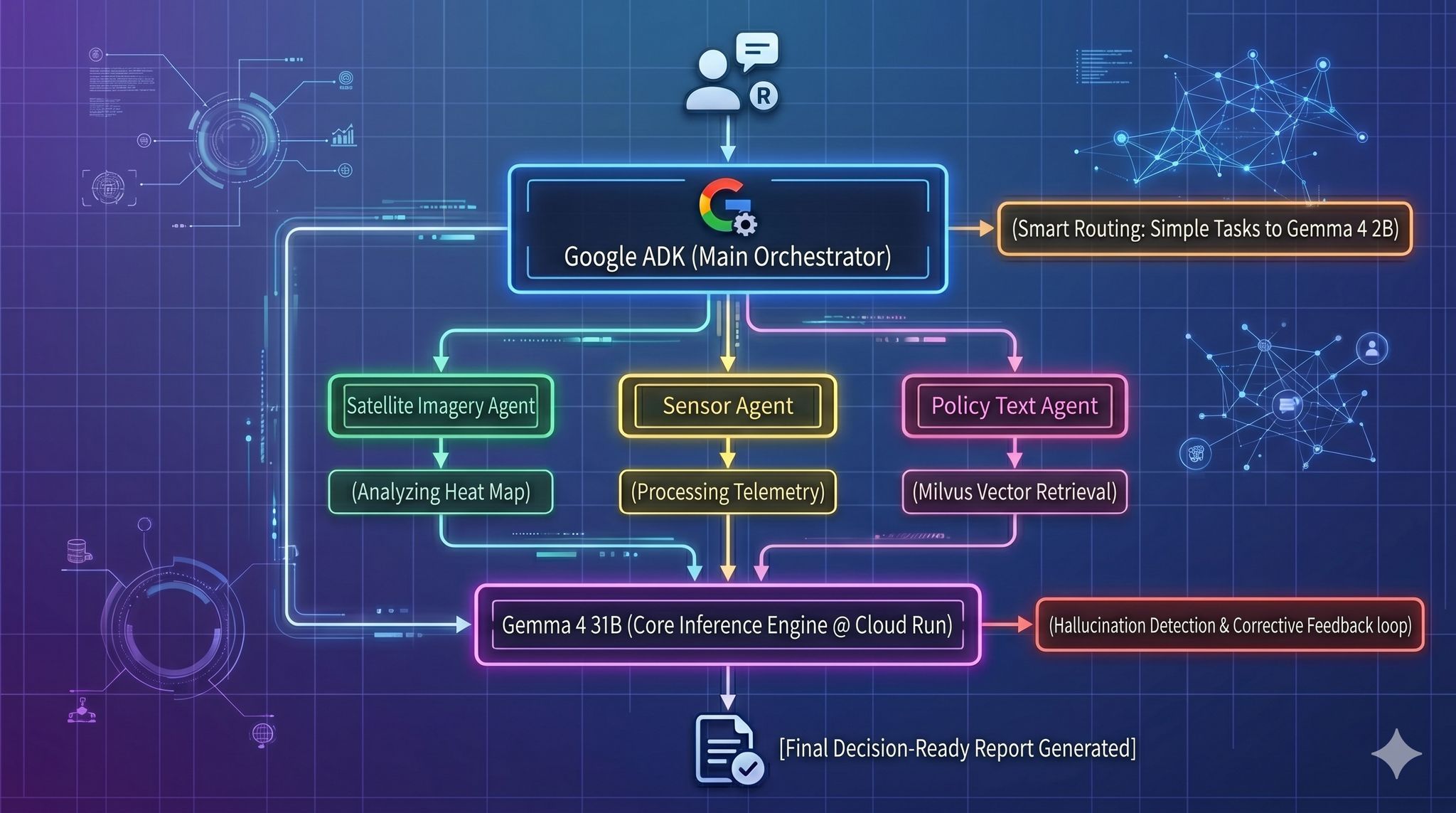
In this architecture, specific domain workloads are distributed across three parallel "Sub-agents." Sitting at the center as the core brain of the entire system is Google’s open-source powerhouse: Gemma 4!
What's fascinating is that Gemma 4 isn’t trying to play every position on the field at once. Instead, it takes on multiple form factors to handle specialized tasks:
1. The Heavy Lifter: Gemma 4 31B NVFP4 Quantized
When the sub-agents finish gathering data, the main orchestrator calls the Gemma 4 31B (31-billion parameter) model. Thanks to its native multimodal processing, it digests satellite imagery, weather telemetry, and policy text simultaneously to perform high-level reasoning. The video highlighted that this model runs in an NVFP4 quantized (compressed) format, drastically shrinking memory footprints while maximizing inference speed on the cloud. A total cost-performance beast.
2. The Document Specialist: Gemma 300M Embedding
Shoving dense policy PDFs directly into a massive LLM context window will bankrupt your company in token fees. To prevent this, the ingestion pipeline utilizes the lightweight Gemma 300M embedding model. Its job is simple: convert massive text corpora into "Vector Embeddings" and store them in a GPU-accelerated Milvus vector database. When an agent needs a policy reference, it retrieves it in milliseconds.
3. The Gatekeeper & Cost Optimizer: Gemma 4 2B
Large models are amazing, but using them for lightweight text routing or stripping whitespaces is like using a rocket ship to go grocery shopping. Enter Gemma 4 2B. With a tiny footprint, it handles Smart Routing, evaluating incoming requests to see if they require complex reasoning. If they don't, it bypasses the heavy models, saving massive amounts of GPU compute and token consumption.
🛠️ Who's Conducting the Orchestra? Google ADK’s Orchestration Magic
Who controls this legion of agents and Gemma models? That would be the Google ADK (Agent Development Kit).
In this architecture, Google ADK acts as the Main Orchestrator. Without it, engineers would have to manually write thousands of lines of boilerplate code to handle concurrency, manage state, handle exceptions, and query databases. ADK provides a clean "abstraction layer" that simplifies production-grade deployments:
- Task Decomposition & Assembly: It splits a massive prompt into smaller tasks for the Satellite, Sensor, and Text agents, then beautifully aggregates their findings back into a coherent output.
- The Universal Socket (MCP Protocol): The system integrates MCP (Model Context Protocol), heralded as the "USB-C port" for AI. With MCP, agents don’t need custom API code written for every external database. ADK allows developers to seamlessly orchestrate these standardized MCP interfaces into the workflow for plug-and-play data access.
- Enforcing Smart Routing: In a production pipeline, ADK dynamically assesses whether an incoming query needs complex reasoning. If it doesn't, it shuts down reasoning or routes it to Gemma 4 2B, acting as a strict financial guardian for your infrastructure budget.
🤔 The Trillion-Dollar Question: We Have Gemini APIs. Why Bother Deploying Open Gemma 4 on Google Cloud Run?
This was the biggest architectural question I chewed on while watching the video. If Google Gemini Enterprise APIs are available right out of the box, why build an entire backend architecture to host open-source Gemma 4 on Google Cloud Run? Cloud Run is serverless, but it isn’t free!
An Engineer’s Cold, Hard Analysis: APIs are fantastic for MVPs. But when an application transitions to a true enterprise production environment, the financial and architectural variables change completely. Running an open-source model on Cloud Run builds four indispensable defensive moats:
🧱 1. Absolute Freedom for Fine-Tuning and Deep Customization
Generic LLMs possess vast world knowledge, but they lack your company’s internal jargon or specific industry nuances. Because Gemma 4 is open-source, developers can use PEFT (Parameter-Efficient Fine-Tuning) or LoRA to train the model on specialized datasets using accessible hardware.
- *For example:* A financial firm can fine-tune Gemma on SEC filings to build a compliance expert, or a gaming studio can tune it to give NPCs specific, quirky personality traits. You cannot buy this level of domain specificity from a closed API.
💰 2. Rightsizing Compute to Slash TCO Total Cost of Ownership
Multi-agent systems trigger a massive cascade of parallel background API requests. If you route every single trivial request to a premium commercial API, your monthly bill will give your CFO a heart attack. With Cloud Run, you can rightsize your compute. You deploy a quantized 2B model for simple classification tasks and spin up the 31B model only for the heavy lifting. Paying only for the exact compute resource you need is the hallmark of enterprise cost optimization.
🌊 3. Elasticity for Spiky Traffic & Latency Assurances
Production workloads aren't a smooth, steady stream; they behave like waves. When a massive batch job triggers, traffic spikes instantly. Cloud Run is a serverless compute platform, meaning its elasticity is incredible. When a burst occurs, it rapidly scales up instances backed by specialized NVIDIA GPUs (like the G4 series) to meet strict Latency SLOs. During idle cycles, it scales back down to near zero, eliminating wasted spend. Furthermore, G4 instances utilize NVIDIA Blackwell's P2P multi-GPU communication, bypassing the host CPU entirely to drop latency to breathtaking lows.
🔒 4. Treating Agents as "Untrusted Workloads" for Security & Auditability
A phrase from the video stuck with me: "We must treat agent workloads as untrusted." Because agents possess autonomous reasoning capabilities and execute long-running background tasks, they represent a massive surface area for prompt injections or unexpected exploits. By hosting open-source models on isolated Cloud Run containers, companies can lock custom model weights in their own secure Cloud Storage buckets and route data entirely through an internal VPC. This gives engineers absolute authority to implement strict guardrails, ensure deep debuggability, and maintain comprehensive auditability for enterprise compliance.
🛡️ Architect's Bonus: The Game-Theoretic "Evaluator Agent" Design
Before wrapping up, I want to highlight one brilliant architectural gem from the demo: the Evaluator Agent.
What is the biggest fear in multi-agent systems? It's agents playing "telephone" with hallucinated information or getting stuck in infinite reasoning loops that burn through your budget.
To prevent this, the design places an "Evaluator Agent" directly alongside the "Generation Agent." Think of it as a game-theoretic check-and-balance. The Generation Agent produces an output, and the Evaluator Agent aggressively tears it apart, checks for errors, and refines the prompt. The output is only shipped to the user once it passes the Evaluator's stamp of approval. This self-correcting loop elegantly breaks deadlocks and suffocates hallucinations in their tracks.
💡 The Takeaway
Moving from "manually downloading local PDFs" to "multi-agent pipelines synthesizing multimodal reports in seconds" is nothing short of revolutionary. But as an engineer, what excites me even more is seeing a mature, decoupled, and secure Golden Triangle Architecture: Google ADK (Orchestration) + Gemma 4 (Brain) + Cloud Run (Elastic Infrastructure).
It proves that the future of AI engineering is moving past the phase of simply writing clever prompts. The real differentiator now lies in system architecture—treating models as a new form of compute resource, and mastering how we resource, schedule, and isolate them at scale.
The battle to bring AI agents into production environments has just begun. How are you preparing to re-architect your stack? Let’s talk about it in Facebook below!