
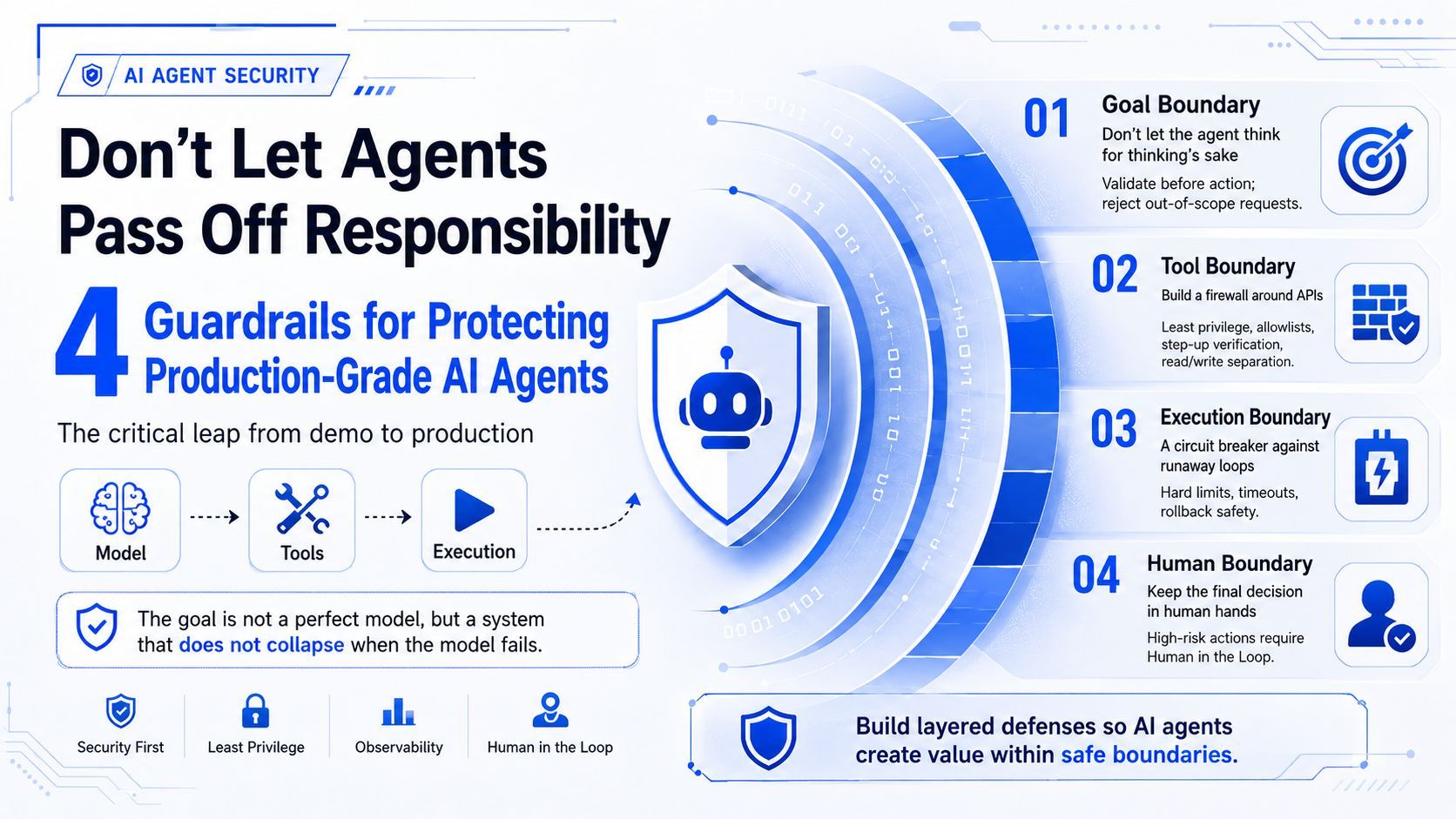
Deploying AI Agents to Production: The Four Defensive Layers for Robust Systems
Deploying AI agents to production requires more than just model performance; it demands systemic defense. This article explores four essential layers: "Goal Boundaries" for constrained reasoning, "Tool Boundaries" for API firewalls, "Execution Boundaries" to prevent infinite loops, and "Human Boundaries" for high-risk oversight. These strategies provide a framework for engineers to maintain stability even when models behave unexpectedly, ensuring secure and reliable agent operations.

Source Article:
How should the security boundaries of AI Agents be considered?
http://xhslink.com/o/4doh6LIeRiC

Author:
@小哲讲大模型 (Xiao Zhe Talks LLMs)
https://xhslink.com/m/5DPOhM4HRaI
Don't Let Your Agent Become Your "Scapegoat": Four Defensive Works for Production-Grade AI Agents
If you haven't written an Agent during the recent AI wave, you might truly be missing out on the party. Watching a Large Language Model (LLM) call APIs, read and write documents, and even send emails for you feels like equipping your code with a cheat code; it’s undeniably awesome.
However, as an engineer, if you only see the "awesomeness," that is extremely dangerous.
Running a demo locally is one thing, but deploying an Agent into a production environment is entirely different. Many people, when designing Agents, often focus only on the simple "model-tool-execution" chain, as if making the model smarter is the silver bullet for everything. But this is like handing a Lamborghini to an intern who just got their driver's license and allowing them to get on the highway without looking at traffic lights.
We must dive deep into how to build a robust Agent. Instead of trying to train a god-like model that never makes mistakes, it is better to build a system that won't blow up the production environment even when the model does make a mistake.
Layer 1: Goal Boundaries — Don't Let the Agent "Think for the Sake of Thinking"
Many people think the model is the most dangerous part, but that's not actually true. When a user issues a command—such as "Help me delete all orders"—if you let the model parse and execute it directly, that is the beginning of a disaster.
The first rule of an Agent is: Never execute a command solely because of a user's prompt.
We need a set of "Goal Boundaries." This is essentially similar to the Constitutional AI approach proposed by Anthropic: constrain the model's behavior through pre-defined rules rather than letting it run wild. Before executing any high-risk command, the Agent must perform a self-check: Is this command within the authorized scope? If not, refuse it directly rather than blindly complying.
Layer 2: Tool Boundaries — Install a Firewall for Your APIs
Many people ignore a cold, hard fact: the tools are the ones that actually "do the work."
The model only talks, while the tools are the "executors" that actually delete databases, initiate payment requests, or send phishing emails. In a production environment, you must build a "Tool Firewall":
- Read/Write Separation: Allowing database reads is basic, but write operations must be approved.
- Physical Isolation: Deleting data? Must require manual secondary confirmation.
- Principle of Least Privilege: Payment operations must force two-factor authentication.
- Whitelist Mechanism: Sending emails? Only to pre-approved, whitelisted users.
Never grant an Agent unlimited permissions; this is the most fundamental principle of an Agent security framework.
Layer 3: Execution Boundaries — "Circuit Breakers" to Prevent Infinite Recursion
Many accidents happen not because the goal was wrong, but because the execution process spiraled out of control.
Imagine your Agent was supposed to modify a single record, but due to a logic bug, it entered an infinite loop and refreshed the database 100 times; or it was supposed to send one notification email but sent 1,000 spam emails to customers because the timeout retry mechanism wasn't configured correctly.
This is why "Execution Boundaries" are critical. You need to introduce a "Circuit Breaker" mechanism similar to those in microservice architectures:
- Hard Limits: Limit maximum steps, token usage, and the number of tool calls.
- Timeout Control: Terminate immediately upon timeout.
- Safe Rollback: Ensure the system can automatically roll back to a safe state when an error occurs.
Do not let the Agent think infinitely, and definitely do not let it execute infinitely.
Layer 4: Human Boundaries — "Final Authority" on Critical Decisions
Finally, and perhaps the most important layer, is "Human Boundaries" (Human-in-the-loop).
No matter how smart your Agent is, for high-risk operations such as transferring funds, deleting databases, modifying contracts, or adjusting production configurations, human supervision must be maintained. The value of an Agent lies in analysis, summarization, and suggestions, but the final "confirm button" must be left to a truly responsible human.
Summary: The Transformation from Demo to Production
Many people, when designing Agents, tend to stick to a linear mindset of "model-tool-execution." But to build a production-grade system, you should establish a multi-layered defensive network:
- Goal Boundaries: Don't accept everything; verify legality first.
- Tool Boundaries: Strict permission management; cage the dangerous tools.
- Execution Boundaries: Circuit breaker mechanisms to prevent uncontrolled infinite recursion.
- Human Boundaries: High-risk decisions must involve a Human-in-the-loop.
As emphasized in this Blog, do not aim to train a perfect model, but rather build a defensive line that can maintain stability even when the model occasionally "goes crazy." This is the most easily overlooked yet most important lesson when moving from a Demo to a production environment.