
Unlocking the Future of Agent Collaboration: An Overview of the ARD Specification
Are you struggling with tool management and context window bloat in your AI agent systems? The Agentic Resource Discovery (ARD) specification, co-developed by industry leaders like Google, Microsoft, and Hugging Face, introduces a DNS-like standard for autonomous resource discovery and verification. This article explains how ARD mitigates these challenges and enhances reliability in multi-agent ecosystems, providing a roadmap for decentralized agent-to-agent communication.

The "DNS" Moment for the Agent World: How ARD Saves AI Collaboration from Collapse
As an AI engineer, have you encountered this pain point? To make an agent "omniscient," we constantly stuff various API tools into its System Prompt. It's fine at first, but as the number of tools grows, the model becomes sluggish, reasoning capabilities decline, and it even starts to "hallucinate" on simple tasks—this is known as "context window inflation."
We have been waiting for a standard—an "Internet protocol" that allows agents to independently discover, verify, and invoke external capabilities across the vast digital ocean. The good news is that the Agentic Resource Discovery (ARD) specification, jointly launched by giants like Google, Microsoft, and Hugging Face, is finally here.
Why is ARD a "lifesaver" for the multi-agent ecosystem?
Before ARD, multi-agent collaboration was in a "manual transmission" era. You had to pre-configure everything, hardcoding every API URL and key. If a service went offline or an API changed, the whole system would collapse like dominoes.
ARD's core logic is clear: it does not do runtime orchestration; it only focuses on "finding."
Think of it as the DNS of the early internet. It doesn't care what data packets you send or how you think; it only answers one core question: "Who can do this, and how can I be sure it's secure?"
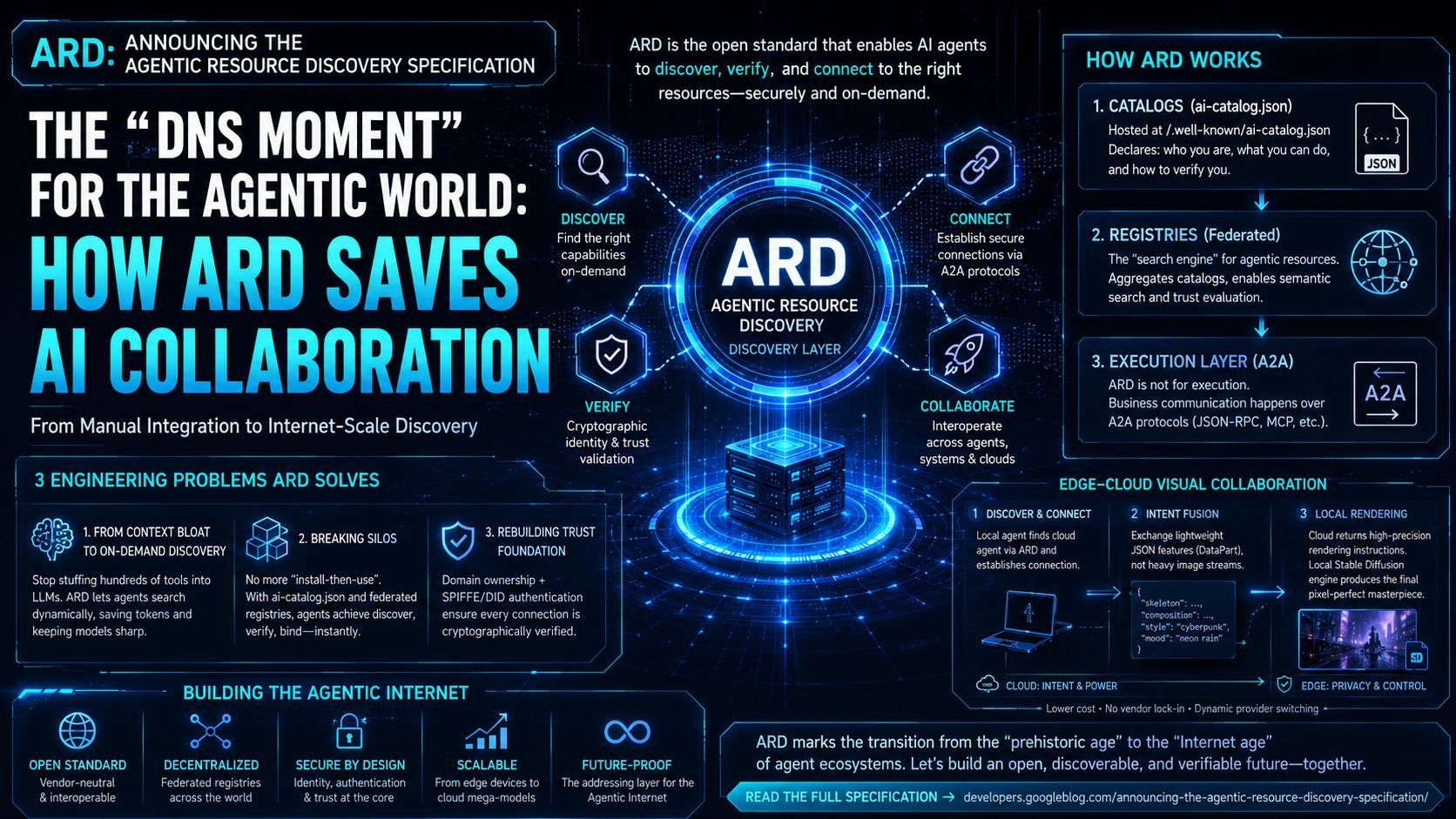
ARD solves three major engineering problems:
- From "Brute-force Stuffing" to "On-demand Retrieval": You no longer need to stuff hundreds of tool schemas into an LLM. ARD allows agents to dynamically find the best-matched resource via a Registry when needed, significantly saving token consumption and keeping the model sharp.
- Breaking the "Silo Effect": Say goodbye to the rigid "install first, use later" process. Through
ai-catalog.jsonfiles and federated registries, agents can achieve "instant discovery, instant verification, and instant binding." - Rebuilding the Foundation of Trust: The biggest fear in cross-organizational collaboration is malicious phishing nodes. ARD ensures every connection undergoes digital signature verification based on Domain Ownership and SPIFFE/DID identity authentication.
Engineering Perspective: From Concept to Implementation
The physical nature of ARD is very down-to-earth: a static file hosted at /.well-known/ai-catalog.json. This is extremely friendly to any engineer familiar with Web development.
How does it work?
- Catalogs: That
ai-catalog.jsonfile, which tells the world: "Who I am, what I can do, and what my encrypted identity is." - Registries: This is the "search engine" for ARD, responsible for aggregating global agent resources and providing semantic search and trust verification.
- Execution Layer (A2A Protocol): Remember, ARD is only the discovery layer. After discovery, actual business communication needs to be handled by Agent-to-Agent (A2A) protocols (such as JSON-RPC or MCP).
Future Outlook: Edge and Cloud "Visual Collaboration"
The truly exciting part of ARD is how it empowers complex cross-device collaboration.
Imagine a scenario where a local agent is responsible for generating low-resolution "visual skeletons" and composition features, while a cloud agent is responsible for understanding the user's deep intent (e.g., "cyberpunk style," "neon rainy night atmosphere").
- Feature Transmission: The local agent finds the cloud agent via ARD and establishes a connection.
- Intent Fusion: The two ends only transmit tiny JSON feature data (DataPart) rather than heavy image binary streams.
- Local Rendering: The cloud returns high-precision rendering instructions (Prompt parameters, depth maps), and the local Stable Diffusion engine is responsible for the final "pixel-level masterpiece."
This is the charm of technology: Large models in the cloud provide the "soul" (intent and creativity), while the edge side retains "data sovereignty" (privacy and computing power). This architecture not only drastically lowers operating costs but also completely eliminates vendor lock-in, allowing your agent to dynamically switch service providers based on real-time performance.
Conclusion
The emergence of ARD marks the agent ecosystem's transition from the "prehistoric era" to the "connected era." For us developers, it is time to stop building closed "AI chimneys" and instead embrace this open, discoverable, and verifiable collaboration specification.
As the industry consensus goes, the significance of ARD lies not in building a specific application, but in laying the fundamental "addressing tracks" for a decentralized internet of agents.
To learn more details about this specification, you can refer to the ARD Specification Details. Let us look forward to a future where agents can collaborate freely\!
https://developers.googleblog.com/announcing-the-agentic-resource-discovery-specification/