
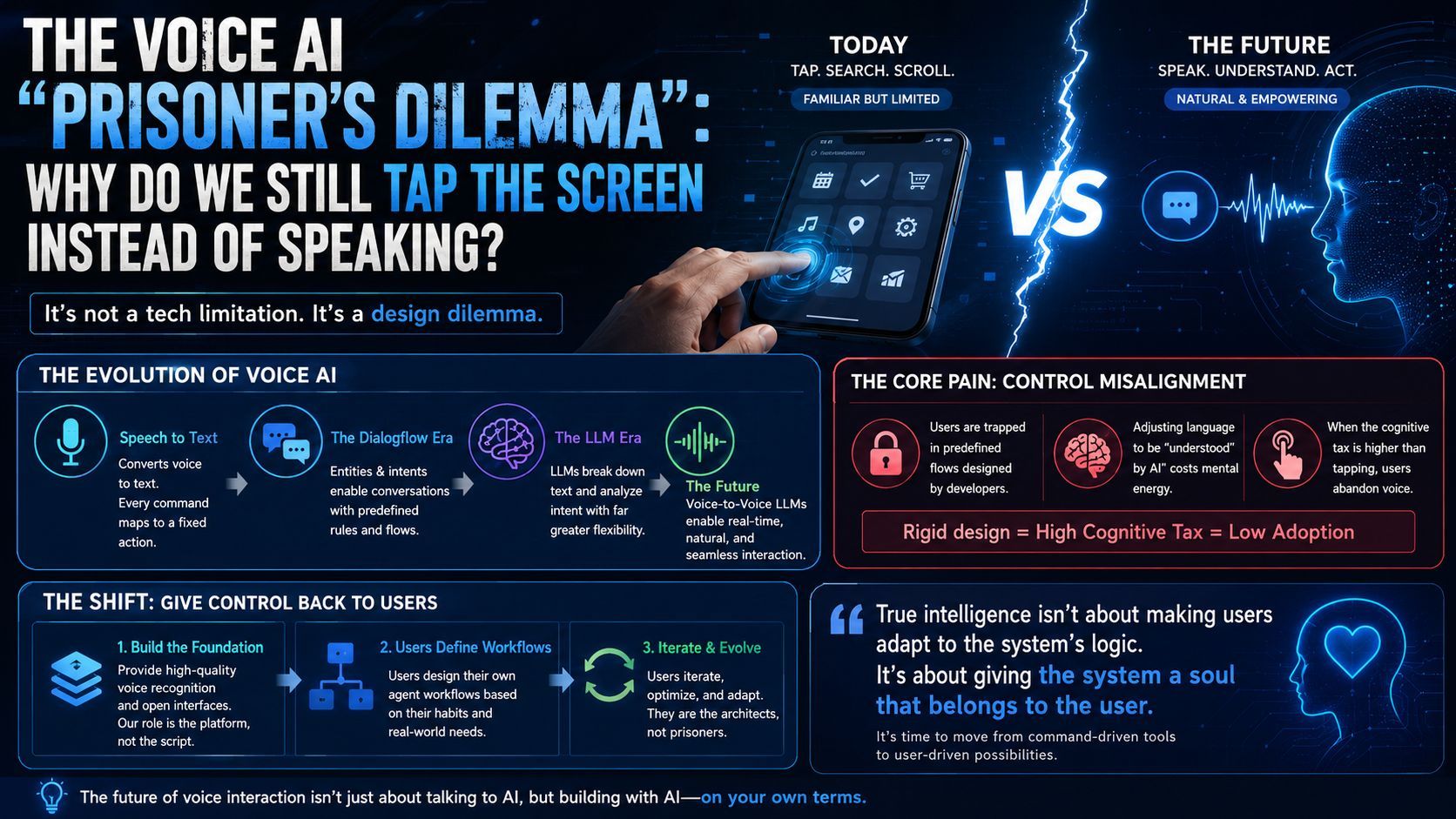
The "Prisoner's Dilemma" of Voice AI: Why We Prefer Tapping Over Speaking
Despite rapid AI advancements, voice interaction struggles to gain widespread adoption. The root cause is a "Prisoner's Dilemma" of design: users pay a "cognitive tax" to adapt to rigid, programmer-defined logic. This article advocates for a paradigm shift, moving from pre-set commands toward user-empowered agent workflows, allowing users to define their own processes and reclaim control over technology.

The "Prisoner's Dilemma" of Voice AI: Why Are You Still Tapping the Screen Instead of Commanding with Your Voice?
As of 2026, we have to admit a slightly embarrassing fact: although AI technology is advancing by leaps and bounds, when we want to perform a somewhat complex operation, our bodies are often more honest than our mouths—we are still accustomed to extending our fingers and tapping the screen.
Voice AI, a technology regarded as the "ultimate form of interaction," has struggled to achieve true mass adoption. This is not a problem of technical capability, but rather a long-standing "Prisoner's Dilemma" we, as developers, have fallen into regarding our design thinking.
The Evolutionary History of Voice AI: The Game Between Dictation and Intent
Reviewing the evolutionary path of Voice AI, we have actually been jumping back and forth between "commands" and "understanding":
- Basic Speech to Text: In the earliest stage, the system was only responsible for converting speech to text, and every command had to correspond to rigid physical actions.
- DialogFlow Era: Around 2018, we introduced the concepts of "entities" and "intents." Through preset grammars, the system was finally able to process long sentences, but this was still based on logical frameworks preset by programmers.
- LLM Era: Now, we utilize Large Language Models to deconstruct text and analyze intent.
- Future Outlook: The industry is moving towards direct "Voice to Voice" LLMs, at which point intent recognition will see a leapfrog improvement.
Core Pain Point: Why Do Users Always Want to "Tap the Screen"?
As engineers, we often confidently think: "My system logic is rigorous, and with so many preset functions, it should be very convenient for users."
But the truth is exactly the opposite.
The fundamental reason why Voice AI has failed to become popular lies in the "mismatch of control" between users and programmers.
In the traditional model, programmers are the "architects," and we design fixed interaction models for users. Users appear to be commanding the system, but in reality, they are trapped within the paths we have preset. If the user's actual needs exceed these preset "fences," or if the interaction method feels awkward to them, users cannot perform "soft adjustments."
This leads to a high "cognitive tax":
- Users either endure rigid interactions;
- Or they spend a great deal of energy adjusting their wording, attempting to "please" the system's logic.
When the cost of this "self-modification to make the AI understand" is higher than tapping the screen, the user's choice is obvious: abandon voice.
Epochal Change: Returning Power to the User
If we are to build a successful audio AI product in 2026, continuing to use the "programmer presets everything" design paradigm is destined to fail.
As engineers, we need to undergo a "power transfer" in our thinking: returning the definition power of "Agent Workflow" to the user.
The core of this new model lies in:
- Architectural Layering: Our responsibility is no longer to preset interaction paths, but to build a high-quality foundational platform. It is responsible for converting speech into high-precision text and providing an open interface.
- User-Defined Workflows: The system's subsequent execution logic is entirely defined by the user according to their own habits.
- Dynamic Iteration: The user is no longer a "prisoner" but an "architect." If a certain workflow feels inconvenient, the user can adjust it at any time.
Conclusion
True intelligence is not about making users adapt to the machine's logic, but about letting the system possess a "soul exclusive to the user." When voice interaction is no longer about preset commands, but about Agent workflows built by users according to their own needs, we will have truly entered the golden age of audio interaction.
As developers, it is time to set aside that arrogance of "having everything under control" and deliver a tool that truly gives users a sense of control. This is not just a leap in technology, but a return to design philosophy.