
Decoding DiffusionGemma: A Parallel Inference Revolution Beyond Autoregression
This post explores DiffusionGemma, a novel approach designed to overcome the "word-by-word" bottlenecks of traditional autoregressive models. By utilizing "Uniform State Diffusion," the model generates and refines 256 tokens in parallel, shifting constraints from memory bandwidth to compute to achieve up to 4x faster inference. It features bidirectional attention for global context and re-noising capabilities for self-correction. Ready for deployment via vLLM, DiffusionGemma represents a significant advancement in maximizing LLM inference efficiency.

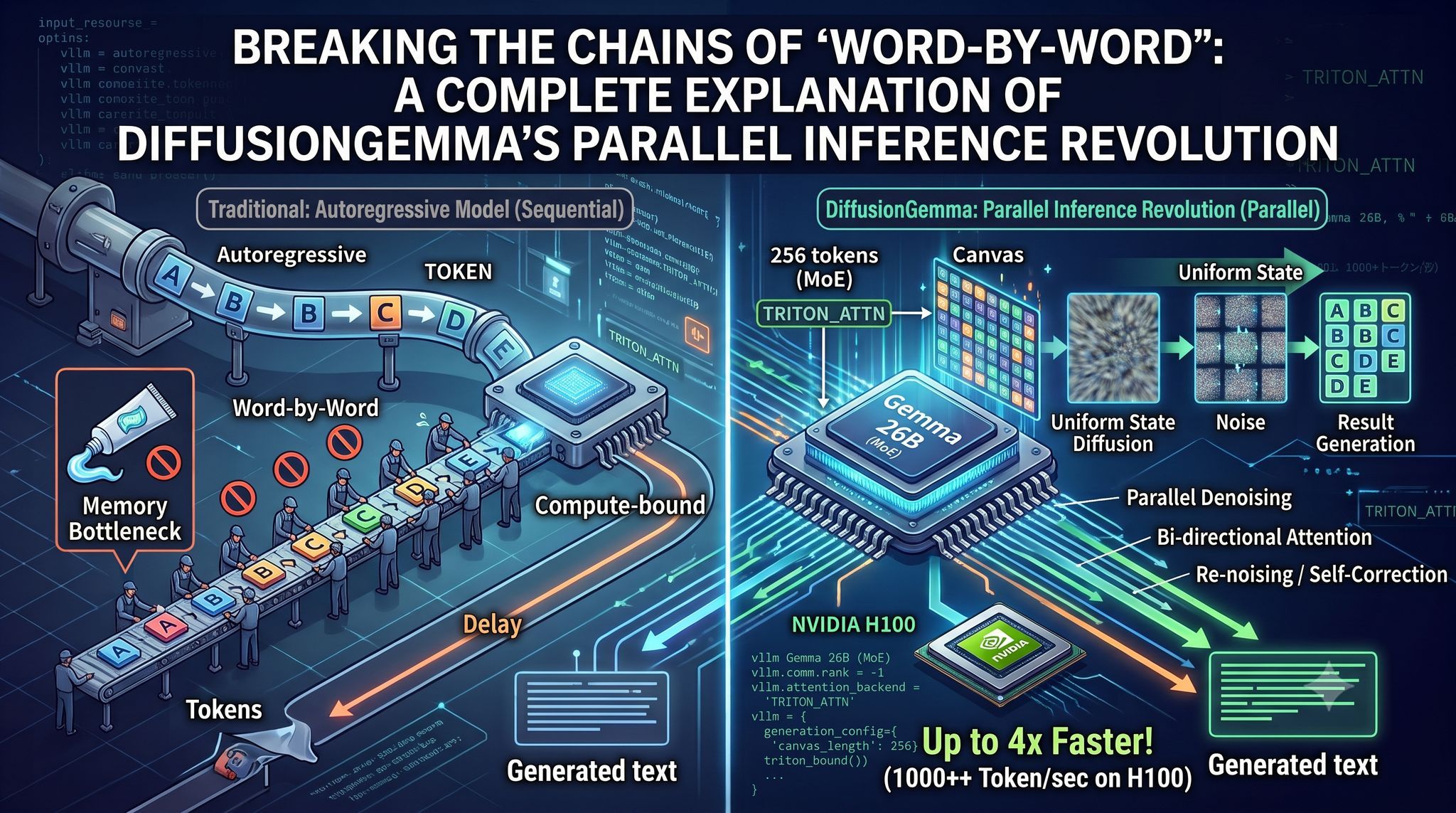
As developers, we seem to have become accustomed to the "Autoregressive" nature of models—the "word-by-word" process. We are used to the model loading weights from memory one token at a time, like squeezing toothpaste, and painfully waiting for the inference to complete just to generate a sentence.
But what if we changed our thinking? What if the model wasn't just a "chain-runner," but could act like a painter, setting up the canvas first and then refining it as a whole? This is the disruptive change brought by the DiffusionGemma: The Developer Guide.
Why are current models "too slow"?
The biggest pain point for traditional autoregressive models running on GPUs is often not a lack of computational power, but memory bandwidth constraints. Because tokens must be generated sequentially, the model must repeatedly load weights from memory, leaving many compute cores idle while waiting for data.
The emergence of DiffusionGemma shifts the bottleneck from memory bandwidth to compute-bound. By generating and refining a 256-token canvas in parallel, it utilizes the previously "idle" tensor cores, achieving up to 4x faster generation speeds. On an NVIDIA H100, this can reach a throughput of 1000+ tokens per second.
From "Chain-running" to "Global Collaboration": The Magic of DiffusionGemma
The core of DiffusionGemma lies in Uniform State Diffusion. Instead of mechanically outputting from left to right, it starts with a "canvas" full of random noise and, through multiple denoising iterations, allows the entire sequence to "focus" on the correct answer simultaneously.
1.True "Global Vision"
For tasks with strict constraints like Sudoku, traditional models often struggle because they "can only look at the past, not the future." DiffusionGemma's Bidirectional Attention mechanism changes the rules of the game. Every token position can perceive all other positions on the canvas, meaning it possesses global control rather than "blindly feeling for the elephant" when dealing with constraint problems.
2.Embracing the "Ability to Correct Mistakes"
Once a token is generated by a traditional model, it is "spilled water"—hard to fix. DiffusionGemma, however, has the ability to Re-Noise. If the model's confidence in a token decreases during iterations, it is fully capable of "erasing" it and regenerating it. This self-correction capability is something autoregressive models dream of.
3.An Elegant Balance for Long Context
To handle long sequences, DiffusionGemma adopts a "Block Autoregressive" strategy. It performs parallel denoising on a block of 256 tokens; once confirmed, it is committed to the KV cache before processing the next block. This perfectly combines the parallel speed of diffusion models with the long-sequence stability of autoregressive models.
An Engineer's "Getting Started Checklist"
This is not just a research model, but a tool ready for production. Based on the Gemma 4 architecture, it is a 26B parameter Mixture-of-Experts (MoE) model that only activates 3.8B parameters during actual inference, meaning it can be deployed with quantization within an 18GB VRAM limit.
Currently, the development team has worked closely with the vLLM team, and you can deploy it directly via vLLM:
vllm serve google/diffusiongemma-26B-A4B-it \
  --max-model-len 262144 \
  --max-num-seqs 4 \
  --gpu-memory-utilization 0.85 \
  --attention-backend TRITON_ATTN \
  --generation-config vllm \
  --hf-overrides '{"diffusion_sampler": "entropy_bound", "diffusion_entropy_bound": 0.1}' \
  --diffusion-config '{"canvas_length": 256}' \
  --enable-chunked-prefill
Looking Ahead: This is Not the End
DiffusionGemma demonstrates a possibility: by changing the generation logic, we can significantly improve inference efficiency while maintaining model performance. Whether downloading weights via Hugging Face or using NVIDIA NIM for enterprise-level deployment, the toolchain is now very mature.
As a developer, seeing innovation that optimizes inference logic at the "essential" level is truly exciting. After all, who wouldn't want a model that is fast, smart, and knows how to "think before acting"?