
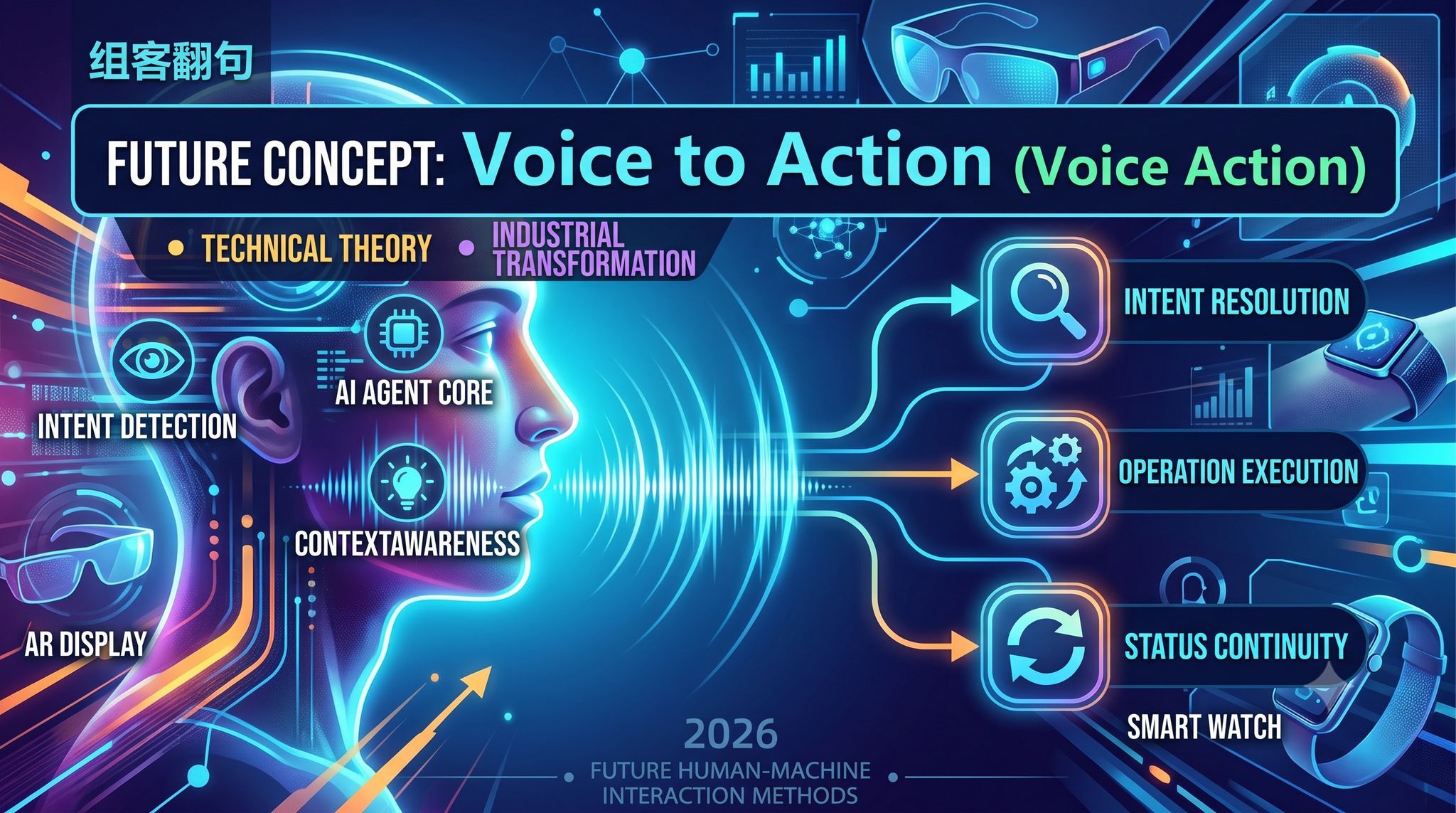
Envisioning the Future: Voice to Action Theory and Industrial Transformation
The "Voice to Action" theory shifts AI interaction from "Speech to Text" to autonomous action based on intent parsing. This article explores how this evolution impacts hardware, shifts developer roles, and drives future industrial transformation.

Envisioning the Future: Voice to Action Theory and Industrial Transformation
Amidst the current wave of AI technological development, I have proposed a core theory: "Voice to Action." This is fundamentally distinct from existing "Speech to Text" systems, various AI Agents, or traditional workflows. Originating in late 2026, this concept aims to redefine the way humans interact with machines.
1. What is Voice to Action?
"Voice to Action" is not merely about converting speech into text. Its core logic lies in the system automatically parsing the user's intent—expressed through voice—and triggering the corresponding action.
The complete loop of this process includes:
> Intent Parsing and Prioritization:
The system analyzes the core intent within the user's voice and determines which "Action" requires the highest priority for execution.
> Action Triggering and Execution:
The system automatically invokes underlying capabilities to perform the relevant business operations and returns the results.
> Human in the Loop State Maintenance:
During interaction, the system records and maintains the current "Human Flow" (human-machine interaction state). It determines whether the user is currently "asking a question," "thinking," or "at a loss."
> Continuous Iteration:
In subsequent interactions, the system combines feedback from the previous round, the saved "State," and newly perceived intent to achieve more precise matching and execution.
2. Breaking Through Current AI Usage Bottlenecks
Since the advent of ChatGPT in 2023, human-computer interaction has somewhat stagnated: people remain stuck in an "input a prompt -> wait -> process" loop. This mode relies heavily on the user's "Prompt Engineering" capability—users must be explicit about what the AI should do. This is not only inefficient but also renders AI usage tedious and lacks transformative impact.
The transformative nature of Voice to Action lies in:
1.Interaction Upgrade:
Users no longer need to learn complex commands; they simply express their needs as they would in normal conversation, while the backend takes care of guessing, parsing, and execution.
2.Breaking Operational Barriers:
Since the iPhone era, human-computer interaction has evolved from buttons to touchscreens, but the sensory essence has remained unchanged. Voice to Action represents the next major shift in operation, enabling true "thought-driven" control without the need for manual input.
3. Reshaping Hardware Forms and Economic Momentum
The current smartphone and smartwatch markets are saturated, with weak consumer incentives for upgrades. The implementation of the Voice to Action theory will drive a new explosion in the hardware industry:
> Essential Wearables:
Future smart devices (e.g., AI glasses, wearable devices with displays) will become essentials. They must be capable of capturing voice at any time and providing real-time feedback, rather than just using simple light indicators.
> Revitalizing Economic Cycles:
This new type of device will stimulate demand in the consumer electronics market. As hardware iteration accelerates and software vendors follow suit, the entire AI industry chain will be revitalized, creating new economic value.
4. Insights for Programmers and Developers
For programmers, the traditional mindset of "speech-to-text" or "real-time translation" is obsolete. The focus of development should shift:
> From "Transcription" to "Intent Capture":
Developers should not focus on how to understand and transcribe speech, but rather on how to distill massive amounts of voice information into specific "intents" and convert them into executable actions.
> Reject Hardcoded Workflows:
This is a common pitfall. Do not attempt to pre-set rigid Agent Flows or Workflows for enterprise clients. Business needs are constantly evolving, and rigid systems will ultimately be abandoned by the market.
> Provide Open Systems:
What programmers should build is an "underlying system" that empowers those who understand the business (e.g., customer service representatives, business experts) to independently adjust Actions. Let the professionals configure and optimize business processes within the "Human in the Loop" stage, realizing true synergy.
5. Looking Ahead: From Standalone to Interconnected
Voice to Action is more than just a technical solution; it is a bellwether for AI development over the next 3 to 5 years.
> Short-term Vision:
Optimize existing fields such as customer service and enterprise services to improve human-machine collaboration efficiency.
> Long-term Vision 10-20 years:
As the technology evolves, Voice to Action will connect various scene-based devices (e.g., smart tables in Starbucks, various city facilities). We will enter a sci-fi era of "device interconnection"—where carrying a terminal is no longer necessary; just by speaking, surrounding perception systems will coordinate to handle tasks, truly achieving an intelligent, hyper-connected society.
In summary, Voice to Action represents the profound integration of technology and business logic. This is not just an update in development philosophy, but a new driving force for social technological progress and economic circulation.