
A Hackathon Showed Me the Gap Between Me and the Neo4j Era
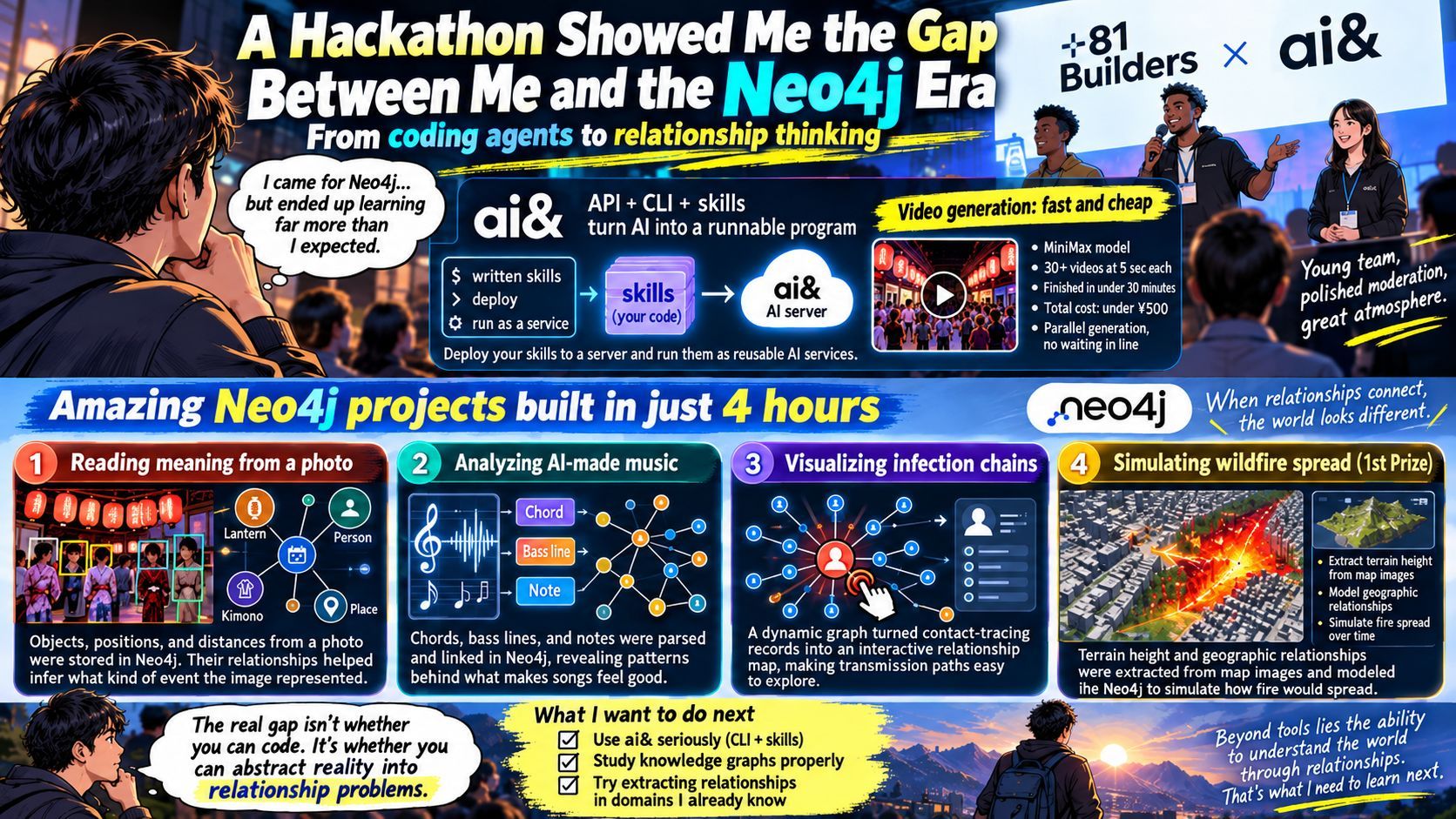
I joined a hackathon hosted by +81 Builders , where ai& showed how its CLI and skills turn an AI service into a deployable server, and MiniMax video generation proved fast and inexpensive. The bigger shock was what participants built with Neo4j in four hours: relationship analysis of photos, music analysis, a dynamic contact-tracing graph, and a fire-spread simulation. The experience made me realize that coding-agent fluency is no longer enough, and that I need to learn knowledge graphs.

A Hackathon Showed Me the Gap Between Me and the Neo4j Era
I went for Neo4j.
The hackathon was organized by +81 Builders. It's a very young organization, and the sponsor was ai&, a company that provides API services. I wanted to hear a graph database vendor talk about its product, but there was no Neo4j session that day. The talk was by ai&. My expectation fell through, but the takeaways were bigger than I expected: one was the way ai& connects APIs, a CLI, and skills; the other was what participants built with Neo4j. The latter gave me a real sense of crisis.
ai&: turning skills into a program you can launch
ai&'s pitch is straightforward: cheap, fast, stable. Honestly, I've grown immune to that kind of pitch. What genuinely surprised me was the CLI that comes with it.
You write skills on your own computer, then call the service through ai&'s CLI. That means you don't have to write the harness engineering from scratch: put your defined skills on an ordinary web server, and it runs as an AI server.
The flow goes like this. Plain text comes in from the front end; the skills you've written on the back end pick it up and execute the steps you defined. It feels less like "calling a model" and more like launching a program — skills are the program, the CLI is the launch command. Whether that analogy holds up is a separate question, but it does turn an "AI service" from a single Q&A into something deployable and reusable. For me, that was more appealing than the price.
In the same session, ai& also offered a video generation service built on a MiniMax model. Fast, and cheap. That day I generated more than thirty five-second videos, all done in under half an hour, for less than 500 yen total. It runs in parallel, so you don't wait in line one video at a time. I don't remember the exact unit price, but the three impressions — fast, cheap, no waiting — are clear. For anyone who needs a lot of material to iterate on, that cost structure changes how you work: before, you'd hesitate before generating; now you can spread out your ideas first and pick later.
The organizers: restraint is a skill
+81 Builders is a very young team. What stayed with me wasn't the scale of the event but the way it was run.
The host was a young Black man. English is his native language, and his Japanese was fluent too. What was even more impressive was his presence: steady, brief, no filler. He didn't open with a long "Hello everyone, welcome to..." He opened gently, with "I'm going to start talking now — could everyone listen for a moment?" Naming people, moving things along, wrapping up — all clean.
I've been to a lot of IT events in Japan and seen another style of hosting: the host works hard to show off, splits one sentence into several, and the tone and rhythm are a little uncomfortable. Against that, this host's restraint looked professional. He didn't need volume to prove he was in control.
There was also a very striking woman handling support. Her role wasn't just "standing nearby": she went up to every visitor, asked what they wanted to do today, offered to make introductions, and lifted people's mood first. Much of the atmosphere came from her. For a young team to handle both hosting and reception without hogging the spotlight or letting the room go cold is hard. Of all the events I've been to this year, this was the best-organized.
What they built with Neo4j in four hours
If ai& made me think "I'll use this a lot going forward," the project presentations that followed made me sit up.
What I built was a small service that connects ai&'s CLI to video generation and produces animations fully automatically. The logic isn't complicated: input from the front end, the back end calls the video model according to skills, and out comes the result. In last year's context, this was my strong suit. Last year everyone was learning coding agents and studying how programmers could use agents to build interesting things quickly. I was relatively comfortable with that rhythm, and I even enjoyed a bit of the spotlight.
But almost everyone who presented was talking about Neo4j.
Ontology, knowledge graphs, how to connect them to applications — I'd heard these words before, but they've only really caught fire in Japan's developer community recently. I didn't expect that, so soon after the hype started, the people on stage would already be using it to this degree.
One photo, and the relationships inside it
The Japanese guy sitting next to me built this: give it a photo, and it breaks down the things in the photo one by one. Many people can think of that step; using image recognition to guess what each object is isn't hard to think of either. What really impressed me was the next step. He put each object's meaning, its position, and the distance relations between objects into Neo4j, had the graph database generate relationships, and then followed those relationships to ask: what meaning do the objects in this photo actually form together?
His example was a traditional Japanese festival. A row of lanterns hangs down, people in kimono line up below them, festival implements sit nearby, and tourists are taking photos. From the photo, the system infers through relationships what kind of event this is. It also had a visualization: click a lantern, and the objects most strongly related to it appear connected. The first thing it points to is the people below the lantern, by the table. Why is this person most strongly related to the lantern? What is the lantern? What festival is this? Why did these people come to sing the festival song? The relationships string the answers together.
He built it in four hours. What impressed me wasn't the flashy visuals but the thinking: relationships themselves can be the object of a query.
An AI-written song, broken down into patterns of creation
Next up was a woman from abroad. She said everyone is using AI to make songs now, so she'd make one too — but what she really wanted to test was what connects the songs she likes.
Her method: generate a song with AI, then analyze it with AI — chords, bass, notes, that kind of data. Then analyze other songs too, and have the model judge whether they sound good. On their own, the data means little. She put it into Neo4j and got a relationship graph with connections: after this chord, that bass comes in; the connection is strong or weak. Creation started to show something like a pattern.
Honestly, I didn't fully understand the technical details, but the moment the visuals appeared, it felt very futuristic. I've been in IT for more than twenty years, and in that moment I felt I still had a lot to learn.
A dynamic graph that turns contact tracing into something you can click
Another presenter, an international student, took on the pandemic. One person gets infected, who did they contact, who did those contacts then contact — the topic itself isn't new. But he built a dynamic, animated relationship graph in Neo4j: click a person and the relationships run to the infected person, then on to their contacts; the graph keeps switching as you click.
Turning facts from written records into relationships you can click and see — that idea opened up an old topic all at once. He also built a point finder for explanations. That was built in four hours too.
First prize: letting a fire spread across a map
The first prize went to a guy who built a fire simulation.
His interface was impressive: a 3D map, and when you click a region or a hospital, it crops out an image of that area. Using what he considered the most technically demanding approach, he judged the terrain's elevation differences from the map image, extracted the data block by block, put it into Neo4j, and trained a model. When a fire breaks out in an area, the system uses the knowledge graph and the trained data to infer which way the fire will spread, where it can be put out, and how long it will burn — all with animation.
From concept to build to completion, also four hours. First prize was well deserved.
What really unsettled me wasn't winning or losing
When the presentations ended, my first thought wasn't "Why didn't I win?" It was "Good thing they didn't pick me."
If I were judging, I wouldn't pick my own project either. What I built was a useful automation. But the others were using a new way of organizing knowledge to answer questions that couldn't be answered before. Those two things aren't on the same level.
Last year, my fluency with coding agents still gave me an edge. This year, that edge is eroding. Once tools lower the barrier to "building something," what sets the ceiling isn't whether you can write code — it's whether you have that network of relationships in your head.
I used to think a knowledge graph was just "another kind of database": know what it is, be able to write queries, connect it to an application, and that's enough. But after seeing these projects, I realized the difference lies elsewhere — whether you can think of which relationships in reality are worth extracting and connecting, and then use them to answer a question that couldn't be answered before.
Most of the analysis I've done has been about business relationships or code relationships. Looking at it today, that isn't wrong — it's just too narrow. Neo4j is only a tool, and ontology is only a method. The watershed is whether you can see the objects in a photo, the harmony in music, the contacts in an epidemic, and the elevation differences in terrain as the same kind of "relationship problem."
After the event, there are two things I want to do. One is to use ai&, especially the CLI-plus-skills way of deploying things. The other is to fill in what I don't know about knowledge graphs — not by memorizing concepts, but by picking a few domains I know well and trying to extract the relationships.
I also hope ai& adds text-to-speech, image generation, and LLM capabilities. If all of those can be called from the same entry point, the "skills as a program" approach will be much more complete.
Finally, thanks to +81 Builders. The event was well coordinated, and both the hosting and the atmosphere were good. I came in wanting only to hear about Neo4j, and went home full of a sense of crisis. It was a very happy day, and worth it.