
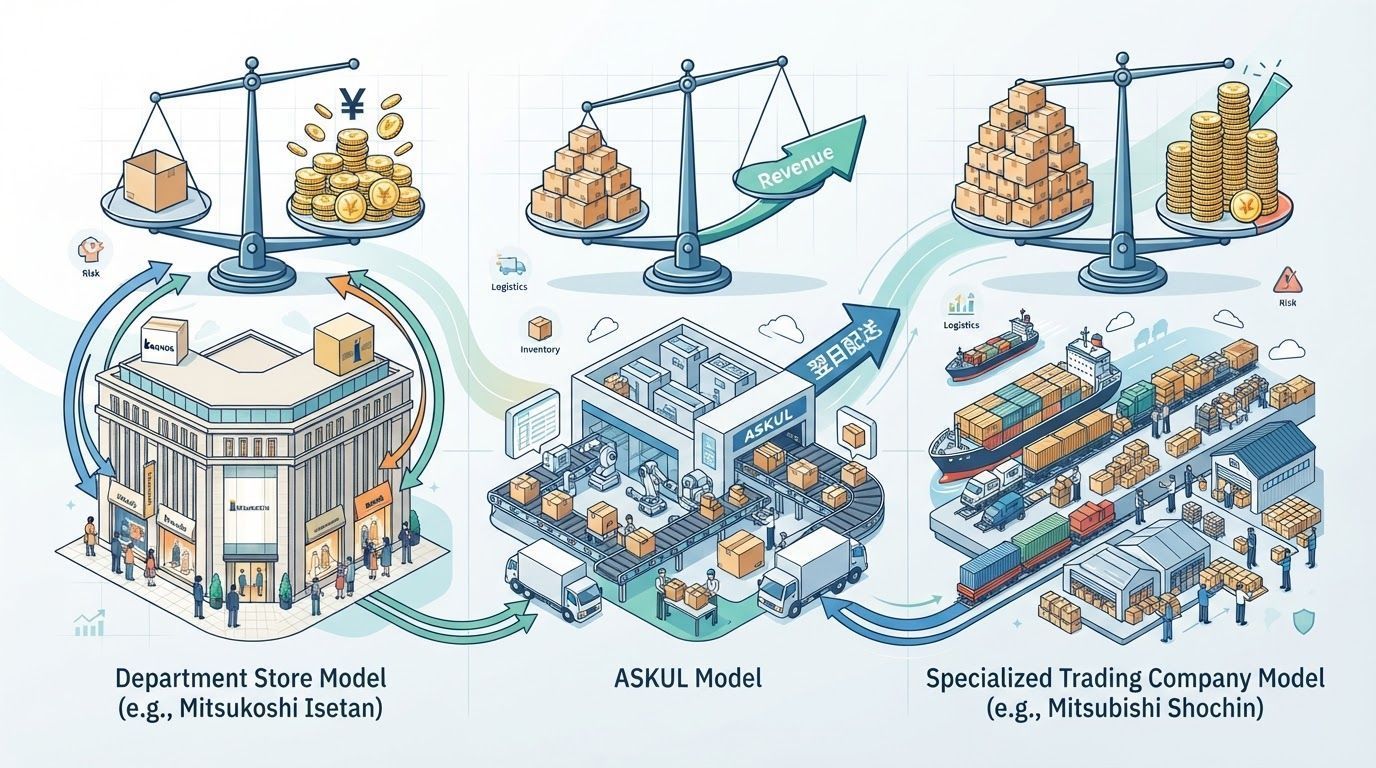
Who Carries the Inventory Risk? Department Stores, Askul, and Japan's Specialized Wholesalers
Department stores push inventory risk onto brands through consignment purchasing; Askul holds stock to guarantee next-day delivery while cutting out intermediaries; specialized wholesalers absorb logistics and labor to make thin margins work. Three cases—Isetan Mitsukoshi, Askul, and Mitsubishi Shokuhin—show how who carries each function and risk shapes the economics of distribution.

Who Carries the Inventory Risk? Three Distribution Models, One Question
A department store group that runs on 1–2% operating margins, an e-commerce company that promises next-day delivery and still earns a healthy profit, and a wholesaler that deliberately operates on thin margins: all three move goods to customers, yet their economics differ sharply. The difference is not what they sell. It is who performs inventory, logistics, and sales—and who absorbs the risk. Once that is clear, the numbers stop being just numbers.
Consignment purchasing: leaving inventory risk with the brand
The classic mechanism at traditional department stores such as Isetan Mitsukoshi Holdings and Takashimaya is *shōka shiire*, or consignment purchasing. Goods on the floor have not been bought outright. The store books a sale only when a customer buys, then settles the purchase price with the brand at a pre-agreed markup ratio, the *kake-ritsu*.
At a 70% ratio, a ¥20,000 item sold in the store records ¥20,000 in sales; ¥14,000 goes to the brand as the purchase price, and the remaining ¥6,000—30%—is the store's gross margin. Until an item sells, the brand carries the inventory, and unsold goods can be returned. That is what allows a department store to fill a floor with a wide range of apparel and other goods without tying up its own capital in stock. Brands gain too: they can sell as much as the market will take.
The costs are just as clear. Deciding what to carry and managing inventory on the floor are effectively delegated to the brands. Compared with outright purchase, the price the store pays is higher, so margins are thinner. Isetan Mitsukoshi's operating margin sat at 1–2% until the pandemic—a direct result of this structure.
Some department stores have taken a different route: rather than absorbing the volatility of retail sales, they lease floor space to tenants and collect rent. J. Front Retailing, which operates Daimaru Matsuzakaya and Parco, is expanding this tenant-leasing model. The traditional consignment model magnifies gains when store sales grow, but it also magnifies the blow when they fall. Rent produces steadier income and dampens swings. Neither model is inherently better; the choice is between betting on sales growth and betting on stable cash flow.
Askul: turning "tomorrow" into the product
Askul began in 1993 as a business unit inside Plus Corporation and was spun off in 1997. In the fiscal year ended May 2024, it posted ¥471.6 billion in sales and ¥16.0 billion in operating profit, both records.
Its customers are businesses. The catalog runs from stationery and copy paper to medical supplies—more than 14 million SKUs—sold through its own site, with next-day delivery as the promise behind a name that plays on *ashita ga kuru*, "tomorrow comes." E-commerce splits into two broad models: direct sales, where the operator holds inventory and sells to customers, as Askul does; and marketplaces such as Rakuten Ichiba, where the operator holds no stock and many merchants list goods. To keep next-day delivery, Askul chose the inventory-holding direct model.
What supports the promise is an internal distribution system the company calls the "Askul System." In the traditional stationery chain, purchasing, inventory management, and sales were duplicated at each layer of wholesalers before a manufacturer's product reached the customer. Askul removed the intermediate layers: manufacturers focus on production, while Askul handles catalog production and mailing, site operations, inventory management, and delivery. Concentrating each function with the player best at it widened the product range while cutting time and cost.
The sales side is more unusual still. Instead of building its own sales offices, Askul brought stationery shops across the country into its system as sales agents. Agents do not handle purchasing, inventory, or delivery; they develop new customers, collect payments, and support clients, with the two sides settling an agency fee. Askul gains local relationships and sales capacity without owning them, and can concentrate its own resources on products, systems, and logistics.
Otsuka Shokai is a case in point. An independent IT services company, it excels at selling copiers and PCs and at building and maintaining systems. What it wants is a way into new customers. A salesperson who opens with "how about replacing your copiers?" or "time to install a new system?" is likely to be turned away; a conversation about low-cost office consumables gets a foot in the door. Consumables become the start of a relationship, and hardware and services can follow. For Askul, agents are both a sales network and a way into the depths of corporate customers.
Mitsubishi Shokuhin: thin margins carried by logistics and people
A specialized trading company connects manufacturers and retailers and earns the spread between the purchase price and the selling price—the margin. There are houses specialized in machinery, food, fuel, steel, pharmaceuticals, and more. But in fields without physical goods—systems, software, finance, telecommunications—the model struggles to add value. Strengths also differ by company: about 60% of Mitsubishi Shokuhin's sales come from processed and chilled or frozen foods, while roughly 40% of rival Itochu Shokuhin's sales come from beer and other liquor.
A low-margin, high-volume business must cover many manufacturers and retailers at once. That takes a large sales force with product expertise, plus warehousing and delivery to stores—trucking and other logistics networks are indispensable. Labor and logistics costs weigh heavily, and wholesalers of low-unit-price goods such as food and daily necessities are especially prone to thin margins. That is the cost reality behind the phrase "sell cheap, sell a lot."
Unlike the general trading companies that turned themselves into investment firms, specialized traders have pursued scale through new transactions and mergers. Mitsubishi Shokuhin itself began as a domestic seller of canned seafood, reached its present scale through a 1979 consolidation and a 2011 business integration, and has accelerated investment in logistics in recent years. It is using IT systems to improve logistics efficiency and delivery, and purchase data and other big data to forecast demand and reduce inventory risk. Those capabilities now extend to retailers' sales-promotion support, private-label development, and marketing support for manufacturers.
Paltac, a major wholesaler of daily necessities, offers a contrast. It has cut logistics costs by automating warehouse work, reducing headcount, and improving delivery efficiency; its operating margin exceeded 3% in fiscal 2023, high for its peer group. As labor shortages and logistics costs persist, how far a company can hold down that cost determines how much room a thin-margin business has left.
Three models, one question
Set side by side, the three companies are answering the same question: who takes on inventory risk, logistics, and sales?
The department store handed inventory risk to the brand in exchange for a broad assortment and a light balance sheet—and gave up control over selection and margin along with it. Askul carries inventory itself, strips out intermediaries, delegates selling to agents, and buys speed and cost efficiency with systems. The specialized wholesaler absorbs logistics and labor between manufacturers and retailers, using scale to live with thin margins. Each choice has a clear price and its own vulnerability: department stores to weak floor sales, Askul to rising delivery costs, wholesalers to higher labor and logistics bills.
As labor shortages and logistics costs persist, whether these models hold comes down to one thing: can the party carrying the function keep its cost under control?