
The Business That Free Users Built: Why Freemium Depends on Recurring Revenue
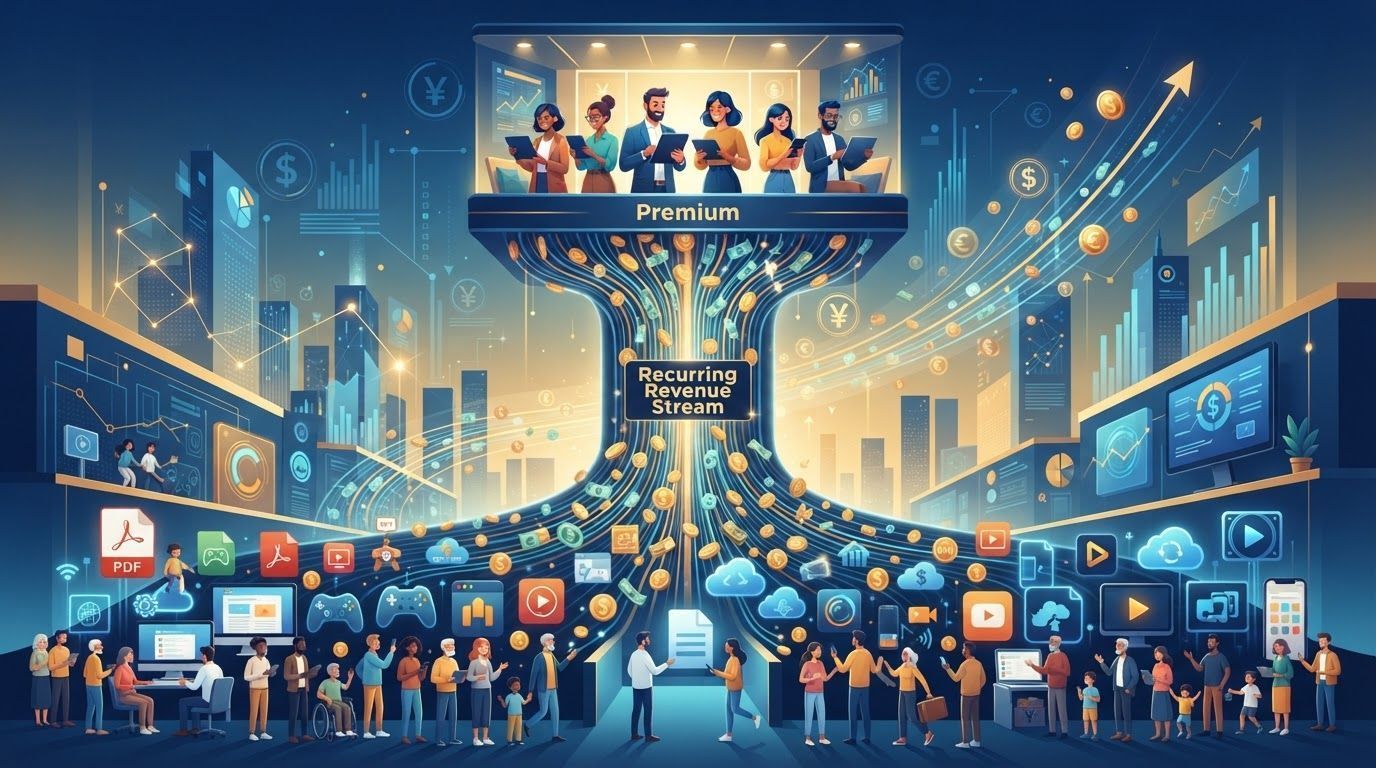
Freemium joins "free" and "premium" into one word: a minority of paying users supports a majority of free users. Chris Anderson's 2009 book Free helped the model spread. Adobe's free PDF reader and free-to-play mobile games are classic cases. The article argues that freemium is not a one-time sale: it depends on recurring revenue, and on gathering enough free users so that some of them will keep paying.

The Business That Free Users Built: Why Freemium Depends on Recurring Revenue
A business model stitched together from two words
Freemium is a coinage that joins "free" with "premium," the higher-priced tier. It reached a wide audience largely through Chris Anderson's 2009 book *Free*. Anderson, a former editor-in-chief of the American IT magazine *WIRED*, laid out a logic of "free" that helped the model spread quickly.
The structure can be summed up in one sentence: a minority of paying users supports a majority of free users. It shows up so often in digital markets because once content and services are digitized, copying and distribution cost very little; serving one more free user adds far less cost than shipping a physical product. That is what lets companies give away a large amount of service in the first place.
Free is only the entrance; revenue has to keep coming
A two-axis diagram makes freemium easier to place: the horizontal axis is the source of value, and the vertical axis is how profit is captured. Freemium's source of value is a kind of matchmaking: let people use the service for free first, then identify those willing to pay for more. Its profit mechanism sits in the "recurring" column, not in a one-time sale.
This point is often missed. If "free version plus paid version" were a one-off transaction, it would essentially be a bundle: use one attractive product to draw customers, then make money on another. Freemium is different. Paying users have to keep paying so that revenue accumulates over time. In other words, time is the decisive variable in this model.
Adobe: a free reader gave away the standard
PDF is the classic case for understanding freemium. Developed by Adobe, PDF is an electronic document format that can display documents and graphics regardless of the computer or hardware in use. Adobe offered Acrobat Reader, the software for viewing PDFs, free to users around the world.
What the free version can do is limited: view and print, nothing more. For most people, that was enough. Only those who actually want to edit a PDF, or share it in a particular way, need to buy the paid Acrobat. As a result, PDF spread as a format as widely as possible, and sales of the paid version had room to grow.
Think about the reverse: if even the software for reading PDFs had been paid, the format probably would not have spread the way it did. Because viewing is free, the format could reach everywhere; because editing costs money, the business works.
The game industry pushed the logic to its limit
Gaming is where freemium is most active, especially mobile games.
Games used to follow a different logic: buy a console such as the Famicom or PlayStation, then buy cartridges or discs, paying once per title. Today's live-service mobile games generally offer "free to play, pay for extras." Monster Strike, operated by mixi, is a typical example, with more than 62 million cumulative users. Scale is the premise, but what matters more is that some of those users are willing to pay.
The president of a popular game company once explained it this way: users who reach the top of the rankings spend more than one million yen a month. It is this small group of heavy spenders that supports the whole game. The biggest difference from buy-to-play titles is that, as long as enough paying users remain, a live-service game never reaches the "finished, so it's over" point.
The other side of the rankings: evergreen hits and a long list of exits
An annual ranking of global game revenue shows that the top earner in 2023 was Monster Strike, launched in 2013. Only four titles released after 2020 made the top ten, among them Uma Musume Pretty Derby and Genshin Impact. In other words, most of the ranking is still made up of games launched in the 2010s: a handful of evergreen titles holding the top for years.
Outside the rankings, the picture is far less romantic. Many games fail to attract the expected number of users after launch and have to shut down. Others are canceled before release because the projected revenue looks too weak.
That brings us back to the premise of freemium: there first have to be large numbers of people willing to use the service for free, and only then can some of them pay. If you cannot even gather free users, the model cannot be sustained at all.
Conclusion
The point of freemium is not the novelty of "free" but whether the path between free and paid actually works: can free bring in enough users, and can paid persuade some of them to keep paying? Free widens the entrance; recurring revenue makes the business real. Neither works without the other.