
Free Users Aren't a Cost: Three Freemium Models from Mixi, Cookpad, and Chatwork
Freemium is often treated as a price list: attract people with a free tier, then convert some of them into payers. But what really decides whether it works is the value the free side produces. Through Mixi's reliance on a few heavy spenders, Cookpad's community of free recipe writers, and Chatwork's use of free users to build network scale, this article compares three revenue structures, their vulnerabilities, and why low marginal costs let SaaS growth eventually turn into profit.

Free Users Aren't a Cost: Three Freemium Models from Mixi, Cookpad, and Chatwork
Treating freemium as a price list is the lazy shorthand of many business conversations: lure people in with a free version, then find a way to make some of them pay. Put Mixi, Cookpad, and Chatwork side by side, though, and it becomes clear that what determines whether the model works isn't the pricing table at all. It's a more basic question: what value is the free side actually producing, and who is willing to pay for it?
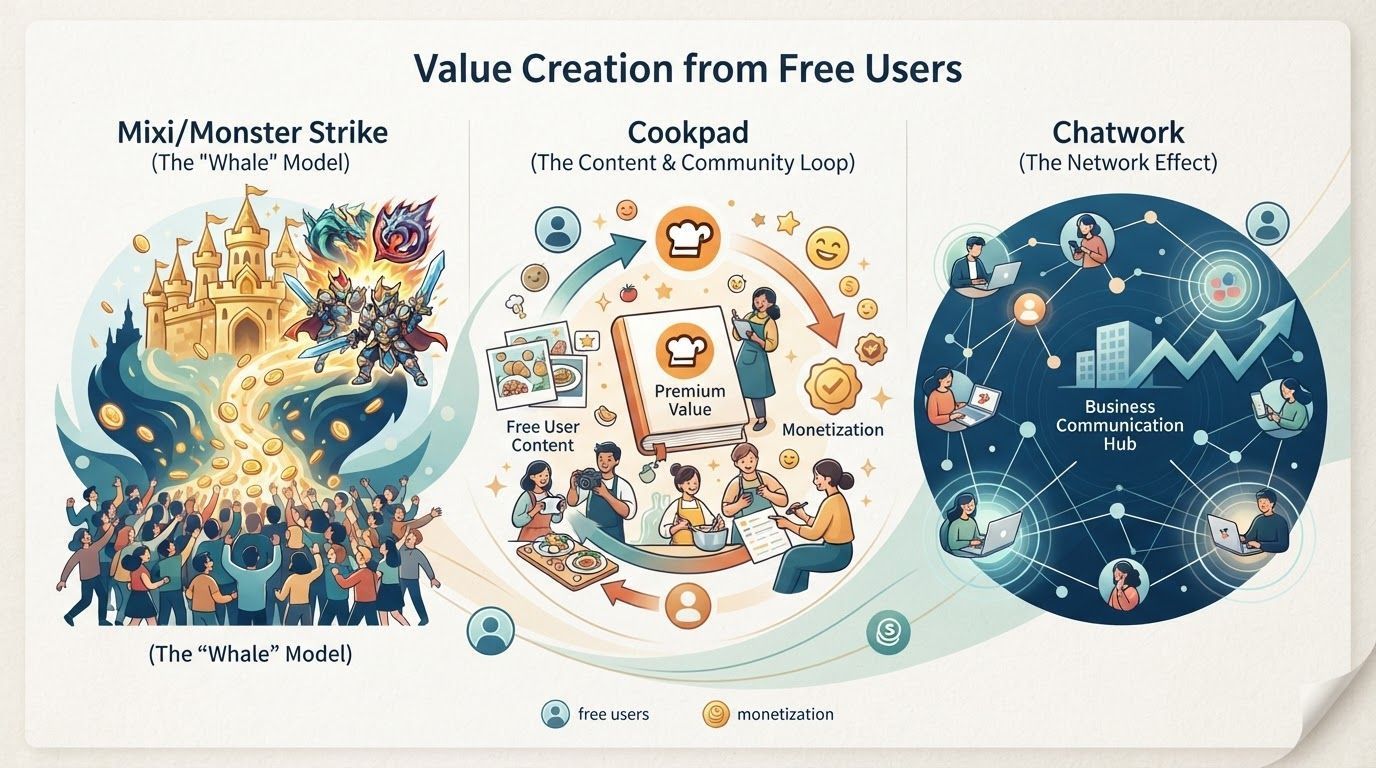
The three companies answer that question differently. Mixi bets on a tiny group of heavy spenders. Cookpad relies on the recipes and community that free users keep contributing. Chatwork uses the scale it gains for free to raise the value of the service itself. All three paths have worked, and all three have their own points of fragility.
1. Mixi: A Few Percent of Big Spenders Carry the Business
Mobile games are the textbook freemium sample. The game itself is free to download and free to play; the real charges come from gacha, a mechanism that randomly draws characters or items. Players can start without paying anything, but if they want a rare character or an easier path through a stage, they end up paying again and again.
The crucial feature of this structure is that very few people actually pay. Heavy users who spend tens of thousands of yen a month make up only a few percent of the player base, yet that few percent covers development and operating costs and generates the game's profit. Free gacha draws usually come with a limit on how many times you can pull, and that limit nudges players who want to get stronger, step by step, toward paying.
Growing revenue by focusing only on existing big spenders isn't enough. Mixi keeps introducing attractive characters and items, running anniversary events, and collaborating with popular anime series to expand the total user base first. More active users make in-game rankings and battles more competitive, which creates room for the paying rate to rise. In other words, heavy spenders are the fulcrum of revenue, but what holds up that fulcrum is a large enough base of free players.
Monster Strike is the model's showcase. More than a decade after launch, it has about 63 million cumulative users and over 1.3 trillion yen in cumulative sales. In fiscal 2023, the segment's operating margin reached 38.9%, a remarkably high level for the games industry.
Long-running operations add another layer of protection. Players have invested time and money, and the characters and items they have built up become switching costs. However interesting a new game may be, few people are willing to walk away from what they have accumulated. That is why games with a long track record tend to hold up better than new releases.
But the risk of relying on a single pillar is equally obvious. Mixi has placed its next growth bet on Mitene, an app for sharing family photos and videos. Launched in 2015, it has more than 20 million users, about 40% of them overseas. Uploading photos and videos is free in principle, while paying premium members can download them in bulk and buy add-ons such as photo prints. The problem is that the business including Mitene keeps spending on advertising overseas and remains in the red. Turning it into a second pillar after Monster Strike is Mixi's most urgent task.
2. Cookpad: Free Users Write the Recipes, Paying Users Buy Efficiency
Cookpad is a different kind of freemium. Its free service is already fairly complete: users can search and browse recipes, post their own, and use "tsukurepo," a feature for reporting back on a dish with a photo and a message. Paying members buy greater efficiency: recipes that many users have rated highly, recipes built around seasonal ingredients, and stronger search.
At first glance, paying members are the ones supporting the recipe site. What actually keeps the service moving, however, is a loop among free members. Someone posts a recipe; someone else cooks it and sends back a photo and impressions; the poster gets a response, feels motivated to write more, and new recipes appear. The more recipes there are, the more valuable the site becomes as a place to look up how to cook something, and the more likely people are to pay for search and filtering.
Cookpad's real asset, then, is not the database on its servers but the community that free users sustain. If that loop slows down, paid conversion loses its source.
And the loop is slowing. Paying membership keeps falling, largely because the competitive landscape has changed. Video-first recipe services such as DELISH KITCHEN and Kurashiru have risen, and recipe videos on YouTube have multiplied. With more choices available, Cookpad's monthly users fell from about 52 million in 2019 to 47 million by the end of 2023.
Financial pressure followed. The company posted huge operating losses for three consecutive fiscal years, from the year ended December 2021 through the year ended December 2023. Cost cuts, including staff reductions, helped it return to profit in the year ended December 2024, the first profit in four years, but retaining users remains its biggest challenge.
The exit from advertising made the situation tighter. Advertising accounted for roughly 30% of Cookpad's sales, shrank steadily as membership declined, and was shut down entirely in February 2023. The explanation offered was notably vague: with information distribution becoming more diverse, it had become difficult to keep providing value to food-related companies. With new businesses sluggish and advertising revenue gone, rebuilding the recipe business is now essentially the only path forward.
3. Chatwork: Free Users Buy Scale, Scale Raises Value
Freemium isn't limited to games and content communities; business-to-business SaaS uses it too. Chatwork's chat tool of the same name is a typical case, sold as a free plan plus two paid plans.
As of fiscal 2024, it had about 7.4 million registered IDs, but only about 800,000 paying contracts, roughly one in ten. The free plan allows unlimited group chats, but video calls are one-to-one only and message history is available for a limited period. Companies that decide they would rather pay a little for a smoother experience move to a paid plan.
Free users do cost money to maintain, so offering only paid plans might look more profitable. But making the service free lowers the barrier to adoption, which allows the user count to keep growing. As users multiply, network effects kick in: when colleagues, clients, and partners are all in the same place, the tool itself becomes more valuable. And only when it becomes more valuable do more people choose to pay.
Chatwork has designed this chain explicitly. It spends on marketing to acquire free users, analyzes how they use the product, and has sales staff approach promising customers to move them onto paid plans. After signing, it upsells higher-tier plans with more convenience and cross-sells additional services, raising revenue per customer.
Looked at through cost structure, SaaS is attractive because it requires no raw materials and no factory, and the same software can be sold to many customers, so marginal cost is low. Manufacturing gross margins are around 20%, while software margins are typically 70% to 80%. The trade-off is heavy upfront spending on marketing and development, which can mean years of accounting losses. But as long as sales are growing quickly, low marginal cost means profit should eventually follow.
4. Three Models, One Question
Line the three companies up and the differences are plain: Mixi gets paid by a small group of heavy spenders, Cookpad by efficiency-seeking members, Chatwork by companies. The free side, in turn, supplies competition and liquidity, content and community, or network and adoption path.
Yet they are answering the same question: what role do free users play in the value chain? If free users are merely inventory waiting to be converted, then free is pure cost, and the bigger the scale, the bigger the loss. Only when the free side keeps producing value, by making the game livelier, the recipe library larger, or the tool more useful, does paying rest on solid ground.
The risk comes from the same place. Mixi's revenue depends heavily on a small number of users and a single IP. Cookpad's community is being siphoned off by outside content platforms, and once the loop decelerates it is hard to reverse. Chatwork's free users are a real cost, and its conversion rate and scale threshold will decide whether it ends up profitable or bleeding.
Freemium, then, was never a price list. It is a system that has to be operated continuously: the free side must keep producing value, the paid side must be able to state clearly why it is worth paying, and the cost structure must allow scale to turn into profit. Miss any one of the three, and free is just a cost.