

The Complementary Goods Platform Model: Why Two-Thirds of Amazon's Profit Comes from AWS
One Company, Two Margins
In one fiscal year, Amazon reported $574.7 billion in revenue and $36.8 billion in operating income. Broken down by business, the online store is the largest by revenue, but most of the profit comes from elsewhere: AWS alone generates about two-thirds of operating income, while the online store and everything else together account for roughly one-third.
The margin gap is starker. AWS's segment operating margin reaches 27.1%, while the online store and related businesses manage only 2.5%. Advertising and subscriptions are generally considered profitable businesses. If the overall margin is still this low even with them included, one plausible explanation is that the core online store business is barely profitable—or possibly loss-making.
The coexistence of a 27.1% business and a 2.5% business inside one company cannot be explained by "cloud is more profitable" alone. AWS earns what it does largely because it belongs to a different business model: the complementary goods platform model.
The Core: A Base Product × Third-Party Complements
The complementary goods platform model works by making a competitive platform or base product the core, then plugging in complementary goods supplied by outside third parties so that the combination raises the value of the whole. In Japanese, it is called the 補完財プラットフォームモデル.
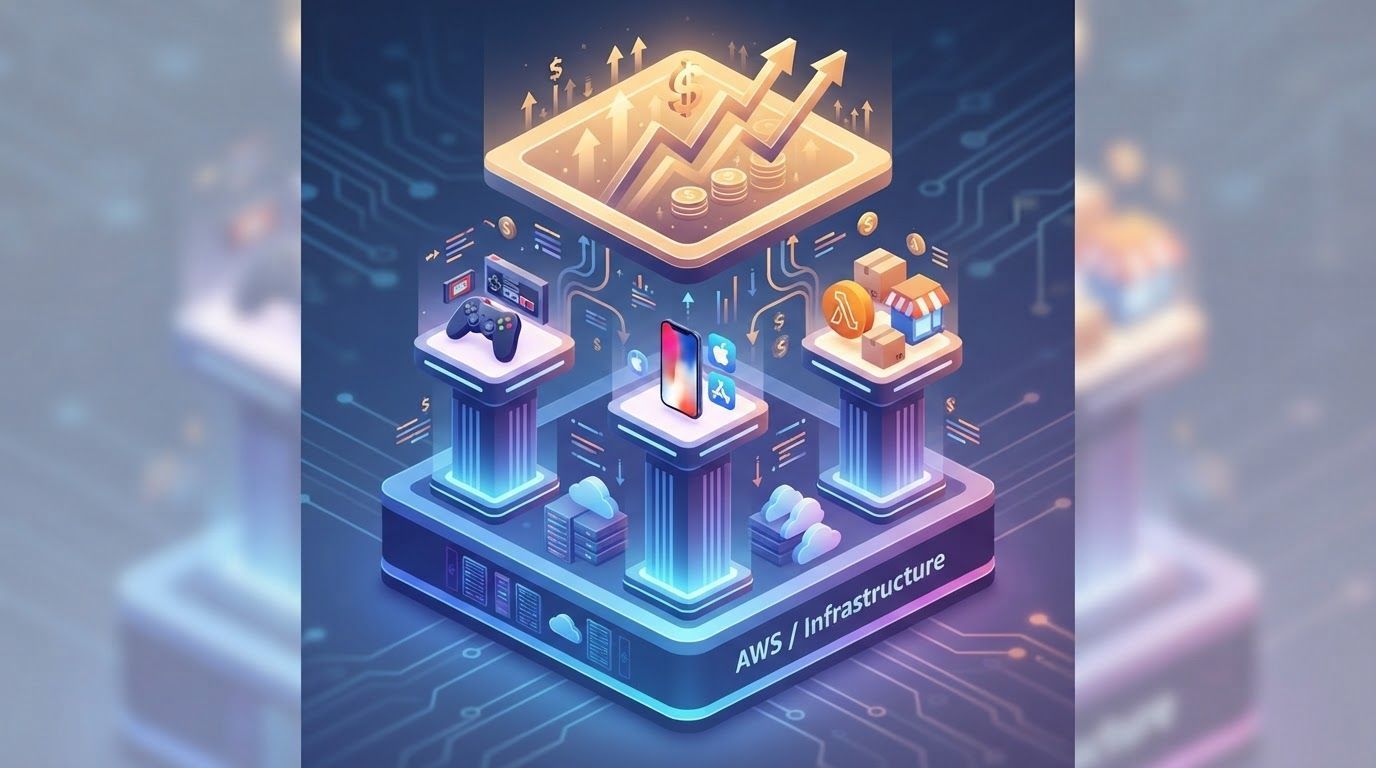
Nintendo's hardware and third-party software, the iPhone and the apps in the App Store, and the personal computer with its operating system and the software running on it all fit this structure. What they share is not "building a platform" but the pairing of a base and its complements.
The model can be understood along two axes:
- The source of value is the power of combination. A piece of hardware or an operating system on its own has limited value. Only when the base hardware is combined with software from the company and from third parties can it produce outsized value.
- The way profit is captured is a three-party market. The platform owner, the complementors, and users are all present at once. The platform does not try to make every layer itself; it brings the three parties together and takes a fee from their transactions.
The key point is that if the company developed both the hardware and the software in-house, it could not achieve this level of efficiency. It is precisely because outside third parties are willing to supply software for the platform that the platform owner can earn a high operating margin and operating efficiency with relatively little of its own investment. In other words, "the power of combination" and "the three-party market" must hold at the same time: the former determines how much value can be created, and the latter determines how much of the added value the platform can capture.
Amazon's Three Layers
Amazon is often summarized as three businesses, and they show neatly how the model stacks up.
The first layer is the online store. In 1995, Amazon started as an online bookstore. It buys goods from other companies, stores them in its own warehouses, and sells them on its own site. This is a classic distribution-retail model: it earns the spread between purchase and sale prices, and its efficiency depends on product selection, warehousing, and logistics.
The second layer is Marketplace. In November 2000, Amazon launched Amazon Marketplace in the United States. Outside sellers can list products on the same pages as Amazon's own goods and sell to users; Amazon charges them registration and sales fees. This is a platform-style matching model: Amazon no longer has to stock every item, yet it can take a cut of third-party transactions.
The third layer is AWS. In 2006, Amazon began offering cloud infrastructure and applications. Cloud services on their own are a recurring-subscription model; AWS is classified as a complementary goods platform because AWS Marketplace is open to outside software companies—the producers of complementary goods. Large numbers of software companies register, distribute, and sell their products on AWS, and Amazon takes a commission of roughly 1.5% to 3% of sales. That commission is not just revenue; it becomes a complement that strengthens the platform: the more software available on the platform, the more users stay, and the more software companies want to join.
By revenue, AWS is only about one-third the size of the online store; by profit, it accounts for about two-thirds. Revenue ranks roughly as online store, third-party services, advertising, subscriptions, and other businesses. That mismatch between scale and profit is the result of three models running side by side.
Why It Is Powerful—and Why It Is Hard to Copy
Among the models compared in this business-model framework, the complementary goods platform has the fewest adopters but by far the highest operating margin. Looking at individual companies, there are of course businesses more profitable than this. But when the unit of comparison is the business model itself, its efficiency still stands out.
The small number of adopters is itself evidence of how hard the model is to reproduce. There are at least three obstacles:
- Building a competitive platform in-house demands long-term investment and product capability.
- The company must make outside third parties feel that developing for this platform is worth it. The platform has to offer good enough planning, development, and distribution conditions for complementors to make money.
- Platform and complements depend on each other. Fewer complements lower the platform's value; fewer users drive complementors away. If either side cools, the flywheel stops.
NTT Docomo's i-mode is the counterexample. In 1999, before the iPhone, Docomo launched i-mode and rode it to dominance with dedicated services such as email, ringtone downloads, fortune-telling, and online banking. But it could not compete with the iPhone and other smartphones, declined, and finally ended service in March 2026. Even a platform that once succeeded can disappear entirely if it loses to another platform.
Conclusion
The point of the complementary goods platform model is not "build a platform." It is to combine your own base product with third-party complements and design the rules for a three-party exchange. The high margin is the reward for a structure that opens its interfaces, lets outside complementors make money, and takes a share of the added value. Its fragility comes from the same place: complementors and users can walk away at any time.