

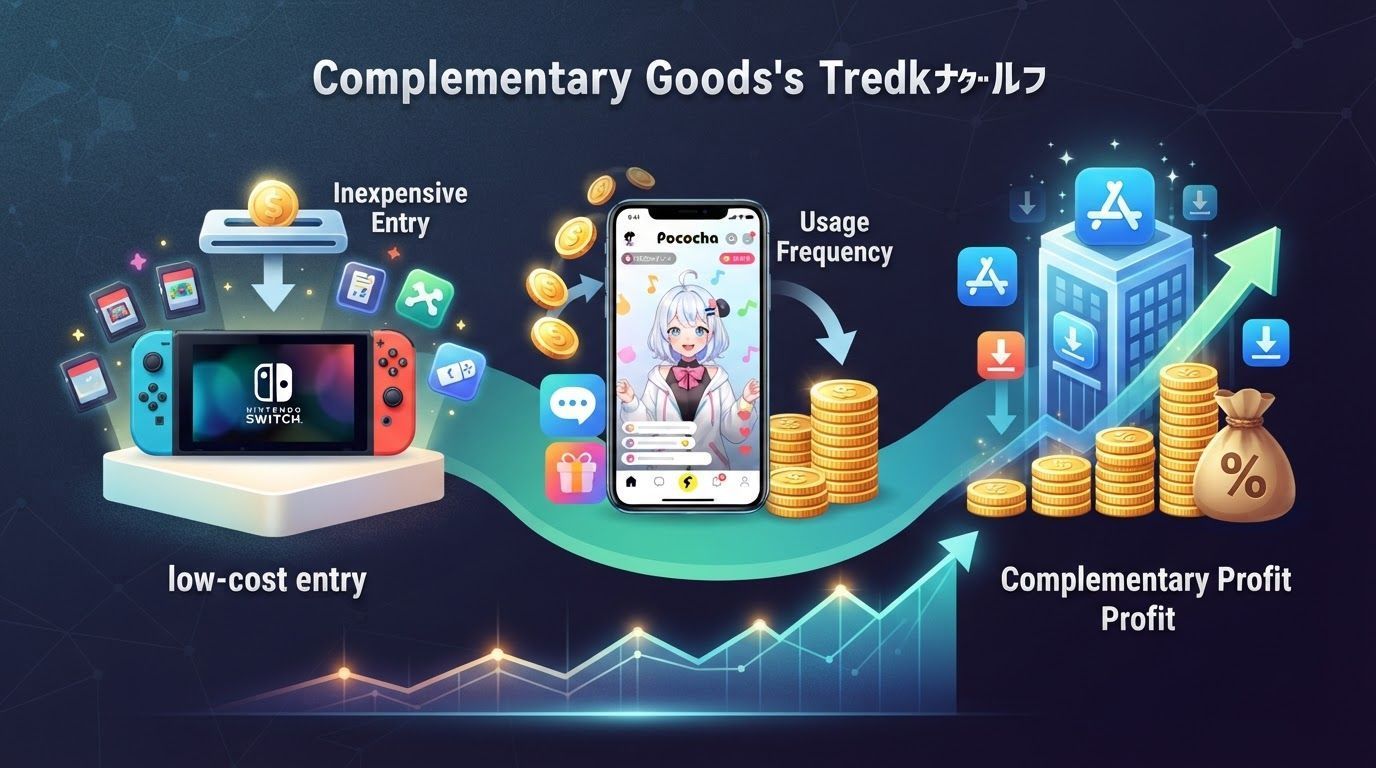
The Complementary-Goods Platform Model: Sell the Entrance Cheap, Make Money on the Complement
Three Companies, One Counterintuitive Result
Nintendo's Switch is not an expensive console. DeNA's livestreaming app is completely free for viewers. Much of the software in Apple's App Store is built by outside developers. Yet all three companies make a lot of money. Nintendo's operating margin sits around 30%, Capcom's holds steady near 40%, and Apple's services business runs a gross margin close to three-quarters.
Look at any single product and the numbers are hard to explain. A console is hardware, and hardware carries material costs. A livestreaming platform has to pay for servers and moderation. The games in the App Store were not written by Apple. The answer is not in the individual products but in the relationships between them: what these companies sell is the complement.
The Core of the Model: One Side Gathers People, the Other Collects Money
In economics, complementary goods are products that only have value when used together with something else: a console and its games, a phone and its apps, a livestream room and the tips viewers send. The complementary-goods platform model works by making one side cheap—or free—enough to pull in scale, then collecting on the other side, the one with higher usage frequency, lower marginal cost, and fatter margins.
For that structure to hold, two conditions have to be true at once. The entrance must be cheap enough that a large number of users will walk through it, and the complement must be consumable over and over at almost no additional cost. What separates the three cases is which side each company turned into the entrance and which side it turned into the profit pool.
Nintendo: The Console Moves Units, the Software Makes Money
Nintendo is the cleanest example. The Switch, launched in 2017, still sold about 15.71 million units in fiscal 2023, holding up relatively well late in its life cycle. What sustained it was not the hardware but the software: *The Legend of Zelda: Tears of the Kingdom*, released in May 2023, sold more than 20 million copies and gave console sales a direct push.
Behind that is a simple piece of cost arithmetic. A major game can take years to go from concept to shelf, and the upfront spending is heavy, mostly on labor. Once development is finished, though, producing more copies adds very little cost. So Nintendo sells the console—the entrance—cheaply, pulls in as many users as it can, and then keeps selling those users software. That is the basic structure.
Third-party publishers make it sturdier. When outside companies such as Capcom and Square Enix Holdings release games for the Switch, the number of titles users can play goes up, and the console itself becomes more attractive. And when those games sell, Nintendo also collects a platform fee.
Break down the revenue and the shape is clear: about 46% first-party software, about 44% hardware, about 10% third-party software. At the gross-profit level, software accounts for roughly 70% and hardware only about 22%. Hardware is the cost of bringing people in; software is the profit.
The structure does fail sometimes. From fiscal 2011 through fiscal 2013—the years ending March 2012 through March 2014—weak sales of its main console pushed Nintendo into three consecutive years of operating losses. Taste in games moves fast, and even Nintendo cannot guarantee that every generation of hardware will be a passable entrance.
Digital Distribution: Turning Back Catalog Into a Long-Term Asset
There is a second thread in the Nintendo case that is easy to miss: digital distribution changed the shape of the software business.
Sell cartridges or discs through retail and price, inventory, and promotional timing are all constrained by the channel. Sell digitally and the publisher sets its own prices and timing. Capcom has pushed digital distribution since the 2010s, timing discounts on older titles to coincide with the release of a new entry in a popular series. That arrangement lets back catalog keep selling for years, and since those older games have already been amortized, the extra revenue drops almost straight to the bottom line. It is one reason Capcom's operating margin holds around 40%.
DeNA: No Cover Charge, Revenue From Tipping
DeNA's livestreaming business brings in about 30% of the company's revenue, and it moved this model onto a content platform.
In the early 2010s, dedicated livestreaming platforms such as SHOWROOM, 17LIVE, and Pococha appeared one after another, then grew rapidly during the pandemic. The structure is straightforward: the platform provides the infrastructure, streamers broadcast on it, and viewers watch for free. Pococha charges nothing to stream or to watch; its revenue comes from two places—advertising, and message items such as "hearts" and "thank you" that viewers buy and can use only inside the app. When a viewer sends an item during a stream, a message appears on screen and the room lights up. The platform takes a cut of those item sales.
What sets Pococha apart is not its features but whom it serves. Platforms like SHOWROOM center on celebrities and streamers with name recognition, where a single broadcast can draw tens of thousands of viewers. Pococha is aimed mainly at ordinary people with no following. To make ordinary people willing to appear on camera, it introduced "digital makeup"—facial filters—to lower the psychological barrier to showing your face, while putting heavy emphasis on two-way interaction between streamer and viewer.
That positioning gave it a foothold in a crowded market. Pococha launched in January 2017, a late entrant among livestreaming services, yet the livestreaming business that includes it grew to roughly 40 billion yen and came to account for about 30% of DeNA's revenue.
Apple: iPhone Is the Entrance, the App Store Is the Toll Booth
Apple takes the model further: it does not even make most of its complements.
The iPhone is the flagship product, launched in 2007, with about 235 million units shipped in 2024. On a fiscal 2024 basis, iPhone revenue is roughly $200 billion, about half of Apple's total, followed in order by services, wearables, Mac, and iPad.
The services layer is what deserves attention. Users download apps through the App Store. Some are built by Apple; more come from outside developers—games, for instance. Outside developers want iPhone users to play their games and pay inside them. Apple opens the App Store and the necessary iPhone interfaces to those companies and takes a fee, widely called the "Apple tax," every time a user pays.
For developers, that cut is not cheap, but it is worth it: iPhone users are everywhere, and if enough of them play and pay, the revenue is attractive. So more and more developers put their games in the App Store, and the richer the App Store becomes, the better the iPhone sells. The complementary relationship turns into a positive feedback loop. And because the marginal cost of collecting that fee is close to zero, the margin is naturally high.
By revenue, products are about three-quarters and services about one-quarter. By gross margin, products are about 37% and services about 74%. Services are only a quarter of revenue but contribute close to 40% of gross profit.
That is also why the "Apple is doomed" calls keep missing. After Steve Jobs died in 2011, plenty of people argued the company was finished, and some still do. Yet even without a new product of comparable scale after the iPhone, Apple's results and share price have kept climbing: its market capitalization went from about $300 billion then to the first trillion-dollar valuation for a US company in 2018, and roughly $3.5 trillion by October 2024, among the largest in the world. What supports that valuation is a remarkably durable complementary-goods platform.
The Other Side of the Same Model: Where TikTok Fits
Another platform adjacent to livestreaming is TikTok. It is a short-video service run by China's ByteDance, launched in China in 2016 and in Japan in 2017, and it grew into the world's largest short-video service on the convenience of editing and posting a clip in minutes. Its fiscal 2023 revenue was estimated at about $120 billion (roughly 19 trillion yen), and its valuation was once put at $250 billion, among the highest for a startup.
But TikTok took a different road: it monetizes mainly through advertising rather than through a cut of complement transactions. That difference changes the risk structure. In 2024, citing national-security concerns, the United States passed a law banning TikTok. Revenue source shapes the scrutiny and constraints a platform faces—even when the platform itself looks similar.
What Has to Be True for This Model to Work—and Where It Cracks
Put the three cases side by side and several shared premises emerge.
First, the entrance has to be cheap enough, or at least unified enough. The Switch's low-price strategy and Pococha's free viewing push the barrier down to a level where large numbers of users will come in; the iPhone uses one device and one store to enclose users and developers in the same ecosystem. Second, the complement has to be consumable repeatedly at a low marginal cost—copying game software, distributing tip items, and collecting App Store fees all qualify. Third, the platform has to control the transaction well enough to take its cut. Otherwise the money never reaches it.
The cracks run through the same places.
Nintendo's crack is hardware. If the entrance fails, even strong software loses its distribution base; the consecutive losses of 2012 to 2014 were the price. Apple's crack is the fee itself: the larger the cut, the stronger the pushback from developers and regulators, and how long this toll booth can keep collecting is not Apple's decision alone. TikTok's crack is external—once a platform gets big enough, its revenue model gets re-examined through the lens of national security and market order.
The complementary-goods platform model is not a template to copy. It is a set of conditions that have to hold at the same time. To judge whether a company is really making money this way, ask three questions: which side did it turn into the entrance, which side does it charge, and how low is the marginal cost on that side? When the three answers line up, the model works; when any link breaks, the bigger the scale, the harder the fall.