
Is the AI "Honeymoon Period" Over? Palantir CEO's Critique on Data Sovereignty and Next-Gen AI Architecture
Through the lens of Palantir CEO Alex Karp's recent critique, this article examines the realities enterprises face when deploying AI. Beyond the hype, businesses grapple with high token costs, IP leakage risks, and the constraints of "black box" engineering. For engineers, regaining control over computational resources and data stacks is paramount. We explore the shift from agent-based workflows to an intent-driven, distributed architecture that prioritizes transparency, security, and model agnosticism.

Is the AI Honeymoon Over? Examining the Struggle for Enterprise Data Sovereignty Through the Lens of Palantir CEO's Critique
Recently, the tech world has been buzzing with an interview featuring Palantir CEO Alex Karp Palantir CEO Interview. In the video, he bluntly points out the problems inherent in current AI business models. As an engineer who spends every day buried in code, I couldn't help but smile when hearing these points—this isn't just "bashing"; it clearly voices the frustrations that many engineers deploying AI on the front lines have been "afraid to say" out loud.
Enterprise "Token Anxiety": The Asymmetry of Input and Output
Let's talk about the status quo. Current AI deployments often fall into an awkward predicament: companies invest massive computational resources and Token costs, but find it hard to see substantial output in actual business operations.
It’s like a massive "black box project": you feed in core data, watch the API run at lightning speed, but feel uneasy deep down. Enterprise managers are, in private, actually very anxious:
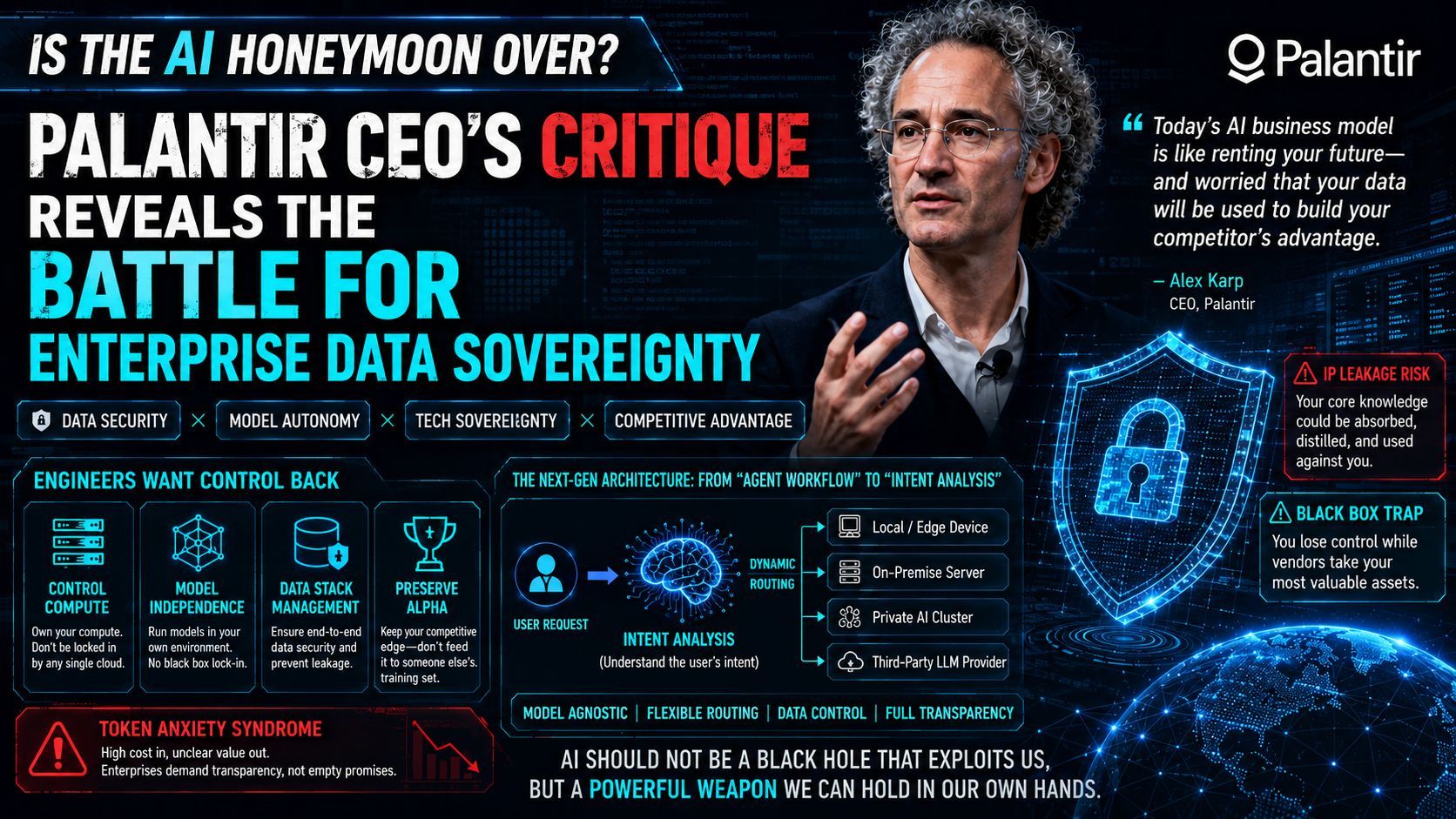
- IP Leakage Risk: If I feed core intellectual property as a prompt into a model, will this data become part of a training set, ultimately benefiting my competitors through model distillation?
- The "Fake Deployment" Trap: Many so-called AI solutions are essentially just "transporting" a company's core value to third-party vendors, while the company itself loses control over its own means of production.
This is not just a question of business logic, but a core issue concerning the security of technical architecture. For engineers, if a system makes you feel like you've lost control, then no matter how fast its response speed is, its status in the production environment is precarious.
Engineering Demands: Taking Back Control
Alex Karp's points are spot on: what technology clients need most urgently right now isn't a flashier UI, but "control." When we examine enterprise-level architecture, the real "hard" requirements can actually be summarized into these four dimensions:
- Compute Control: The ability to independently allocate computational resources and refuse throttling by a single cloud provider.
- Model Autonomy: Ensuring models run in a controlled environment rather than relying entirely on a vendor's black box.
- Data Stack Management: Ensuring absolute security of core data during processing to prevent leaks.
- Alpha Retention: Ensuring a company's core competitive advantage (Alpha) remains in their own hands, rather than being contributed to model vendors as the cost of training.
The market is calling for a "model-agnostic" product format. We don't want to be locked into the ecosystem of any single giant; what we need is a data processing architecture that allows for flexible model switching and possesses transparency.
Rebuilding Trust: Transparency is the Bottom Line
If there's one thing that can pour cold water on the current AI frenzy, it's "transparency." Enterprises are tired of overselling. To rebuild trust, vendors must publicly answer: Who does the data actually belong to? Where is the data cached? Is the prompt actually secure? Is there any unauthorized data transfer?
If a technology cannot bring tangible commercial value and merely increases Token consumption, then this business model will sooner or later be eliminated by a rational market.
The Next Generation Architecture: From "Agent Workflow" to "Intent Analysis"
This leads to my thoughts on future architecture. As I mentioned in my analysis of Nvidia GTC2026, we are experiencing a paradigm shift in architectural design.
In the past, we were accustomed to relying on a single Large Language Model (LLM) to complete the workflows of all Agents, which is both expensive and insecure. The direction for the future should be:
- Intent Analysis: The core of the architecture is no longer about "which model to call," but about "identifying user intent."
- On-Demand Distribution: Dynamically routing to local edge devices, self-built servers, internal enterprise AI clusters, or specific third-party LLM vendors, based on task complexity and security requirements.
This "tailored-to-circumstances" architectural design is the future we, as engineers, should strive for in the current volatile technological environment. If you want to understand this architectural evolution in greater depth, you can refer to my related thoughts: \[In-Depth Analysis of GTC 2026\] Restructuring IT Architecture in the Age of Agentic AI: NVIDIA's Full Strategy and a Programmer's Survival Guide
Ultimately, AI should not be a black hole that makes us feel like we are being "harvested," but a sharp tool that we can control in our hands. Skipping the vacuous hype and listening to the real voices from the front lines—that is the correct posture for building robust, efficient AI systems.