
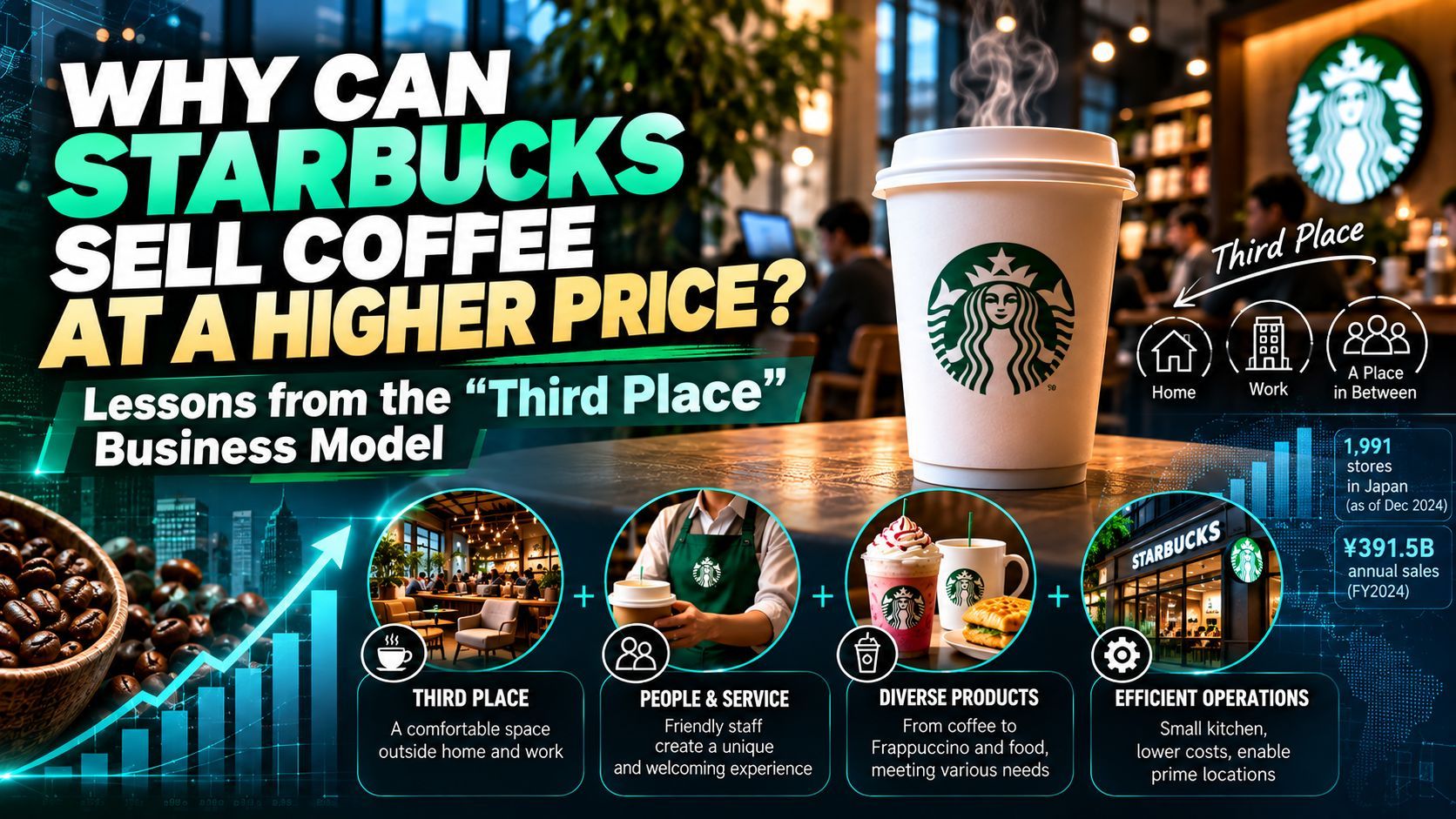
Why Can Starbucks Charge More? Understanding Business Models Through the "Third Place"
Starbucks charges 380–510 yen for a drip coffee—more than Doutor or Tully's—yet it is Japan's largest café chain. Using Starbucks as the example, this article traces the success factors behind it: the "third place" concept, friendly staff, product strategy, and store design. It then separates the narrow and broad definitions of a business model and lays out three ways to build one—strategic analysis, customer insight, and pattern adaptation—along with their trade-offs.

Why Can Starbucks Charge More? Understanding Business Models Through the "Third Place"
When you think of Starbucks, what comes to mind first? The slightly bitter dark roast? A Frappuccino topped with fruit and cream? Or a seating area where you can read or get some work done? Whichever it is, they all lead to the same question: when it is the same cup of coffee, why can Starbucks charge more than its competitors?
According to April 2025 figures, a cup of Starbucks drip coffee costs 380–510 yen, Doutor's blend coffee 280–380 yen, and Tully's coffee 360–480 yen. Starbucks is clearly the most expensive, yet it remains Japan's largest coffee chain. To answer why it can charge so much, it is not enough to look only at the beans and the flavor—what really does the work is the business model behind it.
What Sustains a Pricier Cup of Coffee
Starbucks did not enter Japan early. In 1995, US Starbucks and Sazaby League, a Japanese company that ran fashion and lifestyle-goods stores, formed a joint venture to set up a Japanese entity, and in 1996 it opened its first Japanese store in Ginza. At the time, Starbucks was Seattle-style, centered on dark roasting; the coffee took a long time to make and tasted bitter, and the flavor drew no small amount of controversy. On the other hand, holding a paper cup printed with the Starbucks logo was seen as very stylish, and it quickly became a trend.
What is worth noting is that Japan already had a large number of kissaten, as well as chains such as Doutor and Coffee-Kan. That Starbucks could hold its ground even at higher prices is generally attributed to two reasons: the influence that comes with a foreign brand, and its introduction of the concept of the "third place" (サードプレイス)—the third place, after home and work, where people can relax.
This idea showed up not only in store design but also in the people. When hiring and training staff, Starbucks deliberately chooses people who can offer friendly service and fit the "third place" atmosphere. Compared with other chains, what makes a Starbucks store more relaxing is not just the interior but also a team like that.
The third pillar is product strategy. Starbucks not only sells coffee at a higher price but also extends beyond coffee. The Frappuccino, sold from 2001 onward, uses fruit, cream, and other ingredients; it is Starbucks's most iconic evergreen product, priced from 504–1200 yen, higher than coffee. Making one is more involved—the fruit has to be blended, and cream and other toppings added—yet customers get it soon after ordering. At the same time, Starbucks keeps its food limited to light items such as cookies, doughnuts, and sandwiches, so stores do not need a large kitchen. With a small kitchen, the initial investment and rent can be kept down. And so Starbucks, able to sell high-priced products and run efficiently at the same time, can put its stores in the best locations: in front of stations and inside commercial facilities.
Look back at the results: the Japanese entity opened its first store in 1996, listed in 2001, and in 2014 US Starbucks acquired all its shares and the company was delisted. By the end of December 2024, it had 1,991 stores; in the fiscal year ended September 2024, its sales were 391.5 billion yen, making it Japan's largest coffee chain. Behind these numbers lies a whole series of deliberate arrangements—in other words, its business model.
A Business Model Is More Than "How You Make Money"
Put into Japanese, the term "business model" comes out roughly as "a mechanism for making money." But if your understanding stops at that layer, you miss the crucial part.
According to a Waseda University professor who studies business strategy, academia offers both a narrow and a broad definition of the business model. The narrow definition focuses on revenue streams—on "how you make money." At first glance this seems reasonable; the problem is that it leaves out several perspectives: what value is actually being sold? Why are customers willing to pay for it? And how do these things reach the customer? If the product or service itself is not appealing, or is not necessary for customers, sales will struggle to grow.
The broad definition includes "to whom, what value, and how it is delivered." Beyond the immediate way of making money, it also looks at who the customers are, what kind of price they want, and how the company delivers its value. Only by looking at this full scope can you see the real business model.
Applying the two definitions to Starbucks from the opening makes this clear. Narrowly, Starbucks is "a café that sells coffee." Broadly, what it does is: provide customers with a comfortable third place outside home and work; offer a range of products from coffee to Frappuccinos, delivered by friendly staff; and operate efficiently with a small kitchen. The difference between Starbucks and its competitors thus lies not only in the products but also in many other things: the third place, staff service, product design, and the way stores are run.
So a business model can be defined as a logical description of how value is created, delivered to customers, and turned into profit. In other words, it is very important to bring "how social value is created" into view alongside "how you make money."
Three Approaches to Building a Business Model
So how do you build a business model? There are three common approaches, each with its strengths and its limitations.
The first is the strategic-analysis approach. You start with a SWOT analysis to sort out the company's external and internal environment, dividing the elements into four categories: strengths (S), weaknesses (W), opportunities (O), and threats (T). Then you use a cross SWOT to think about how to leverage your strengths and maximize market opportunities. Next you pin down who the customers are, what value you offer, and what activities you carry out, organizing the business concept into a business plan. On that basis, you discuss what ways of making money exist and how much sales and profit are needed. This path produces a safe, solid proposal and values data and logic; but its limitation is obvious: it tends to become an extension of the existing model and can hardly spark innovation.
The second is the customer-insight approach. Through interviews and on-site observation, you try to understand what problems customers have and how they express them, with the emphasis on empathizing with customers. You then visualize the customer's pain points and pressures (pain) and what they truly need (gain) with the Business Model Canvas, and develop products and services from there. This is roughly close to what the marketing industry calls "insight marketing." Its strength is that subjective insight can help generate new value propositions in unfamiliar industries; its weakness is the lack of objective evidence and data.
The third is the pattern-adaptation approach. You read the business model structures of competitors, overseas companies, and companies in other industries as "patterns," organize them into diagrams of transactional relationships, and then imitate and adapt them to your own company. 7-Eleven Japan is an example: it brought the convenience-store concept created by the US company Southland Ice into Japan as a joint venture and went on to forge its own path of development there. The major izakaya operators Monterosa and Watami are similar: they first joined existing izakaya chains, later broke away, and drove the growth of the izakaya industry as a whole.
The steps of pattern adaptation are roughly as follows. First, find a model case that can serve as a reference for solving your own challenge, understand the structure of its business model, and then re-conceive it within your own industry. Then put it into practice while pushing measures forward, testing your feel for it as you repeatedly verify and improve. When interpreting the structure of a model case, it is very effective to classify it into one of several patterns. By referring to these precedents, it becomes relatively easy to borrow patterns from overseas and from other industries. But there are also challenges: some cases simply do not fit any pattern; if you approach with the preconception that you "must fit it into some pattern," you cannot produce an independent reading; and unless you do the patterning yourself, your understanding will not go deep.
Simplify First, Then Turn It into a Pattern
That is exactly why, when facing a complex business model, the better approach is to simplify it first and then turn it into a pattern. Next time, I will divide business models into nine types and analyze and explain them. Stay tuned for the next installment.